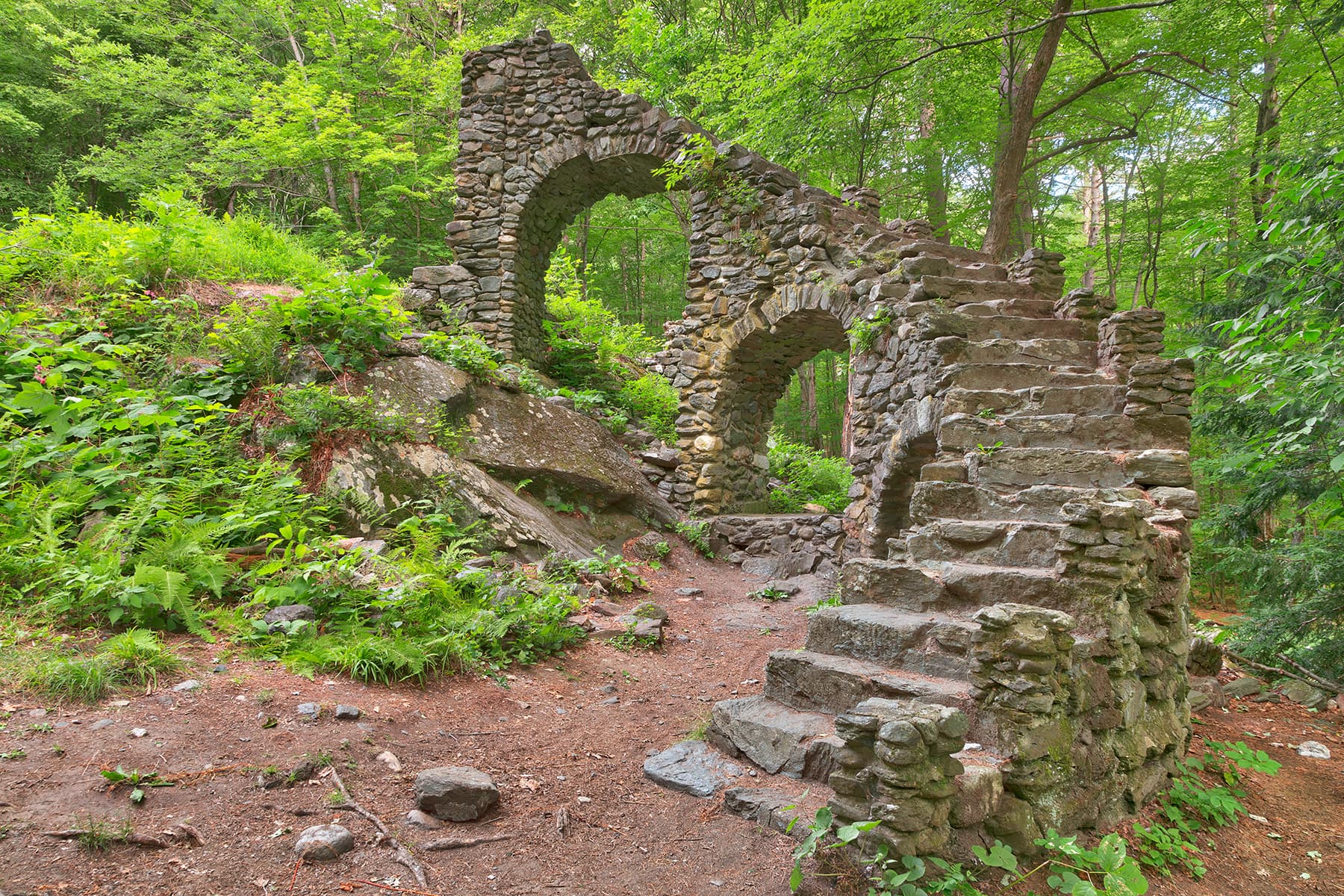
A stone staircase rises into the trees, toward a house that no longer exists.
Madame Sherri's Castle is the ruined summer retreat of a New York costume designer in Chesterfield, New Hampshire. Its surviving masonry stands within a protected forest near Brattleboro, Vermont. Visitors can walk to the ruins, but the staircase is fragile and must not be climbed. The upper section collapsed in 2021, so familiar older photographs show a different scene.
The appeal is easy to understand. Arches, steps, and foundations suggest a much larger building, while the surrounding woods leave room for imagination. The real story, however, is more interesting than a generic haunted-castle tale.
The woman behind Madame Sherri's Castle
Madame Antoinette Sherri worked in costume design in New York. The Brattleboro Historical Society describes an extravagant summer home that attracted local attention for its owner's unusual lifestyle. This was a personal retreat, not a medieval stronghold or a royal residence.
That distinction changes the way to read the ruins. The sweeping stairway once served a house and its guests. Its theatrical appearance fits the memory of someone whose working life involved clothes, performance, and visual effect. Calling it a castle captures its atmosphere, but can hide its more recent, human origins.
Historical accounts do not agree on every date. The Forest Society places construction in 1930, while some local histories give an earlier date. Similarly, accounts differ between 1962 and 1963 for the fire. Describing the house as an early-20th-century retreat destroyed in the early 1960s avoids turning an unresolved discrepancy into false certainty.
From summer retreat to forest ruin
According to the Forest Society's property history, Sherri returned to find the house badly vandalized in 1959. Fire later destroyed the building, and she died in 1965.
Stone survived where the house did not. That uneven survival explains the site's strange appearance: a staircase without an upstairs, architectural openings without rooms, and foundations without a roof. These are fragments of domestic life, rather than an intentionally designed monument.
A Yankee account of a visit to the ruins describes the surviving stonework and the fascination it creates. Published before the major staircase collapse, it also shows why travel stories need dates. A detailed older description can be accurate about the past and still mislead someone planning a visit today.
What happened to the staircase in 2021?
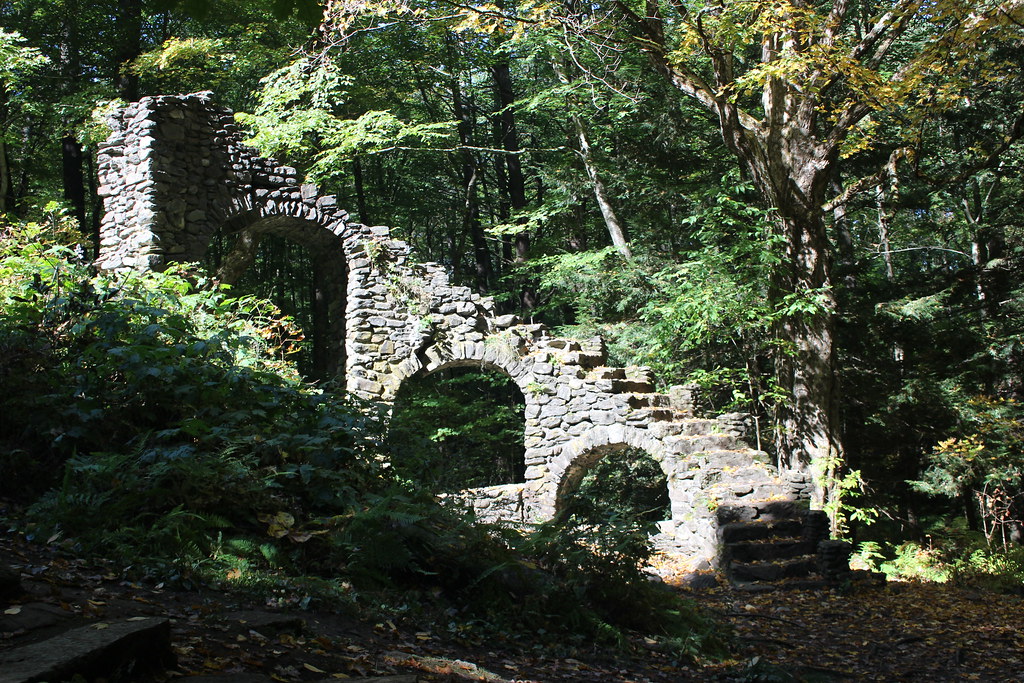
The upper part of the stairway fell on July 11, 2021. In its account of the collapse, the Forest Society explains that deteriorating mortar and heavy rain contributed to the loss. No injuries were reported.
The event removed one of the ruin's most recognizable arches. It also made a long-standing warning impossible to ignore: old masonry that looks solid in a photograph can fail without warning.
Treat ropes, barriers, and signs as limits, not suggestions. A photograph taken from the ground preserves both the structure and the photographer. Recreating an old picture of someone standing on the steps is not a reasonable goal for a visit.
The photographs accompanying this article are archival views from before the collapse. They document what was lost, rather than promising that the same complete staircase remains.
The forest has a story beyond the house
Anne Stokes helped protect the surrounding landscape after buying land in 1965. Conservation agreements and later gifts brought the property into Forest Society care. The reserve now covers roughly 513 acres.
The ruins are close to the Gulf Road trailhead, making them a short stop. A longer outing can follow the Ann Stokes Loop toward Indian Pond. Use the official trail map to distinguish that walk from longer routes toward Wantastiquet Mountain.
Choose your route before leaving the parking area. A quick look at the masonry and a woodland hike require different amounts of daylight, water, and preparation. Fallen leaves, wet roots, and winter ice can also make a short distance slower than expected.
The Forest Society's visitor guidance makes the best approach clear: appreciate the ruins, then explore the landscape with care. Pack out what you bring, leave stones where they lie, and keep the forest quiet enough for other visitors to enjoy it.
Madame Sherri's lasting legacy is now shared between an unforgettable architectural fragment and the protected woods around it. Looking beyond the famous staircase makes the visit richer, even as the staircase itself continues to change.
Frequently asked questions
Where is Madame Sherri's Castle?
It is in Madame Sherri Forest in Chesterfield, New Hampshire, near the Vermont border. The main trailhead is on Gulf Road.
Can you climb the staircase?
No. The masonry is unstable, part collapsed in 2021, and visitors should remain outside barriers.
Is it a real castle?
It was a private summer house associated with costume designer Antoinette Sherri. The castle name describes its dramatic ruins.
Is the site haunted?
Ghost stories are folklore, not established historical evidence. The documented house, fire, conservation work, and collapse explain the site's history without paranormal claims.
Image credits
Body image: Amy Meredith, CC BY-ND 2.0.
Featured image: Nicolas Raymond from Bethesda, Maryland, USA, CC BY 2.0. Original photograph.
