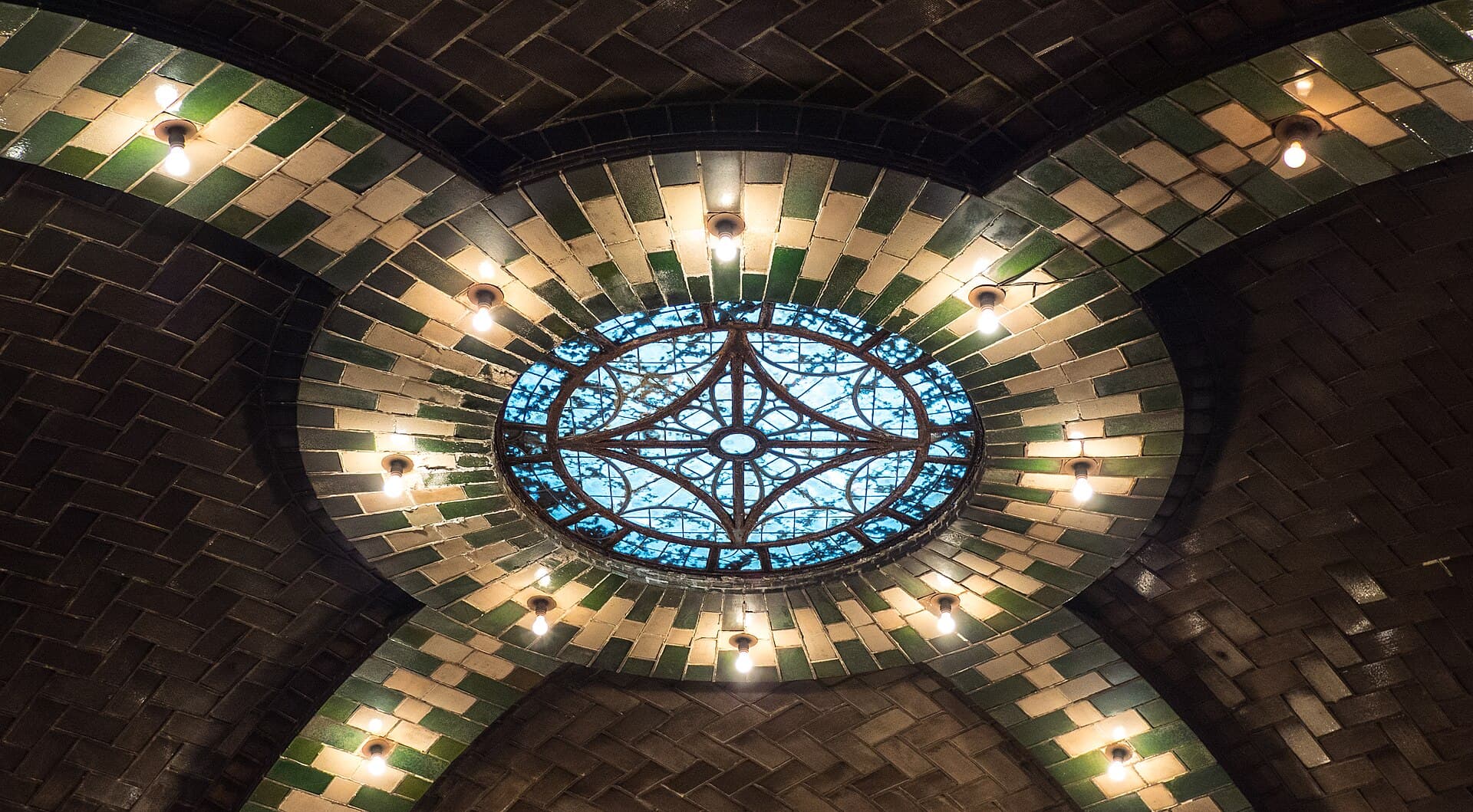
Beneath Lower Manhattan, a curved platform survives under tiled arches and colored glass.
Old City Hall Subway Station opened with New York’s first subway line in 1904 and closed to regular passengers in 1945. Its loop track still serves train operations, while platform access is limited to authorized visits. The New York Transit Museum offers guided tours under specific membership, booking, and security requirements.
This is the former IRT station beneath City Hall Park. It is not the active City Hall station on the Broadway line, nor the nearby Brooklyn Bridge–City Hall platforms used by everyday riders.
A subway opening worth celebrating
New York’s first subway opened on October 27, 1904. City Hall served as a ceremonial showpiece for a new way to move through the city.
The Museum of the City of New York describes the enthusiasm surrounding that opening and the station’s exceptional decoration. Heins & LaFarge’s design included Guastavino tile vaults, skylights, and chandeliers, giving the underground space a dignity rarely associated with a routine commute. Museum of the City of New York
The choice was meaningful. A new transportation system needed to feel useful, but it could also express civic confidence.
The station’s curve gives the space a strong visual rhythm. Arches repeat along the platform, and the track bends out of view. A photograph captures only part of that continuous sequence, which helps explain why the place can look larger and more mysterious than its compact plan suggests.
What the tiles and arches reveal
The station’s beauty comes from structure as well as decoration. Its vaults follow the geometry of the platform and distribute light across surfaces that would otherwise feel heavy.
Historic American Engineering Record documentation preserves measured and written information about the station. Such records allow its design to be studied beyond a few dramatic photographs. Library of Congress engineering record
Look for the relationship between the arches, the wall panels, and the curve below them. The repeated forms are not interchangeable decoration pasted onto a straight room. They belong to this particular space.
Why Old City Hall Subway Station closed
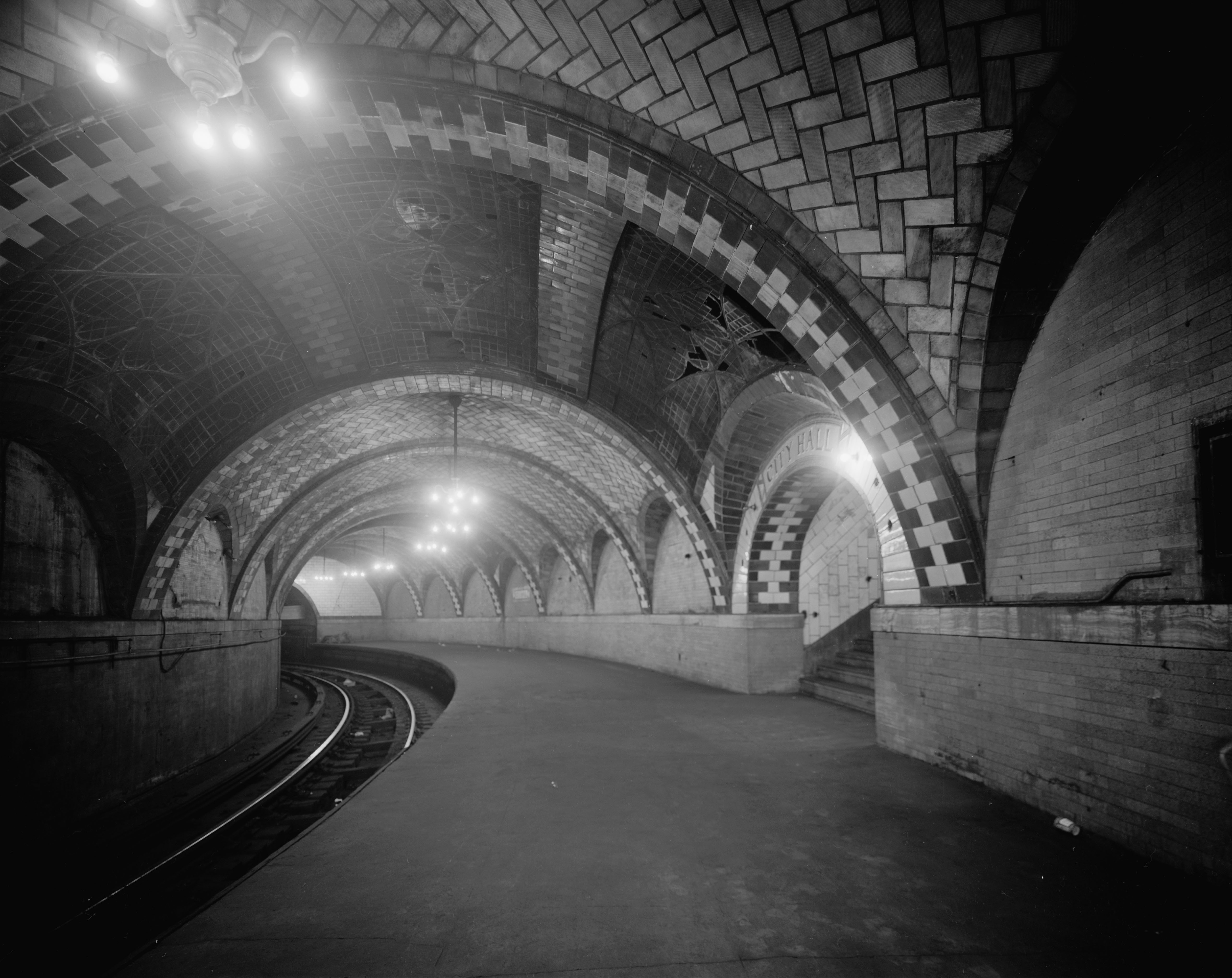
The features that make the station memorable also help explain its limitations. Its tight curve complicated adaptation to longer trains, while nearby Brooklyn Bridge station offered a more useful stop for many passengers.
Regular passenger service ended on December 31, 1945. The loop continued to serve an operating purpose even though riders could no longer board at the platform. Station history and layout
The closure therefore did not create an isolated tunnel cut off from the subway. It left a disused passenger station beside an active railway function.
Joseph Brennan’s detailed station history and diagrams help explain that distinction. His account is valuable for the physical layout and historical operation, although older statements about visitor access should not replace today’s museum rules. Columbia-hosted station research
The archival photograph above, taken in 1978, shows the curved platform, tiled vaults, and hanging lights. It documents the station decades after closure, not a scene from opening day.
A hidden place with a documented history
“Hidden” does not mean unknown. Photographers, engineers, historians, and transit staff have recorded the station over many years.
An Urban Archive feature using historical collection material discusses the station’s changing appearance and the wartime treatment of its skylights. It also describes later ideas for museum use, reminding readers that proposed futures do not always become operating attractions. Urban Archive historical feature
Its appeal lies in an unusual overlap: an early twentieth-century civic interior remains within a system that continues to carry people every day. The station is old, but the railway around it is not a frozen exhibit.
How to arrange a legal visit
The New York Transit Museum’s Old City Hall tours are for eligible museum members and require advance booking. Participants must meet the minimum age requirement of 10 and complete the required security process. Tickets are not transferable.
The museum describes a roughly 90-minute experience. Read its current rules for identification, background checks, stairs, footwear, photography, and arrival instructions before purchasing. Tour availability is limited, so a membership should not be mistaken for a guaranteed reservation. Official Old City Hall tours
Never enter tracks or restricted passageways independently. Follow transit staff directions during ordinary travel, and do not treat an online sightseeing tip as permission to remain somewhere passengers have been told to leave.
If a tour is unavailable, the museum’s information and archival records still offer a substantial way to explore the station’s design.
The strongest reason to visit is not to claim access to a secret. It is to see how much thought went into a small public space, and how a working city can outgrow a building without erasing its beauty.
Frequently asked questions
Is the old City Hall station still used by trains?
Its loop remains part of subway operations, but the historic platform is closed to regular boarding and exiting.
Is this the same as the active City Hall station?
No. The active Broadway-line City Hall station is separate. Brooklyn Bridge–City Hall is also a different passenger stop.
Can anyone buy an ordinary admission ticket?
Official tours have membership, advance-booking, age, and security requirements. Check the New York Transit Museum’s current conditions.
Why did the station close in 1945?
Its curved platform was difficult to adapt to longer trains, and the nearby Brooklyn Bridge stop reduced its usefulness to passengers.
Image credits
Featured image: Rhododendrites, CC BY-SA 4.0.

Body image: David Sagarin, Public domain.
