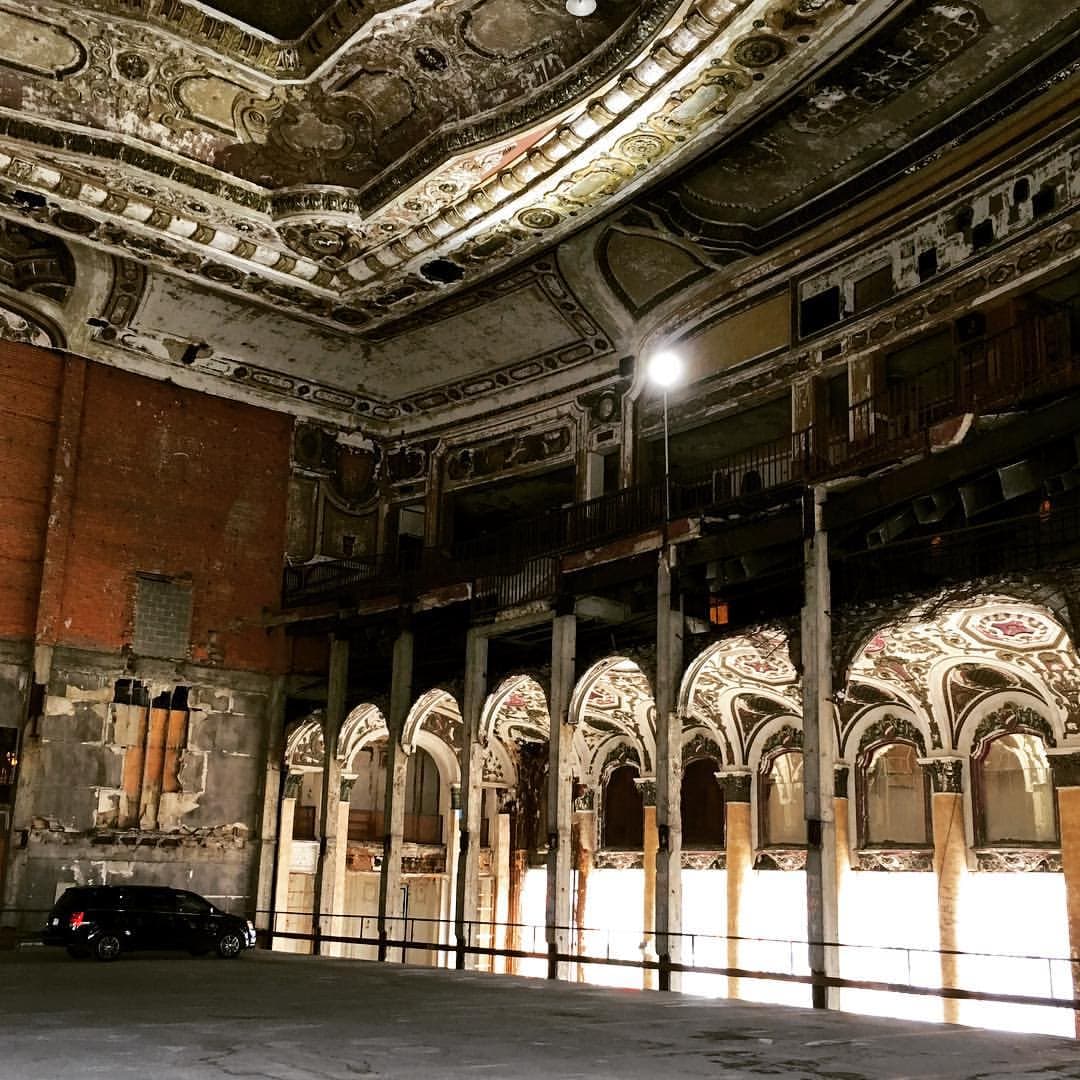
Cars now park beneath the ornamental ceiling of a Detroit movie palace.
The Michigan Theatre in downtown Detroit opened in 1926 as a lavish entertainment venue. After later changes in use and closure, its auditorium became a parking garage in 1977. Parts of the elaborate interior survive above the vehicles, creating one of the city’s most unusual examples of reuse.
This is the Michigan Theatre in the Michigan Building on Bagley Street, not a currently operating cinema with a similar name elsewhere in Michigan. Its story is striking enough without confusing it with another venue.
When the Michigan Theatre was a night out
The theater opened on August 23, 1926, as part of John Kunsky’s entertainment business. Architects Rapp & Rapp created a large movie palace with roughly 4,000 seats and an ornate French Renaissance-inspired interior.
The experience extended beyond the film. Live entertainment, an orchestra, and a theater organ belonged to the original program, while the elaborate spaces made entering the building part of the attraction. Historic Detroit’s theater history
Think about what that required from the architecture. An audience had to move from the street into a world designed to feel exceptional, then find a seat among thousands of others.
The decorative ceiling was part of that transformation. Its details were meant to be seen by people gathering for entertainment, not by drivers looking for an empty space.
The exterior tells a different part of the story
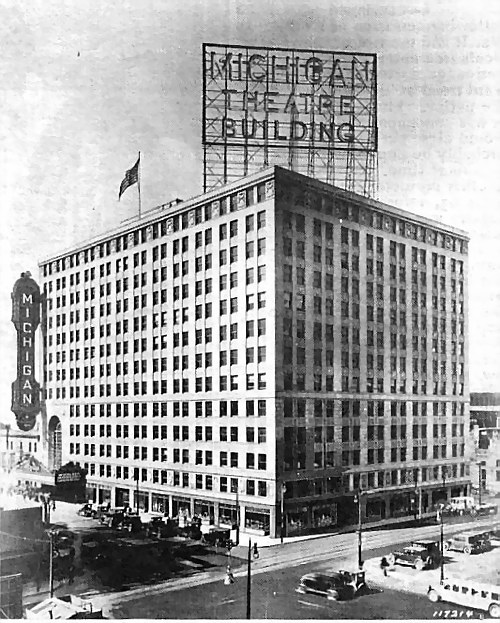
The archival exterior photograph shows the theater within the larger Michigan Building. From outside, it was part of a substantial downtown office property, rather than an isolated auditorium.
That relationship later affected what could be removed and what had to remain. Buildings that share structural and commercial relationships do not always have independent futures.
The Center for Land Use Interpretation identifies the Michigan Building as a 13-story structure and describes the theater’s later use as parking for building tenants. Its account emphasizes the unusual survival of the ornate upper walls and ceiling. Center for Land Use Interpretation
The outside and inside views therefore need to be read together. The exterior explains the practical setting, while the interior reveals the startling collision of two different uses.
How a movie palace became a garage
The theater’s later years included closures, attempts at revival, and a period as a concert venue known as the Michigan Palace. Its entertainment use finally ended in the 1970s.
The documented conversion in 1977 followed concern that completely removing the theater would threaten the attached office building’s structure. Parking offered a practical use for the former auditorium while portions of its upper interior remained. Detroiturbex historical documentation
This was not a restoration of the movie palace. It was a conversion that preserved some features while sacrificing others.
The distinction matters because “saved” can mean different things. The building survived; the original theater experience did not. Seats, sightlines, stage activity, and an audience cannot be recovered simply by pointing a camera toward the ceiling.
Yet total demolition would have left no ceiling to study at all. The garage occupies an uncomfortable middle ground between loss and survival.
What remains above the cars
Photographic documentation shows the relationship between inserted parking levels and surviving ornament. The upper portions retain the visual richness of the theater even as the lower spaces perform a much more ordinary task. Detroiturbex photographic history
Look at the featured photograph carefully. The decorated surface draws attention upward, while the cars establish scale and present function. Neither element makes much sense without the other.
Independent photographs from a 2010 visit also document surviving details and the arrangement of the converted interior. They are valuable dated records, rather than proof that every area remains accessible today. Robert Yasinsac’s photographic documentation
The Library of Congress preserves a separate documentary view by Camilo José Vergara, placing the theater within a longer record of urban change. Looking across photographs from different years is more useful than treating one viral image as the complete story. Library of Congress collection record
Can you visit the Michigan Theatre?
Treat the property as a privately managed working building and garage. Historical interest does not provide permission to walk through vehicle lanes, enter closed levels, or arrange a photo shoot.
There is no regular public museum schedule verified for this guide. Contact the property’s current operator about any legitimate access, and follow staff instructions if permission is available. Do not assume that a parking transaction includes unrestricted exploration.
For a street-level visit, the exterior still helps connect the theater to downtown Detroit. The archival photograph offers a useful comparison without requiring entry.
What makes the Michigan Theatre memorable is not simply that luxury became utility. It is that both remain visible in the same room. The ceiling remembers one kind of gathering while the floor serves another.
Frequently asked questions
Is the Michigan Theatre still showing movies?
No. The historic Detroit auditorium discussed here became a parking garage after its entertainment use ended.
When did the parking conversion happen?
Historic Detroit dates the conversion to 1977, following the theater’s final years as an entertainment venue.
Was the entire theater interior preserved?
No. Significant elements were removed or altered, while portions of the upper walls, ceiling, and other features survived.
Can anyone walk inside to take photographs?
Do not assume public access. Ask the current property operator and follow any permission, safety, and photography conditions.
Image credits
Featured image: grego1402, CC BY 2.0.

Body image: Unknown photographer, Public domain.
