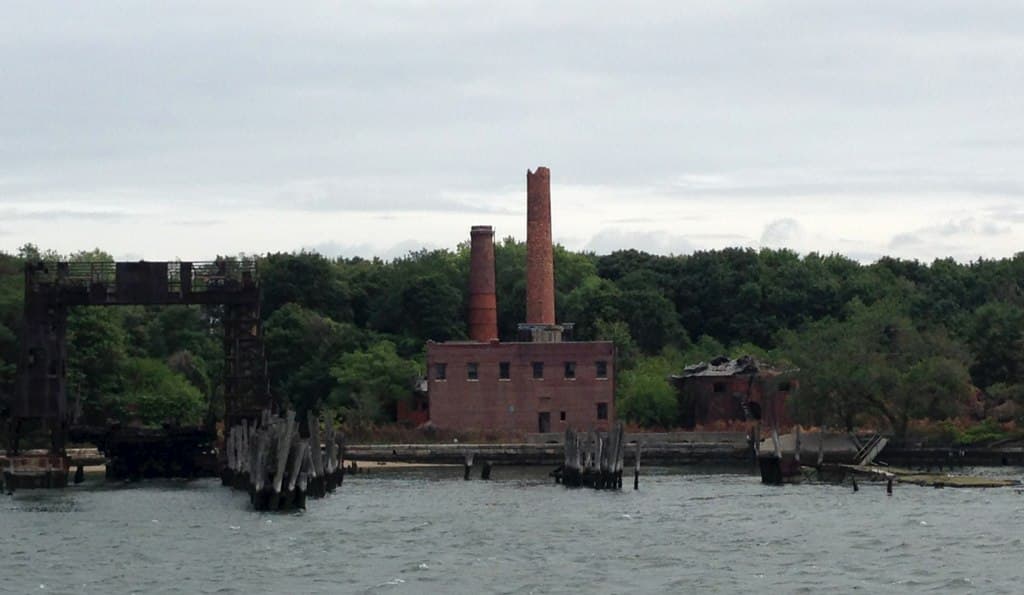
A wooded island in New York’s East River holds hospital buildings that the public cannot enter.
North Brother Island, near the Bronx, was home to Riverside Hospital and later institutions before its abandonment in the early 1960s. Its overgrown ruins now sit within a protected island landscape. It is not an open park or an urban exploration attraction.
The setting creates an unusual contrast. New York surrounds it, yet the island’s former streets and hospital grounds remain apart from ordinary city life. Understanding that separation explains both its original purpose and its present restrictions.
Why North Brother Island became a hospital
In the nineteenth century, New York placed some institutions on islands to separate their residents from the crowded city. Water provided a boundary, but also made every delivery, staff journey, and patient transfer a logistical task.
The city’s health department records that a larger Riverside Hospital opened on North Brother Island in 1885, replacing the earlier facility on Blackwell’s Island, now Roosevelt Island. The move belongs to a longer history of dedicated facilities for infectious disease. The hospital’s name traveled; the buildings did not. NYC Department of Health chronology
That distinction matters when looking at photographs. Roosevelt Island’s famous Gothic hospital ruin and North Brother’s Riverside complex are separate places. Combining their histories creates a convincing but incorrect story.
The woman behind the familiar nickname
North Brother Island’s best-known resident was Mary Mallon, remembered as “Typhoid Mary.” New York health officials confined her here from 1907 to 1910, then returned her in 1915 after another outbreak was linked to her cooking work. She remained on the island until her death in 1938.
Those were two periods of confinement, not one uninterrupted stay beginning in 1907. The city’s historical account records her release after an agreement to stop cooking and her later return under another name to hospital kitchen work. NYC health department historical booklet
Her story raises difficult questions about public health, personal freedom, and unequal treatment. The Women’s Museum of Ireland notes that she was neither the only carrier nor the only person who broke restrictions, yet her name became the enduring label. Women’s Museum of Ireland
A ruined building cannot answer those questions on its own. It can, however, bring a familiar phrase back to the life of a real person.
More than one abandoned institution
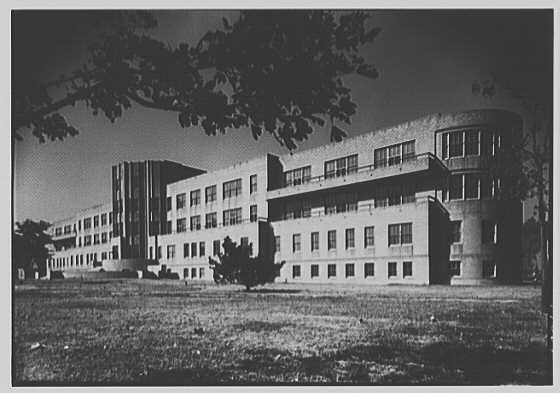
The hospital complex changed over time. Its surviving buildings should not be imagined as a single untouched nineteenth-century campus.
The Historic American Buildings Survey documents several construction periods, including substantial twentieth-century work. Its records cover hospital buildings alongside housing, industrial facilities, and waterfront infrastructure. These were practical parts of an institution that had to function across a stretch of water. Library of Congress architectural survey
After the hospital era, the island accommodated veterans and their families, then a program for adolescents with drug dependencies. That later institution closed in the early 1960s. The site’s vacancy therefore resulted from changing uses and institutional decisions over decades, rather than one dramatic evacuation. Atlas Obscura’s island history
The archival photograph above shows a hospital building in 1943. Its orderly facade offers a useful counterpoint to the vegetation and exposed masonry visible in later island photographs.
What the ruins mean today
The former campus is now also a landscape of trees, shorelines, and habitat. New York State identifies North and South Brother Islands together as a significant coastal fish and wildlife habitat. The two islands belong to the same ecological story, even though their buildings and individual histories differ. New York State habitat designation
Preservation work must therefore consider more than masonry. Vegetation, unstable structures, access routes, and wildlife all affect what could happen here.
The University of Pennsylvania’s conservation study examined how historic preservation and carefully managed access might coexist. Its proposals are planning ideas, not evidence that regular tours have opened. Reading the date and purpose of such reports is essential. Penn conservation and access study
This is part of what makes the place compelling: the buildings have not simply disappeared, but neither have they returned to ordinary use.
Can you visit North Brother Island?
Public access remains prohibited. Do not arrange an independent landing or treat an online photograph as proof of permission. ProtectedSeas’ current entry reproduces the restriction and directs readers to the managing authority for updates. Access restrictions
For now, historical photographs, maps, and architectural records provide the most reliable way to explore its details. They also reveal things that a distant view cannot: how the campus grew, which buildings served which purposes, and how much changed before abandonment.
North Brother Island’s strongest story is not that New York forgot it. It is that a place built around separation still asks who can enter, who makes that decision, and what deserves protection.
Frequently asked questions
Where is North Brother Island?
It is in New York City’s East River near the Bronx and Rikers Island, beside the smaller South Brother Island.
Was Mary Mallon confined there continuously from 1907?
No. Her first confinement ended in 1910. She returned in 1915 and remained until her death in 1938.
Is this Roosevelt Island’s Smallpox Hospital?
No. They are separate sites, although Riverside Hospital’s institutional history connects the two islands.
Are regular public tours available?
No public access is currently allowed. Check the managing authority for any future changes rather than relying on old proposals.
Image credits
Featured image: Jessica Sheridan from NYC, USA, CC BY 2.0.

Body image: Gottscho-Schleisner Collection, Public domain.
