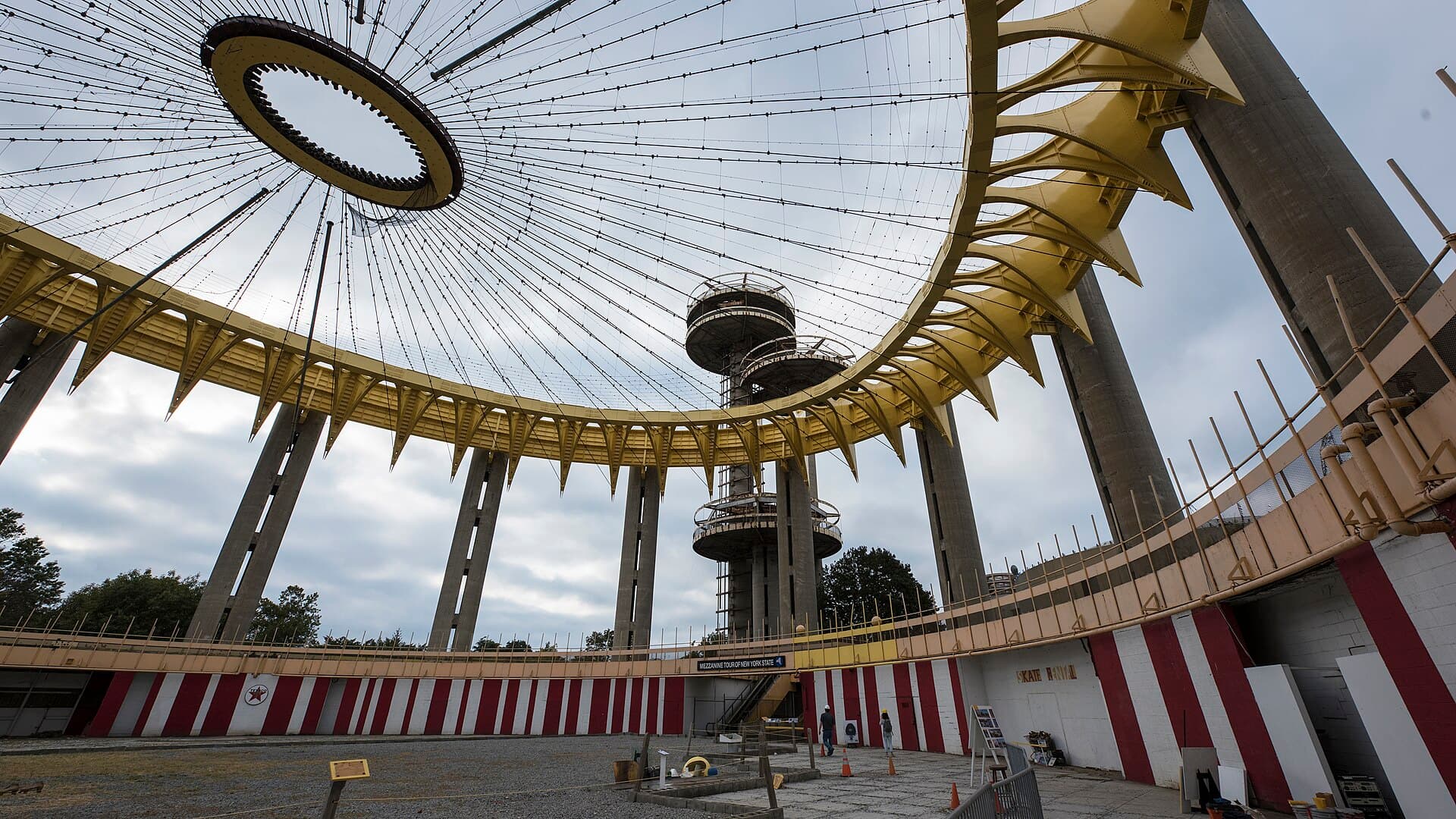
Yesterday’s vision of tomorrow still rises above a Queens park.
The New York State Pavilion was built for the 1964–1965 World’s Fair in Flushing Meadows Corona Park. Its observation towers and open circular structure became famous reminders of a future that never quite arrived. Years of decline followed the fair, but preservation work has kept the complex from simply becoming a lost landmark.
Restoration is not the same as unrestricted admission. Visitors can appreciate the pavilion within its park setting, but should verify any interior tours or tower access through current official announcements.
What the New York State Pavilion included
Architects Philip Johnson and Richard Foster designed the pavilion as three related parts: the Tent of Tomorrow, observation towers, and Theaterama.
The preservation group People for the Pavilion explains how the complex represented New York State at the fair. Its architecture made the exhibit itself part of the attraction.
That helps explain why the remains still draw attention. Many fair buildings depended on displays inside ordinary rooms. Here, the shapes alone created a spectacle.
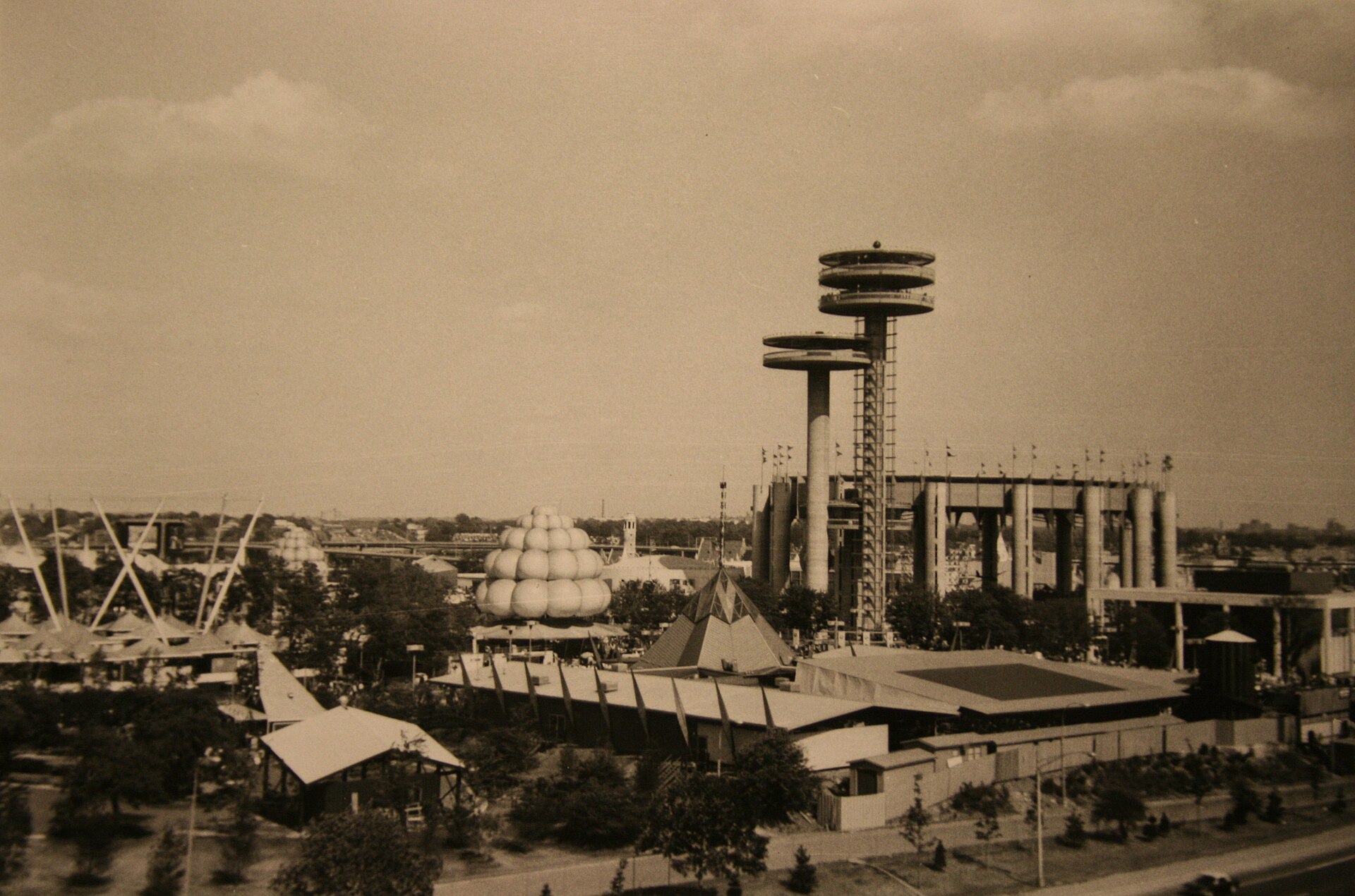
The towers look like circular platforms stacked high above the ground. The Tent of Tomorrow is enormous and open, closer to a grand outdoor gathering space than a conventional tent. Together, they made a bold promise about travel, technology, and public life.
The “tent” was a serious engineering achievement
The National Park Service’s technical study describes a roof supported by a cable system resembling the spokes of a bicycle wheel. Engineer Lev Zetlin helped make that unusual design possible.
Sixteen tall columns supported the structure. Colored fiberglass panels once filled the roof, while a giant terrazzo map of New York covered the floor below.
Visitors could look down at the state as an image beneath their feet, then look outward from elevated observation platforms. The design joined spectacle with a very literal way of seeing New York.
The same study explains the separate Theaterama building’s later life as Queens Theatre. That surviving use matters: the three parts did not share an identical fate after the fair.
How a fair attraction became a ruin
After the fair, the pavilion struggled to find a lasting purpose. The Tent of Tomorrow hosted activities including skating and concerts, but those uses did not solve its long-term maintenance needs.
The National Trust for Historic Preservation records the removal of the deteriorating roof panels in 1976. Without that protection, the map floor faced the weather.
The loss changed the building’s appearance. What had been a colorful canopy became an exposed framework. A structure designed to celebrate the future began to look like evidence of its collapse.
Yet it never stopped being recognizable. That is part of its appeal to people who love forgotten places: the intended optimism is still easy to see, even when looking at the effects of neglect.
Preservation became part of the story
Saving the pavilion has required more than public affection. Large concrete and steel structures need investigation, repairs, drainage, and sustained funding.
The National Trust records a stabilization milestone in April 2023. Work on one phase, however, does not mean every space becomes ready for everyday use.
Jan Hird Pokorny Associates, a firm involved in the preservation effort, documents restoration work on the landmark. Its project information helps explain why protecting the fabric is a distinct task from reopening an attraction.
A good restoration story leaves room for that complexity. A painted surface can improve appearance while deeper work continues elsewhere. A repaired structure may still need a defined operating plan, staffing, and accessible visitor arrangements.
What recent reports mean for visitors
A December 2025 report from Time Out described a major renovation and the possibility of limited tours later in 2026.
That was a projection, not proof that tours are now running. A July 2026 Queens report also discussed continuing investment in the towers.
For a trip, check current NYC Parks announcements rather than relying on an estimated opening date copied into an older travel story. Confirm whether any advertised event includes the pavilion interior, a particular ground-level area, or the towers themselves.
The photograph at the top of this article dates to 2017. The body image shows the pavilion during the 1965 fair. Comparing them is useful for understanding change, but neither image establishes today’s work zones.
How to appreciate it from the park
Begin with the overall shape. Look at the circular platforms, the slender supports, and the broad ring of the Tent of Tomorrow. Imagine how those pieces would have appeared amid crowds and bright fair displays.
Then look for the relationship between survival and reuse. Queens Theatre gives one part of the complex a continuing public role, while the towers and tent have required a different preservation path.
The pavilion’s appeal comes from that unfinished conversation between past ambition and present care. It is still possible to recognize the future people once pictured here, even while its own future takes shape.
Frequently asked questions
Was the pavilion built for the 1939 World’s Fair?
No. This pavilion was built for the 1964–1965 fair, although the park also hosted the earlier fair.
Why is the Tent of Tomorrow open to the sky?
Its deteriorating roof panels were removed in 1976, leaving the supporting structure exposed.
Can you ride to the observation platforms?
Do not assume the towers are operating. Confirm any authorized access through current official visitor information.
Is the whole pavilion abandoned?
No. Queens Theatre has a continuing use, and preservation work is underway elsewhere in the complex.
Image credits
Featured image: Shuo Yan, CC BY-SA 4.0. Body image: Gary Lee Todd, Ph.D., CC0. Images retain their original framing; dates are identified in their captions or the article.

