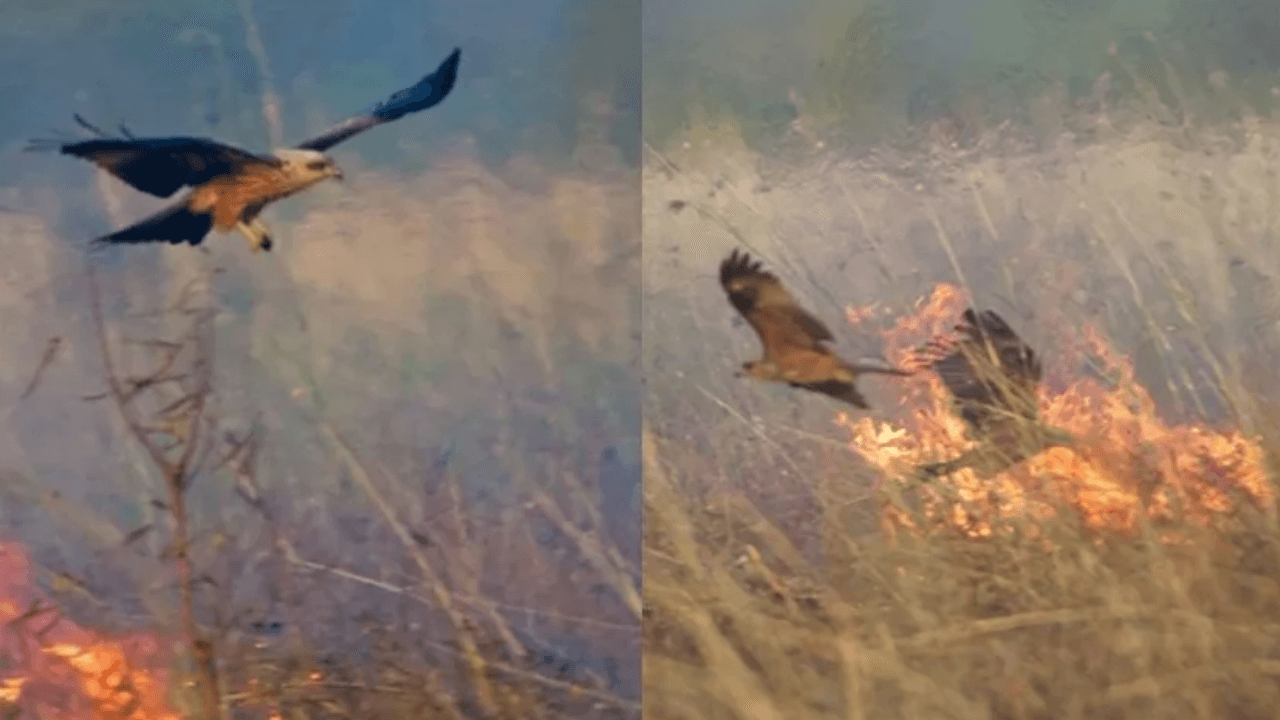
In the dry savannas of Australia, there’s a story that sounds too astonishing to be true, yet it is. It’s about birds known as ‘firehawks’—the black kites, whistling kites, and brown falcons—that have been seen grabbing burning sticks from wildfires and carrying them to start new fires. This behavior isn’t just an odd curiosity; it’s a strategic hunting technique that leaves nature experts both fascinated and deeply concerned.
Imagine a bird soaring through the smoky sky, clutching a flaming branch in its beak. With a single calculated drop, it ignites a patch of dry grass miles away. Why would it do this? As the flames race across the land, small mammals and insects flee from the inferno, making them easy targets for the raptors waiting to pounce. It’s a gruesome synergy of nature that showcases intelligence in a way we often attribute only to humans.
Studies have revealed that these birds aren’t just mindlessly creating chaos. According to researchers, this behavior is a sophisticated method of hunting that has evolved over generations. Mark Bonta, a researcher studying firehawks, notes that these birds have been observed carrying burning sticks as far as a kilometer away, deliberately targeting unburned areas where they know prey will be hiding.
The Aboriginal peoples of northern Australia have long spoken of ‘firehawks,’ attributing to them almost mythical qualities, claiming they were the originators of fire. Modern scientists corroborate these stories with observations and studies. For instance, one paper details how these birds manipulate their environment to aid in feeding—a sharp contrast to our unintentional impacts on nature.
This careful orchestration raises profound questions about intelligence and survival in the animal kingdom. Are firehawks heroes, adapting smartly to their environment, or are they perpetrators of destruction? Their actions ignite debates on what it means to use tools and weapons in the animal world.
As Australia faces increasing wildfire threats, the role of these firehawk raptors becomes ever more relevant. Rangers now consider these birds’ behaviors crucial to understanding and managing ecosystems amidst volatile fire seasons. The very existence of these creatures sheds light on the delicate balance of nature; they both preserve and disrupt it.
The aftermath of observing these birds is chilling. Some consider them a natural wonder, while others view them with fear, understanding that nature’s tools are not always gentle. As fires rage across landscapes, whose side are we on—the hunter or the prey?
One prevailing thought lingers: In a world increasingly defined by human actions, what does it mean for an animal to wield the power of fire? Firehawks exist in a grey area between nature’s brilliance and a thrilling horror. Where do we draw the line in our understanding of intelligence in the wild? Could it be that the firehawks are not the only ones altering their landscapes? Are we perhaps all unwittingly part of this fire dance?
Disclosure: We may earn a commission when you make a purchase through the ads.