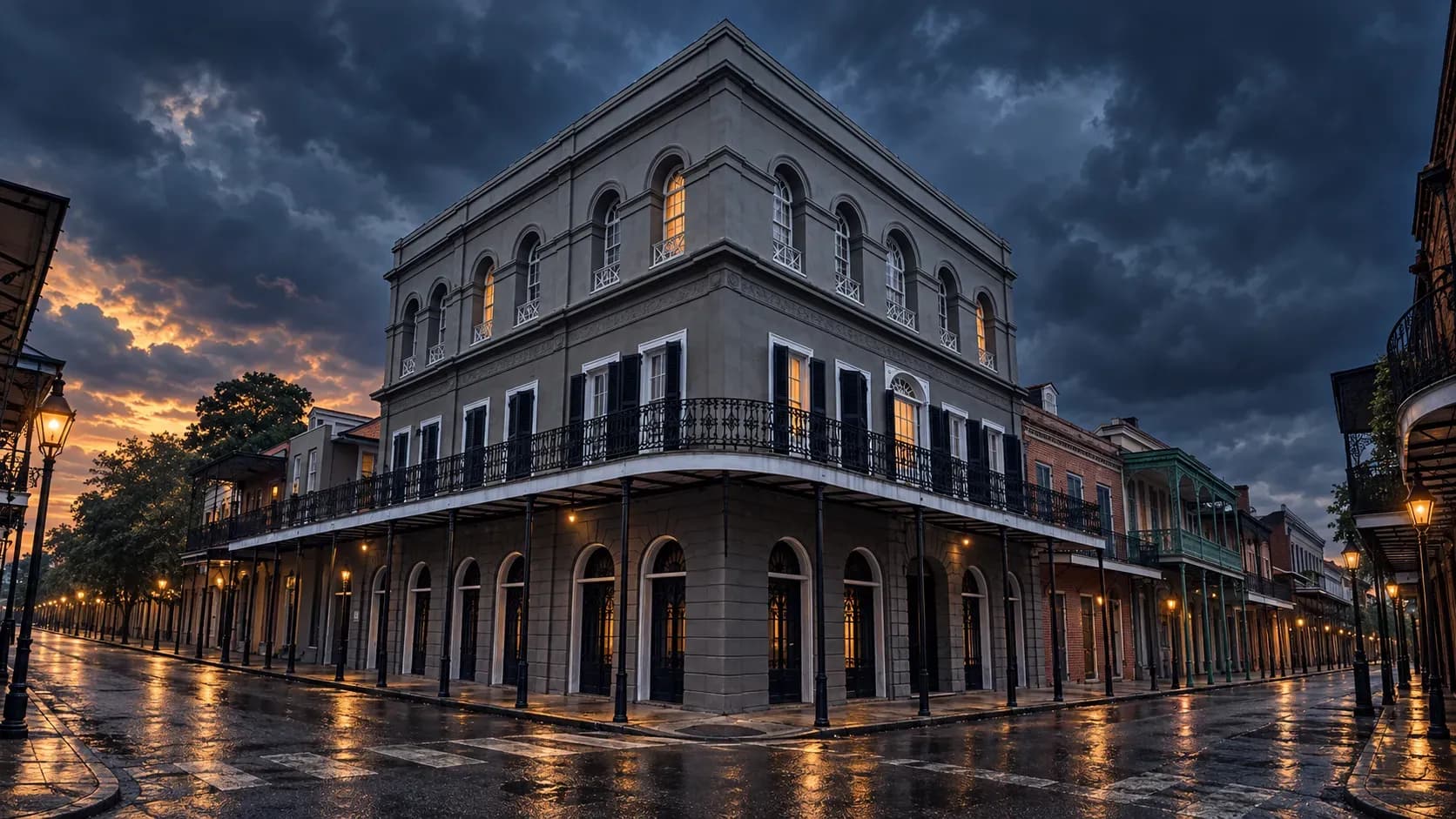
At Royal and Governor Nicholls streets in New Orleans, Louisiana, a tall gray mansion draws curious visitors. Its shuttered windows and iron balcony offer little explanation. From the sidewalk, you see an elegant French Quarter home with a name that carries a terrible history.
That history centers on Delphine LaLaurie and the enslaved people who suffered under her control. Their discovery during a fire shocked the city. Later writers added ghostly children, strange noises, and increasingly elaborate accounts of torture.
Today, the address attracts history lovers, ghost-tour groups, and fans of American Horror Story: Coven. Understanding it means separating the documented crime from the stories built around it. It also means knowing what visitors can actually see, including a building that changed after LaLaurie fled.
Why Is LaLaurie Mansion Famous?
LaLaurie Mansion is famous for the abuse exposed there on April 10, 1834, and its lasting haunted reputation. Rescuers discovered seven enslaved people who had endured starvation, confinement, and severe physical abuse.
Newspaper coverage carried the scandal beyond Louisiana. Over the following decades, writers turned the address into a haunted-house landmark. An 1885 guide already described it as the “Haunted House Royal Street.”
Television brought another wave of attention. In 2013, American Horror Story: Coven introduced Kathy Bates as a fictionalized Delphine LaLaurie. The series connected a real historical figure with an invented world of witches and immortality.
The Story Behind The Legend
The Household on Royal Street
Delphine bought the property in 1831 while its residence was still under construction. She belonged to New Orleans’ wealthy slaveholding society. Her third husband, Louis LaLaurie, was a French physician.
The household’s troubling reputation predated the fire. Historian Carolyn Morrow Long’s archival research identifies letters discussing abuse allegations and an 1829 receipt for legal defense. The criminal court records from that period have not survived.
The Fire That Exposed the Abuse
On April 10, 1834, fire broke out in the kitchen. People gathering to help became concerned about those confined inside. Rescuers forced entry and found injured people in chains.
The evidence includes contemporary newspaper accounts and Judge Jacques François Canonge’s sworn statement. These establish severe abuse without relying on later ghost stories. Rescuers brought the survivors to the Cabildo for treatment.
As an angry crowd gathered, LaLaurie escaped. The crowd then wrecked the house. She eventually settled in Paris, where she died in 1849.
The surviving accounts leave painful gaps. They do not name the seven rescued people or fully explain their later lives. Those omissions deserve as much attention as the woman whose name survives on the building.

The House Changed, but the Name Remained
The mansion visitors photograph today does not preserve LaLaurie’s home unchanged. Architectural historian Robert J. Cangelosi Jr. dates the present three-story house to 1838, when Pierre Trastour built it for Charles Caffin.
The property later served as an integrated school during Reconstruction and a music conservatory in the 1880s. These chapters rarely receive the attention given to its haunted reputation.
That broader history changes how you read the facade. This address holds stories of education and community life alongside the violence that made it notorious.
Why People Think It's Haunted
The mansion’s folklore includes unexplained cries, moving doors, and the apparition of a child. Popular retellings connect these experiences to the people who suffered here. They remain haunting claims, without independently verified evidence of a supernatural cause.
The stories have a history of their own. George Washington Cable’s nineteenth-century account helped turn the house into a ghost-story setting. Later writers expanded both the hauntings and the descriptions of violence.
The historians behind DIG’s examination of the LaLaurie legend trace medical-experiment stories to Jeanne deLavigne’s 1946 book, Ghost Stories of Old New Orleans. That publication appeared more than a century after the fire.
A story’s repetition can make it feel established. Yet a reported noise, a frightening photograph, and a documented crime require different kinds of evidence. Knowing the mansion’s history may also shape how someone interprets an ordinary sound or shadow.
Fact Vs Fiction
The fire, discovery of abused people, and attack on the house belong to documented history. Claims of elaborate surgical experiments go beyond what the contemporary evidence establishes. Uncertainty about those additions does not erase the cruelty described in early accounts.
Coven adds another layer of confusion. Its supernatural punishments and immortal LaLaurie belong to television fiction.
Even the screen mansion differs from this address. The museums’ filming-location information confirms that Hermann-Grima House supplied the LaLaurie interiors, while Gallier House represented the exterior. Fans seeking those scenes should distinguish the filming sites from the historical location.
Can You Visit Today?
Visitor information checked September 25, 2026: Plan to view LaLaurie Mansion from the public sidewalk at 1140 Royal Street. Do not assume a ghost-tour booking includes entry.
The owner’s current website identifies Lance Zaal as the mansion’s resident and owner. At the time of checking, it did not provide public admission hours or an interior-tour booking schedule. We could not verify a public overnight-stay program.
You can view the exterior without purchasing a tour. Guided walks charge separately, and routes vary. Before booking, confirm that the itinerary includes this address and ask which buildings, if any, guests enter.
Take exterior photographs from public space and keep entrances clear. Visitors with mobility needs should confirm the walking route, distance, and sidewalk conditions with their operator. We could not verify interior accessibility or an interior photography policy.
Is It Worth Visiting?
LaLaurie Mansion makes a worthwhile stop for travelers interested in how history becomes legend. Its street presence is striking, but the experience depends heavily on the context you bring.
History lovers should choose a guide who explains sources and acknowledges uncertainty. Horror fans can pair the address with the actual Coven filming locations. Casual visitors should expect an exterior stop rather than a walk-through attraction.
The most troubling part of this place remains the documented suffering of real people. Remembering them gives the visit a meaning that a ghost sighting cannot supply.
Frequently Asked Questions
Is LaLaurie Mansion really haunted?
It has a longstanding haunted reputation. The ghost stories do not establish that supernatural activity occurs there.
What happened at LaLaurie Mansion?
An April 1834 fire exposed the severe abuse of enslaved people. LaLaurie escaped, and an angry crowd wrecked the house.
Can you go inside LaLaurie Mansion?
We could not verify a public interior-tour schedule as of September 25, 2026. Plan an exterior visit unless authorized access is confirmed.
Was American Horror Story filmed there?
For its LaLaurie house scenes, Coven used Hermann-Grima House for interiors and Gallier House for the exterior.