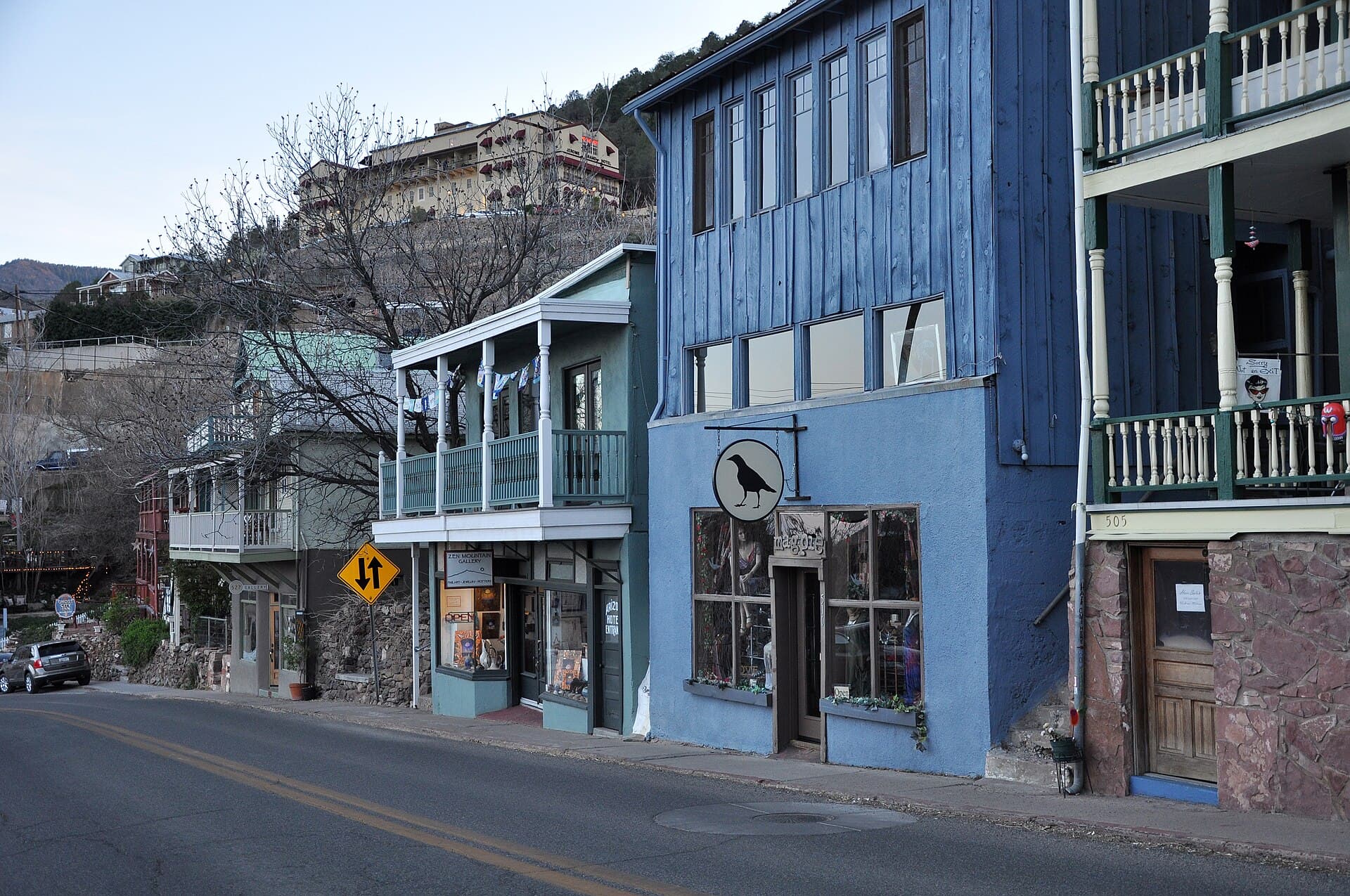
Jerome nearly became a memory, then found a new reason to keep its steep streets alive.
Jerome, Arizona is a former copper-mining boomtown on Cleopatra Hill above the Verde Valley. Mining ended in the 1950s, and the population fell sharply. Preservation, new residents, art, and tourism helped the town survive.
It belongs in a story about forgotten places, but it is not an empty ruin. People live and work here. That revival is the most interesting part of its ghost-town reputation.
Why a town grew on this hillside
The Town of Jerome’s official history places early mining claims near Cleopatra Hill in 1875. The United Verde Copper Company developed the deposits, and the settlement took the name of financier Eugene Jerome.
Copper supplied the reason to build in such a demanding location. Streets and buildings followed the hillside rather than a simple flat grid.
The setting still shapes a visit. A view across the valley can be beautiful, while the slope makes the effort of creating a working town easy to imagine.
Mining did not mark the beginning of human history in the area. The town’s account also acknowledges Indigenous use of the region before industrial development.
That longer timeline matters. A mining boom is one chapter in a landscape’s history, even when its buildings dominate what visitors see.
Copper connected Jerome to a larger world
Jerome’s growth depended on investment, transport, processing, and labor. It was part of an industrial network, not merely a collection of independent prospectors.
The Arizona Department of Transportation’s account of the town’s name explains the link to Eugene Jerome. The name itself points toward the outside finance behind the local work.
A settlement built around copper also connects to a familiar modern material. The metal in wires and other equipment had to come from somewhere, and towns like Jerome helped supply industrial demand.
That connection makes the history easier to grasp. The steep streets were part of the infrastructure behind a changing country, even when the work that sustained them happened out of sight underground.
A town repeatedly rebuilt
Jerome’s early wooden buildings suffered major fires. Incorporation in 1899 allowed the town to strengthen its approach to fire protection and construction.
The official history describes a community shaped by rebuilding, mining growth, and a diverse workforce. Its prosperity was real, but so were its vulnerabilities.
The Society of Architectural Historians’ district account adds another layer: the built environment reflects labor relations and the organization of the mining industry.
This is worth remembering when a striking old facade becomes the subject of a photograph. The building was once part of a working social world, with employers, employees, families, and competing interests.
A good walk through Jerome can therefore become an exercise in reading the town. Ask what each building served, who used it, and how its function changed after mining.
What happened when the mines closed?
Declining ore quality and changing economic conditions undermined mining. Operations finally ended in 1953, according to the town’s history.
The result was a dramatic loss of residents. A place built around a large industrial employer had to find another basis for survival.
The Jerome Historical Society formed in 1953 and helped promote preservation and tourism. The architectural history describes the opening of a museum as part of that effort.
Later arrivals brought new activity, including art and small businesses. The town’s survival depended on adaptation rather than simply waiting for the old economy to return.
That makes Jerome different from a preserved empty town. Its buildings have continued to acquire new uses, and its story includes the people who chose to stay or arrive after the mining era.
The Douglas Mansion explains the world below
Jerome State Historic Park centers on the Douglas Mansion, built in 1916 for a family associated with mining.
The architectural account of the mansion describes its adobe construction and the later donation of the property to the state. The park opened to the public in 1965.
The building’s scale makes a useful contrast with the workers’ history. Mining wealth did not appear evenly across the landscape.
Visit Arizona’s park guide recommends the site for understanding the town’s copper industry. Exhibits provide context that a streetside view alone cannot offer.
Start there if you want the hillside buildings to become more than attractive backdrops. Learning how the mines operated changes the meaning of the town above them.
Visiting a living historic community
Check current park information before planning a museum stop. Treat the town and the state park as related but separate destinations, with their own access arrangements.
Wear shoes suited to steep streets and take care when walking beside traffic. Park legally, respect homes, and enter only businesses or historical sites open to visitors.
Ghost tours and local legends may form part of the visitor experience. They should be understood as storytelling, not proof of paranormal events or explanations for the end of mining.
Leave room in the day for ordinary Jerome as well as historic Jerome. Its active streets are evidence of the successful second chapter.
The most surprising sight here is not an abandoned building. It is a town that could have vanished but instead made its past useful to its future.
Frequently asked questions
Is Jerome, Arizona a ghost town?
It is often called one because of its mining decline, but Jerome is a living community with residents and businesses.
What was mined in Jerome?
Copper was central to the town’s industrial growth and economy.
When did mining end?
The town’s official history places the end of mining operations in 1953.
Where should history-focused visitors begin?
Jerome State Historic Park and local historical interpretation offer useful context. Check current opening arrangements before traveling.
Featured photograph: Finetooth. Original image and details. CC BY-SA 4.0. Photograph predates this article; it is not a real-time view.
