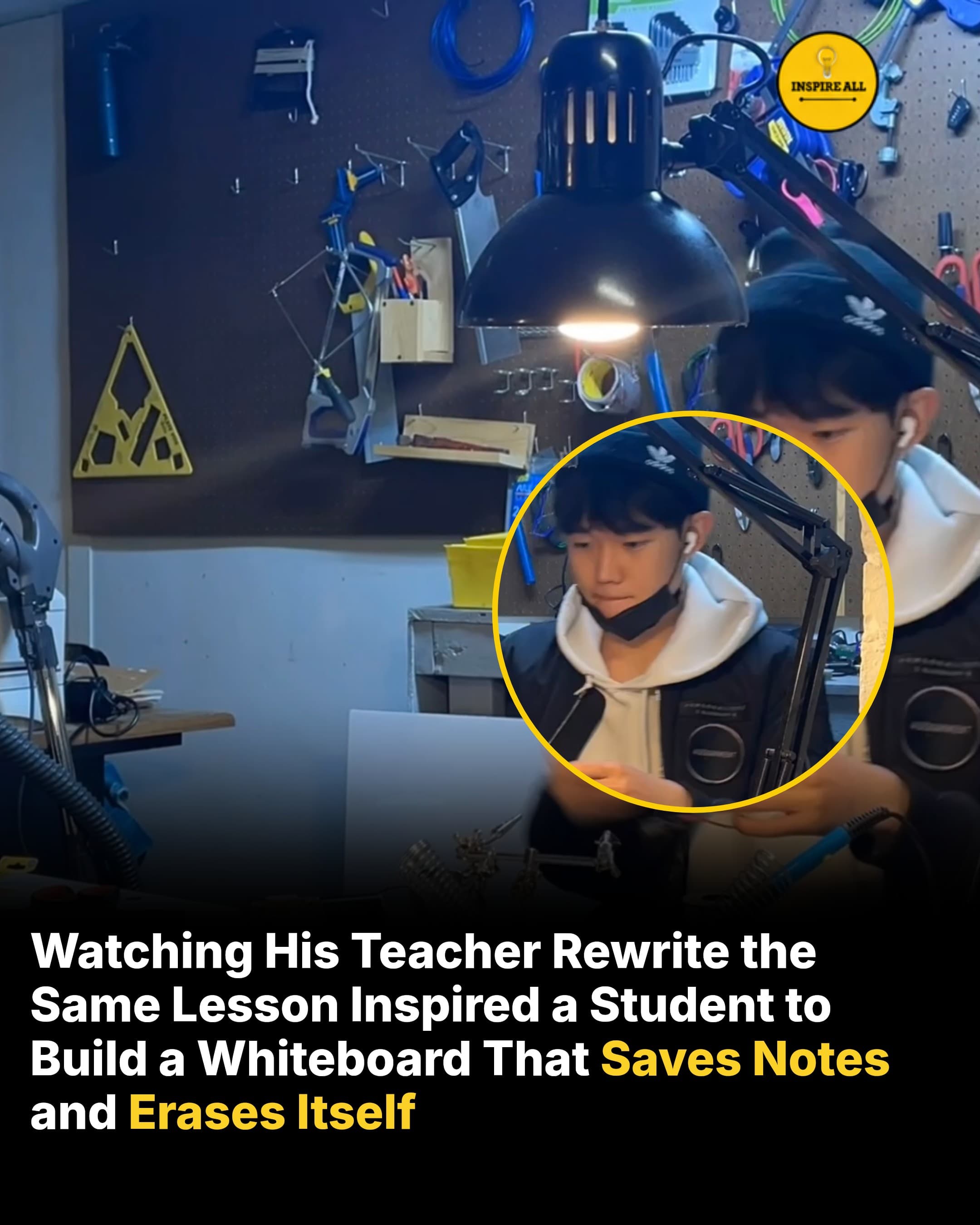
A student’s question about repeated classroom work became a rolling whiteboard, years of testing and national recognition for the invention process.
Jason Seong Hun Ahn noticed a teacher erasing a lesson before writing it again for another class. He began investigating whether a whiteboard could preserve that work and prepare its own clean surface.
The result was the ARE Board, short for Auto Rolling and Erasing Whiteboard. In an October 1, 2026 profile, the University of Iowa’s Jacobson Institute described a looped surface that moves, digitally captures completed writing and erases before returning to view.
What the early failures revealed
Ahn started building in early 2022, using a kitchen table and available school spaces. Versions jammed or failed to erase properly.
Teachers contributed practical help. Elizabeth Brenneman helped investigate friction; Patrick Leonard helped construct wooden frames. The institute reports that Ahn received the Best Logbook Award at Invention Convention U.S. Nationals and support for a patent application.
That recognition makes the development record part of the story. A jammed mechanism is useful evidence when the next version addresses what caused it.
A closer look at the mechanism
The published patent application, US20240165987A1, names Jason Seong Hun Ahn as inventor. Filed November 22, 2022, it was published May 23, 2024.
Its description sets out a flexible writing sheet, rollers, a motor and an erasing arrangement. Moving the sheet allows writing and cleaning to occur in different parts of the mechanism.
The application helps distinguish a specific mechanical proposal from the broader idea of a digital classroom board. It also provides a dated public record of the design.
A published application is not itself proof of an issued patent or commercial availability. This article does not establish either.
Preserving the lesson, and the learning process
The classroom problem combines two tasks: saving what has been written and providing a clean place to continue. The ARE Board brings them into one proposed workflow.
Ahn’s story also shows how several kinds of knowledge meet in a prototype. Observation identifies the problem; mechanics, materials and testing determine whether a solution works.
The useful lesson is in that sequence. Asking for help and recording failures gave the project concrete next steps.
Reporting is based on the Jacobson Institute profile and published patent application. Trending American has not tested the board. Featured graphic supplied by Inspire All.
Related reading: Himaja’s voice-controlled Braille printer and Gargi Agrawalla’s portable alert prototype.