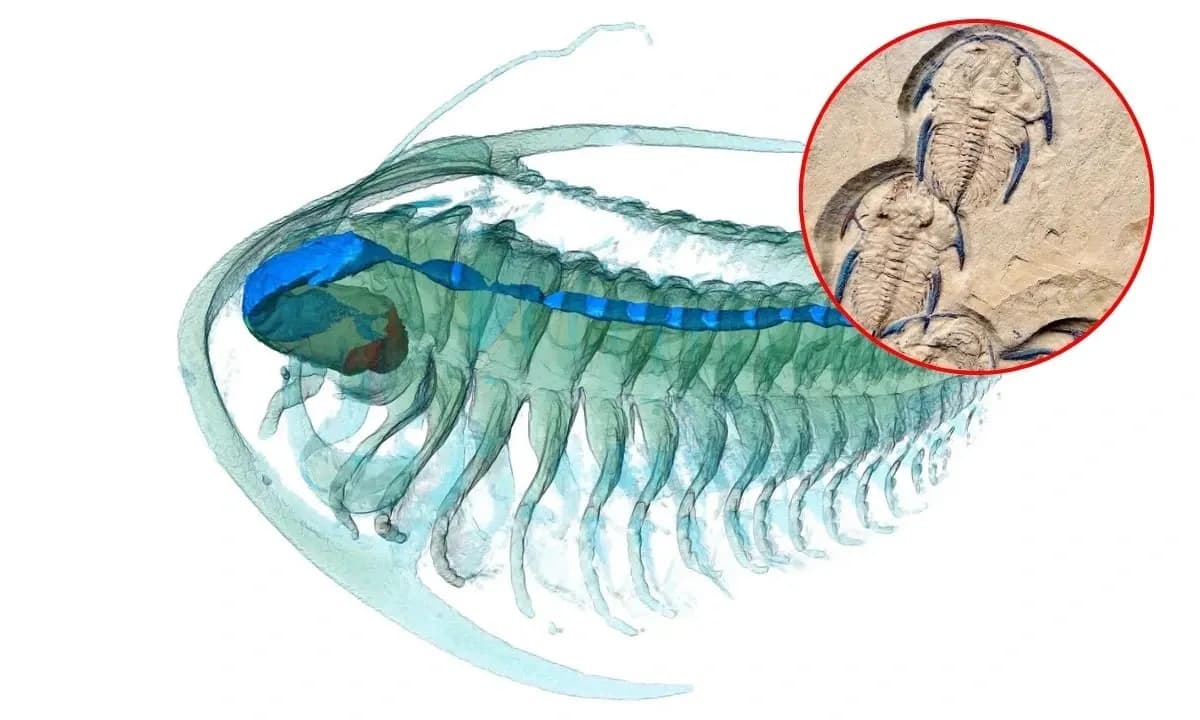
Just when paleontologists thought they had seen it all, nature surprised them again. Recently, a remarkable discovery has emerged, revealing a grouping of trilobites fossilized in a crawling position across what once was the ocean floor. These ancient arthropods, dating back hundreds of millions of years, are turning heads not just for their historical significance but also for their peculiar coloration.
Trilobites are an extinct group of marine arthropods that roamed the Earth during the Paleozoic Era, around 520 million years ago. Originating from the Cambrian period, they are considered one of the earliest complex life forms. This grouping of trilobites boasts oblong, multi-segmented bodies that have survived the ravages of time.
What surprised researchers was the striking hint of blue that outlines their segments. Although most fossilized trilobites are found in shades of brown or black, the blue edges create an unexpected pop of color, suggesting these creatures may have been more vibrant than previously imagined.
The fossils were uncovered in a region rich with sedimentary rocks, known for preserving prehistoric life. The details captured in these fossils provided scientists not just with evidence of how trilobites lived but also insights into the environments in which they thrived. Scientists believe the blue coloration might stem from the mineralization process or possibly from organic compounds that colored their exoskeleton while they were alive.
One eloquent observer remarked, ‘Finding such an exquisite assembly of trilobites is like uncovering a page from an ancient history book—woods rich in color,’ referencing the extraordinary find. Currently, research is underway to determine the exact conditions that allowed these trilobites to fossilize in such an elaborate and vibrant manner. Scientists have long debated the appearance and lifestyle of trilobites, and the vibrant blue may equal more than aesthetic appeal. It could hold clues to their behavior or the ecological aspects of their environment.
After the discovery, the paleontological community was abuzz with excitement. Fossils like these allow researchers to piece together the ancient world, offering crucial insights into evolutionary history. Not only does this discovery enhance the understanding of trilobites as a species, but it also points to the vivid, diverse life forms that once thrived in ancient seas.
In the aftermath of the discovery, enthusiasts and academics alike ponder the implications. Could colors like blue suggest social signaling or environmental adaptations? As the research progresses, the excitement around this fossil find continues to grow, enabling scientists to ask deeper questions regarding prehistory.
But with so many mysteries locked within the earth, one can’t help but wonder: what other stunning secrets does the past yet hold, waiting to be unearthed?