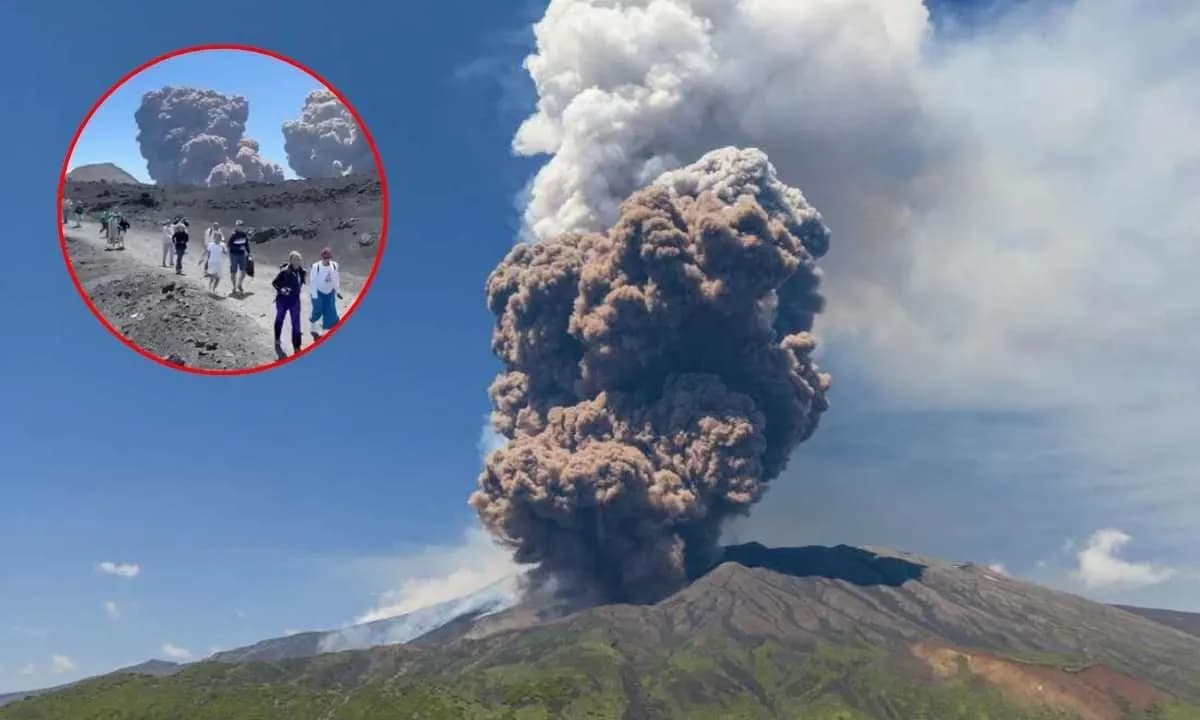
On June 2, 2025, the majestic Mount Etna in Sicily, Italy, erupted violently, sending enormous clouds of ash and volcanic gas hundreds of meters into the sky. Tourists who had come to witness its beauty found themselves in a terrifying race for safety. Around 11:24 AM local time, a sudden explosion marked the beginning of chaos, as the southeast crater collapsed, releasing lava flows that illuminated the landscape like a scene from Dante’s Inferno.
Michelle Nigro-DiLeonardi and Nicholas DiLeonardi, a couple visiting from the United States, described their escape. ‘People were running all around, shouting, unsure of where to go,’ Michelle recalled, her eyes wide with the memory of fear. The unthinkable was happening; the earth was roaring, and the sky was darkening from the ash cloud. They had planned a beautiful day hiking on the volcano, but now survival was the only goal.
The eruption produced stunning visuals that captivated the media, but for those on the ground, it was a nightmare. Witnesses spoke of a ‘lava fountain’ that shot up from the ground, reminiscent of a wild firework display; beautiful yet profoundly dangerous. The sounds of the veritable thunder of the volcano mixed with the cries of tourists fleeing left a surreal stain on the day that was expected to be filled with adventure.
Locals told stories of how they had witnessed eruptions before, but nothing compared to this. The ash rained down like dark snow, covering homes and trails, obscuring visibility and turning the scenery into a scene from a sci-fi disaster movie. Families were separated; some hurried towards evacuation routes while others stayed behind, unsure if they could outrun the unpredictable disaster.
‘We heard earlier that the eruptions were minor, that tourists should feel safe,’ Nicholas said. ‘But in a matter of minutes, everything changed.’ The contrast between their expectations and the ensuing trauma highlighted the unpredictable nature of the forces of nature. Standing amidst the chaos, they and countless others began running down the trails, their hearts racing with the frantic sounds of nature unleashing its fury.
After a day filled with chaos, reports confirmed there were no serious injuries or fatalities. The local authorities managed evacuations, quickly guiding thousands away from danger. Scientists explained that the eruption, while spectacular, was typical for Etna, but the overwhelming eruption spectacle left many feeling vulnerable in the face of nature’s raw power.
As night fell, the mountain smoldered quietly, whispering tales of destruction and beauty in equal measures. The aftermath brought forth national discussions on tourism, safety measures, and the unpredictability of nature. Even as people began to return to their normal lives, the fear of that single day lingered in their hearts.
This ordeal raised questions about the relationship between humans and nature. When beauty becomes danger, how do we prepare ourselves? As tourists shared their dramatic escapes, many reflected on the moments of connection forged through shared terror and survival. Society may be able to predict weather, but volcanoes remain enigmas of the earth.
Had they anticipated the disaster, could they have prepared differently? Or is it simply part of the experience of exploring nature’s wonders, respecting her vast power while marveling at her beauty? Perhaps the true lesson is in our acknowledgment of nature’s unpredictability, allowing it to remind us of our frailty as we engage with this majestic world.