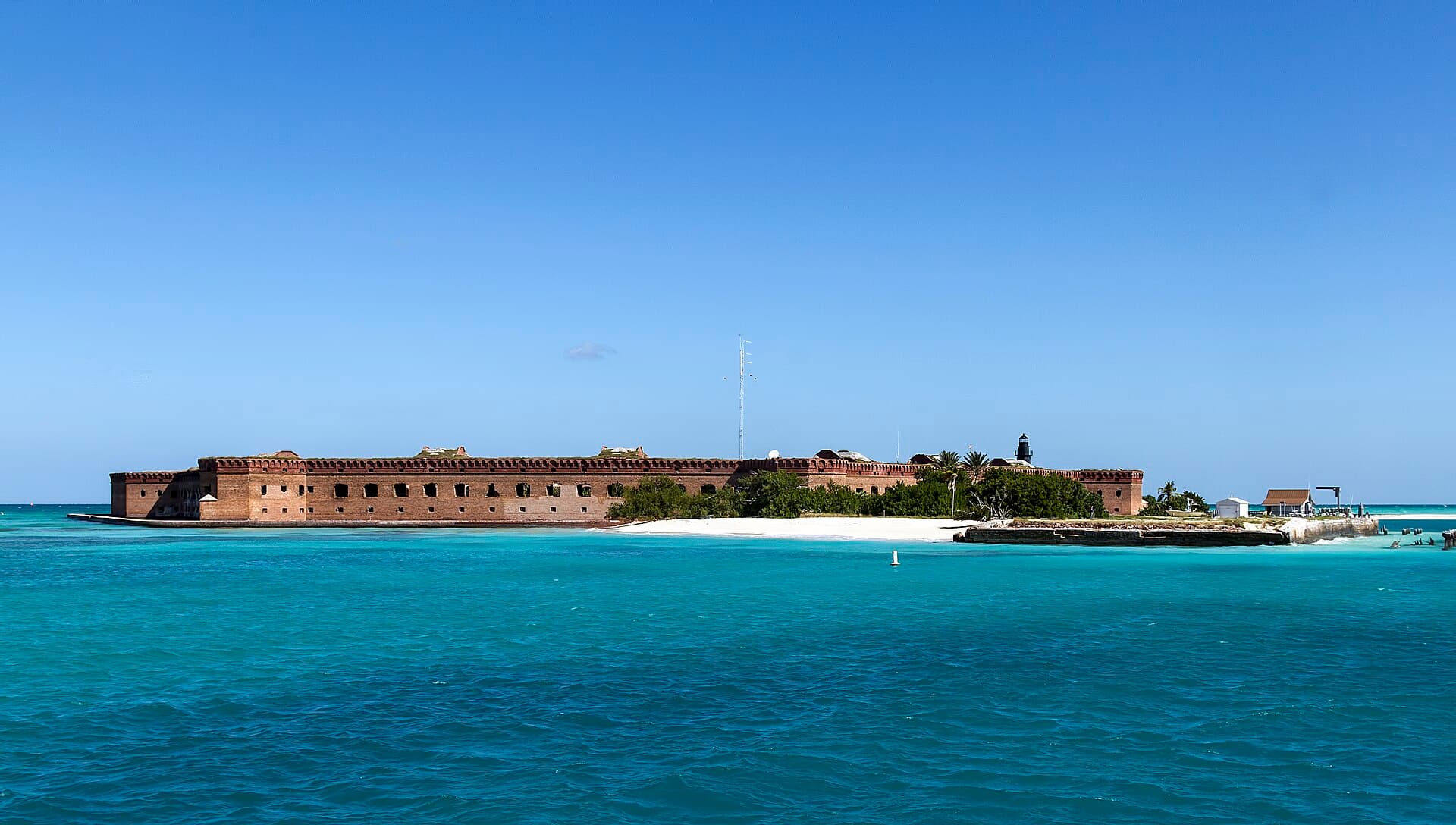
Far beyond Key West, a brick fortress rises from water bright enough to seem unreal.
Fort Jefferson occupies Garden Key in Dry Tortugas National Park, Florida. Construction began in 1846, but the immense coastal fort was never completed. It later served as a military prison and outlived its original defensive role.
Today it is a protected national park destination, not an abandoned building open to unsupervised exploration. Visiting requires a boat or seaplane, careful planning, and attention to conditions at a remote island site.
Why build Fort Jefferson so far offshore?
The fort protected a valuable anchorage near important sea routes. Its strategic value came from the sheltered harbor and the naval operations that harbor could support.
The National Park Service’s fort history explains its place in the Third System of American coastal defenses. Work continued for decades, but the project never reached its full intended form.
During the Civil War, Union forces held the fort. It supported the wider effort to control nearby waters and became a prison, holding many soldiers convicted of offenses such as desertion.
Samuel Mudd, convicted for his role in the aftermath of Abraham Lincoln’s assassination, became its best-known prisoner. Yet the larger prison story involved many people whose names are less familiar.
That military past gives the beautiful setting a different weight. The same water that attracts travelers helped make confinement here feel remote.
An enormous building on a small island
The Dry Tortugas lie about 70 miles west of Key West. The park’s historical overview describes seven small islands and a landscape shaped by navigation, shipwrecks, and military ambitions.
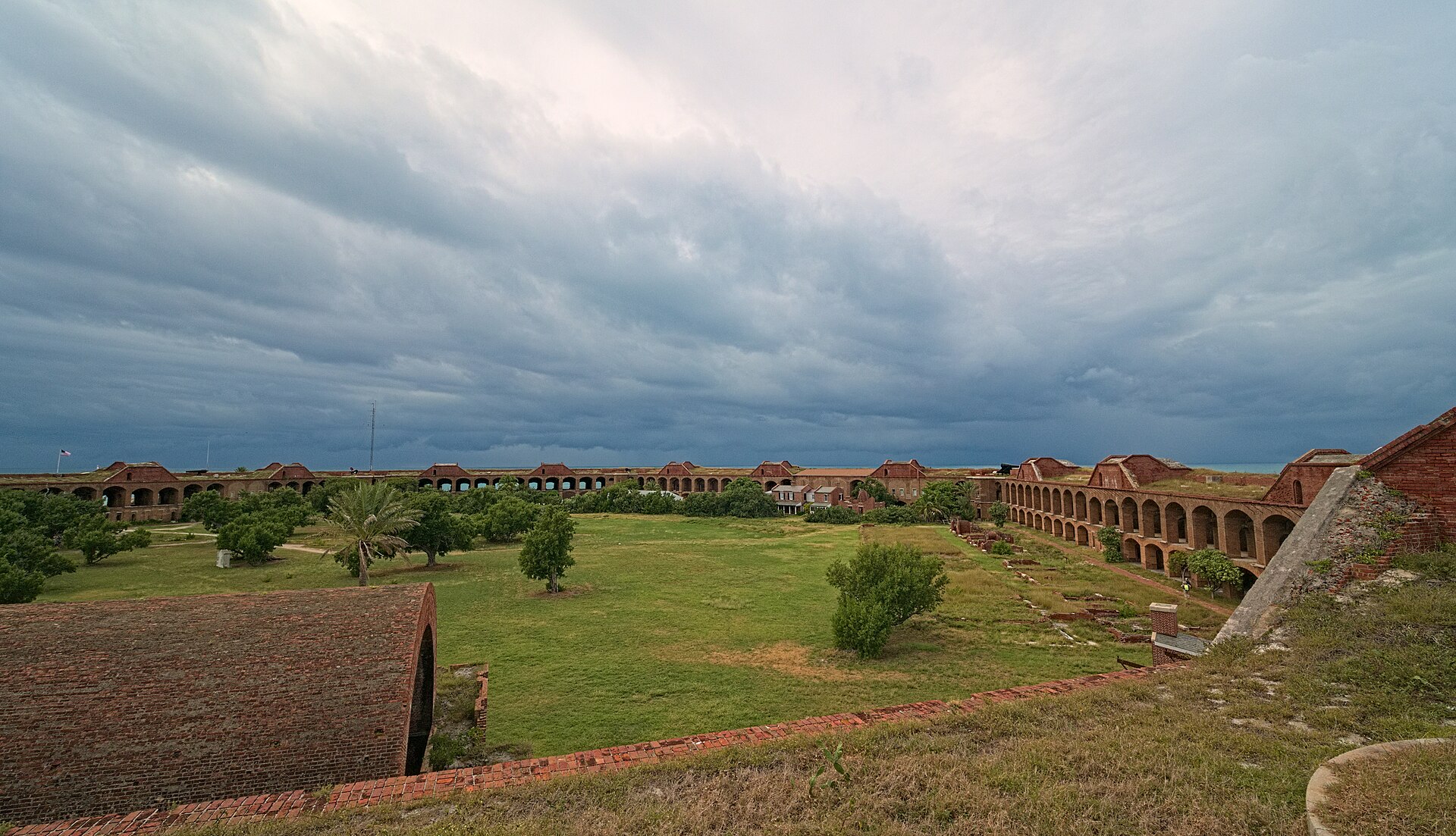
Fort Jefferson’s thousands of brick arches create a rhythm that is easy to recognize in photographs. Repeated openings frame sky, sea, and interior space, while the long outer walls make the island appear almost swallowed by the structure.
The scale also created problems. Settlement affected the fort, including its water-storage system. A remote garrison needed practical services as well as defensive walls, and the site proved difficult to maintain.
This is one reason “unfinished” is more revealing than “mysterious.” The missing pieces reflect engineering limits and changing needs rather than an unexplained disappearance.
What happened after the military mission faded?
The Army abandoned its principal use of the fort in 1874, although the site’s wider story continued. The islands later served other purposes, including naval coaling activity.
Protection eventually replaced military use. Fort Jefferson became a national monument in 1935, and Dry Tortugas National Park followed in 1992.
Those changes transformed the meaning of the old masonry. A structure designed to control access to a harbor became a place where visitors could learn about that history.
The photographs here show the exterior in 2012 and the courtyard in 2019. They illustrate the fort’s layout, but visitors should not assume every visible walkway or area is currently open.
Preservation is a continuing job
The park’s preservation program addresses both cultural and natural resources. Fort Jefferson shares the park with historic navigation features, marine environments, and evidence of earlier voyages.
That broader setting matters. The fort was never separate from the water around it. Boats carried people, supplies, and construction materials here, and the same marine conditions now shape preservation work.
For a visitor, repairs and closed sections are part of keeping the structure available over time. A barrier may protect fragile masonry, ongoing work, or a hazardous edge. Follow the route that park staff authorize rather than trying to recreate an old photograph from an inaccessible spot.
The most rewarding details are often simple: an arch, a view across the courtyard, or the meeting of brick walls and shallow water.
Planning a legal visit to Fort Jefferson
Start with the National Park Service trip-planning page. There is no road to Garden Key. Visitors arrive by authorized ferry, seaplane, or an appropriately planned private boat trip.
Book transportation before building the rest of your itinerary around the fort. Check what your operator provides and what you must carry, especially drinking water, food, and sun protection.
Do not assume services available in Key West will be available on the island. Remote travel rewards a simple plan: know your arrival and departure times, carry the essentials, and leave enough time to return to your transport without rushing.
If you hope to camp, consult the separate current camping instructions. A day-trip booking and an overnight arrangement are different plans.
Let the weather shape the day
The park’s current conditions page is an essential final check. Offshore weather and marine conditions can affect transport and activities, even when the mainland forecast looks inviting.
Allow some flexibility around a visit. If swimming or snorkeling is part of the plan, assess local conditions and follow park guidance rather than treating calm-looking water as a guarantee.
Once ashore, give the fort time. Its scale becomes clearer when you stop thinking of it as a single photograph and start reading it as a workplace, a garrison, and a prison.
The unfinished walls hold all those stories at once. That is what makes Fort Jefferson more than a beautiful ruin.
Frequently asked questions
Can you drive to Fort Jefferson?
No. Garden Key is reached by boat or seaplane, not by road.
Is Fort Jefferson abandoned?
Its original military role ended, but the National Park Service protects and manages it within Dry Tortugas National Park.
Was the fort ever completed?
No. Construction continued over several decades without completing the original plan.
Do you need to check closures before visiting?
Yes. Review park alerts, transportation information, and current conditions before departure, and follow posted restrictions on the island.
Image credits
Featured image: Acroterion, CC BY-SA 4.0. Body image: Daniel Kraft, CC BY-SA 3.0. Images retain their original framing; dates are identified in their captions or the article.

