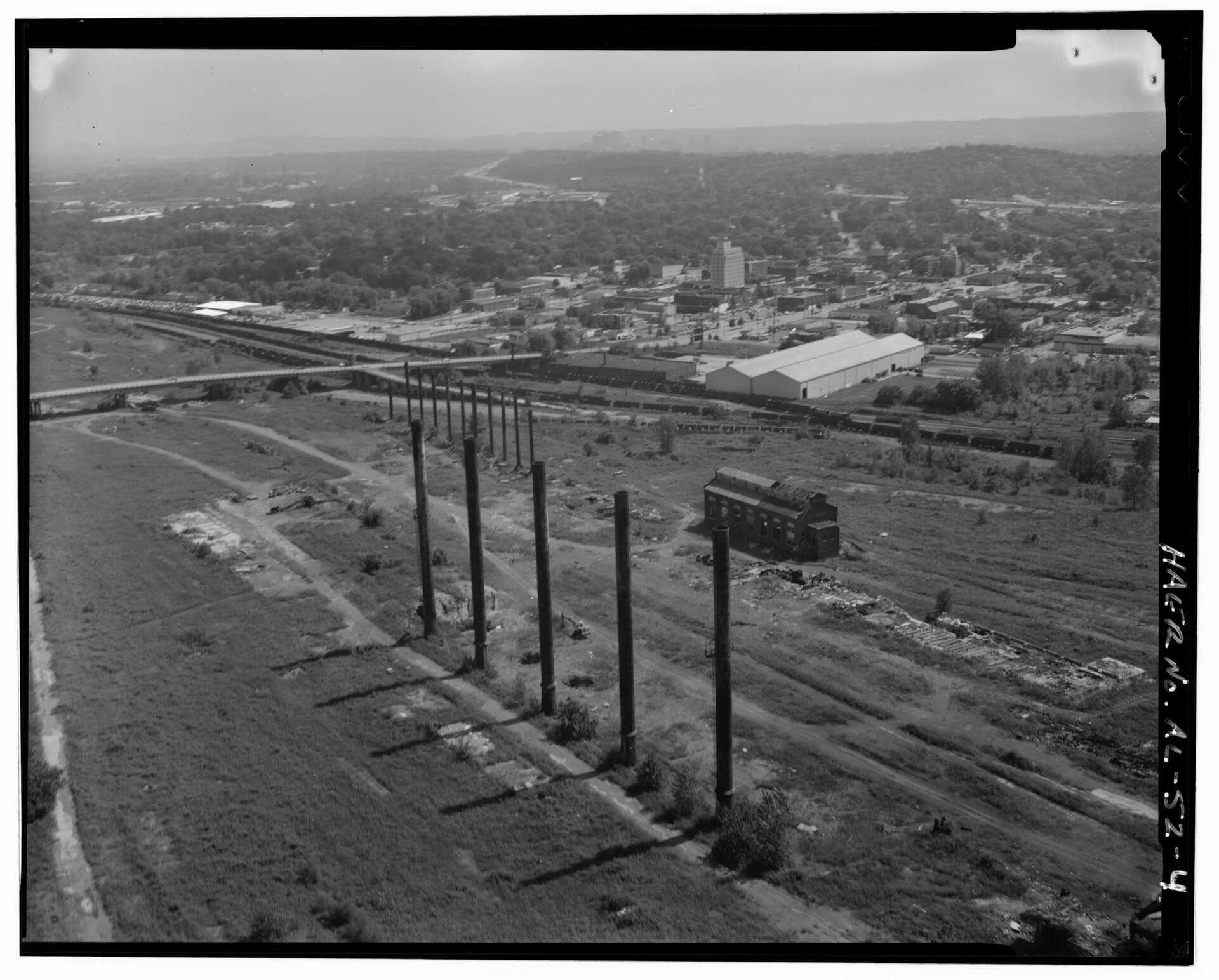
A line of lonely smokestacks once marked where an entire steelmaking world had stood.
Ensley Works, west of downtown Ensley in Birmingham, Alabama, was a major iron and steel complex established in 1888. Its principal steelmaking era ended in the 1970s, leaving a vast industrial property that has changed through demolition, vacancy and redevelopment proposals.
In 2026, Birmingham announced funding for new planning and environmental studies. The site remains a place to understand through archives and current public records, not an unrestricted industrial-history attraction.
How Ensley Works became a steel center
The works developed under the Tennessee Coal, Iron and Railroad Company, commonly called TCI. It became part of U.S. Steel in 1907.
A Federal Reserve Bank of Atlanta historical account describes Ensley’s importance to the Southeast’s steel industry and places it within Birmingham’s wider economic development. Federal Reserve historical essay
The plant depended on more than furnaces. Rail connections, raw materials, power, maintenance and skilled labor had to function together.
That is why an integrated works occupied so much land. Each stage of production needed space, and materials had to move between them efficiently.
The surrounding community grew with this industrial economy. A mill’s presence shaped employment and commercial life well beyond its gates.
A place of technical experimentation
The Historic American Engineering Record identifies Ensley with important developments in steelmaking, including an early American use of the duplex process in 1899.
In that process, metal passed through more than one kind of furnace treatment. The historical report connects the resulting steel with railroad-rail production and notes the influence of Ensley’s methods elsewhere. Library of Congress engineering history
The details challenge a simple picture of an old mill as a place that never changed. Engineers and managers adapted equipment, tested designs and responded to new demands.
What the aerial photographs reveal
The featured and body images are archival aerial photographs from 1992, preserved through the Historic American Engineering Record.
They show a landscape already stripped of much of its former equipment. Rows of stacks and isolated buildings stand within broad open areas, with neighborhoods and transport routes nearby.
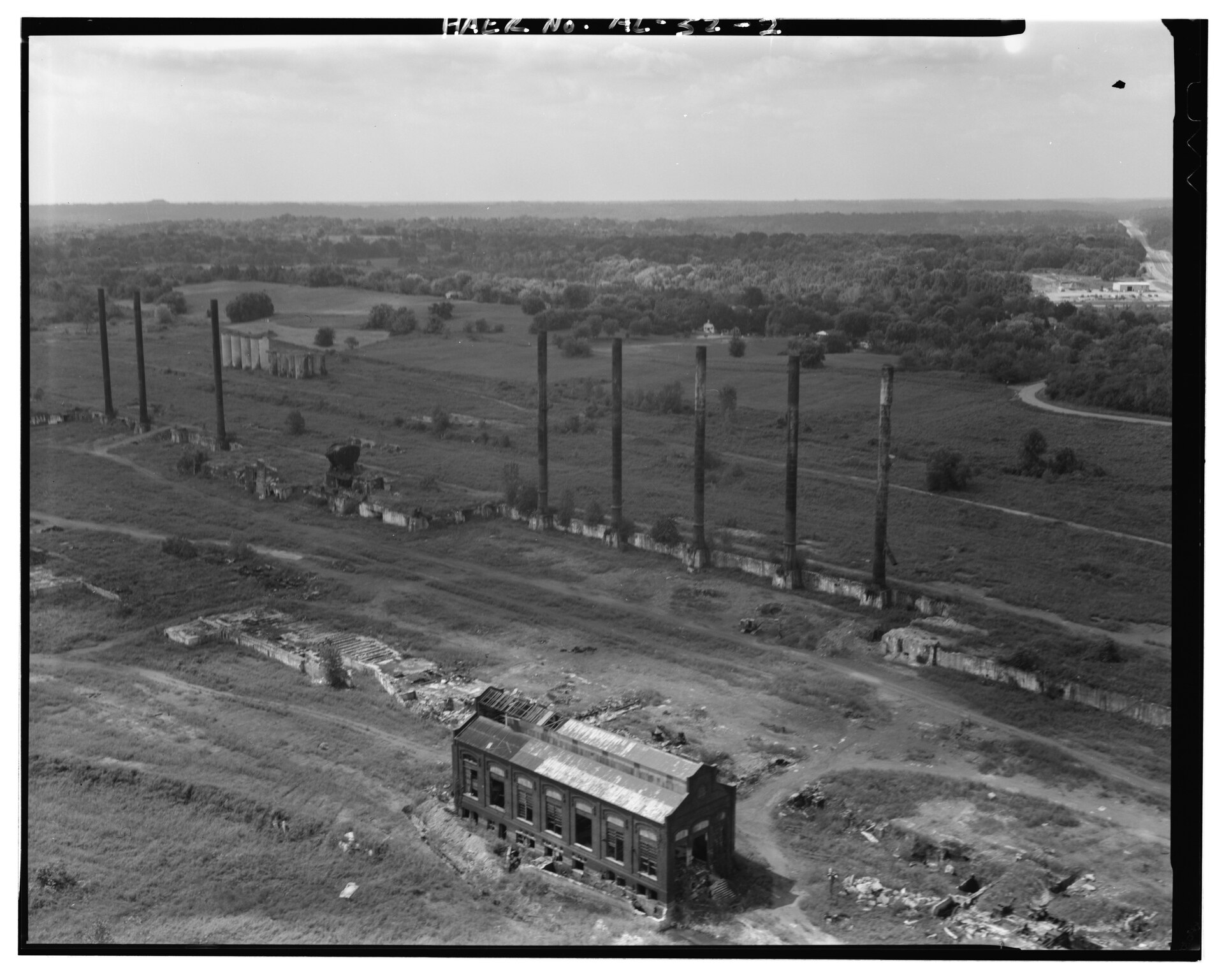
The views are valuable because they place the remnants in context. A single close-up of a stack cannot show how the mill related to the surrounding city.
The Library of Congress collection includes photographs, captions and written documentation that help identify those relationships. Ensley Works archival collection
These images are not current-condition photographs. They should not be used to claim that a particular building, road or stack still survives today.
Why closure dates can be confusing
The Federal Reserve account dates the works’ main operating history from 1888 to 1976. Other historical records describe periods of significance or later activity that extend beyond a single shutdown date.
That is typical of large industrial complexes. Steel production, support functions, demolition and the disposal of property do not necessarily end together.
Ensley’s postindustrial history has lasted decades. In that time, vegetation spread, structures were lost and different proposals attempted to give the site a new role.
The land remains part of the neighborhood
Birmingham’s Ensley and Pratt planning material describes the former works as a large redevelopment opportunity. It also places the property within a community with needs extending beyond the mill itself. City planning background
For residents, the future of such land involves jobs, access, environmental conditions and the relationship between industrial uses and nearby homes.
Those concerns can be obscured when outside visitors focus only on dramatic ruins. The property is not a detached historical stage set. It sits beside places where people continue living and working.
Separate projects, different scales
In January 2024, WBRC reported Alabama Power’s plans for a new transmission substation on more than eleven acres purchased from U.S. Steel at the former works.
The proposed move was intended to replace an aging transmission installation while retaining distribution functions at the older location. WBRC’s substation report
That project concerns one portion of the land. It should not be described as the redevelopment of the entire historic complex.
Large sites often change parcel by parcel. A completed use in one corner can coexist with planning or vacancy elsewhere.
What Birmingham announced in 2026
In February 2026, the city announced a $2 million SEEDS Act grant for its Western Corridor.
The first phase includes a master plan and environmental studies for roughly 500 acres at Ensley Works, alongside improvements involving Birmingport. The city presents this as preparation for future logistics and manufacturing investment. Birmingham’s grant announcement
It is planning funding, not evidence that a new industrial district is already complete.
As of November 2026, the reviewed sources do not establish a public visitor program at the former mill. Respect restricted land and follow official updates.
Ensley’s story continues in the space between what the photographs preserve and what the community hopes the land can become.
Frequently asked questions
What was Ensley Works?
It was a major TCI and later U.S. Steel iron and steel complex in Birmingham.
When did its main steelmaking era end?
Its principal operating history is commonly dated through 1976, with later site activity and clearance continuing afterward.
Are the photographs recent?
No. Both images are archival aerial views from 1992.
Has the 2026 redevelopment been completed?
The city announced funding for planning and environmental studies. That announcement does not establish a completed project.
Image credits
Featured image: David Deising / Historic American Engineering Record / Wikimedia Commons, Public domain. Ensley Works’ stacks and the surrounding district in an archival 1992 aerial photograph.
Body image: David Deising / Historic American Engineering Record / Wikimedia Commons, Public domain.