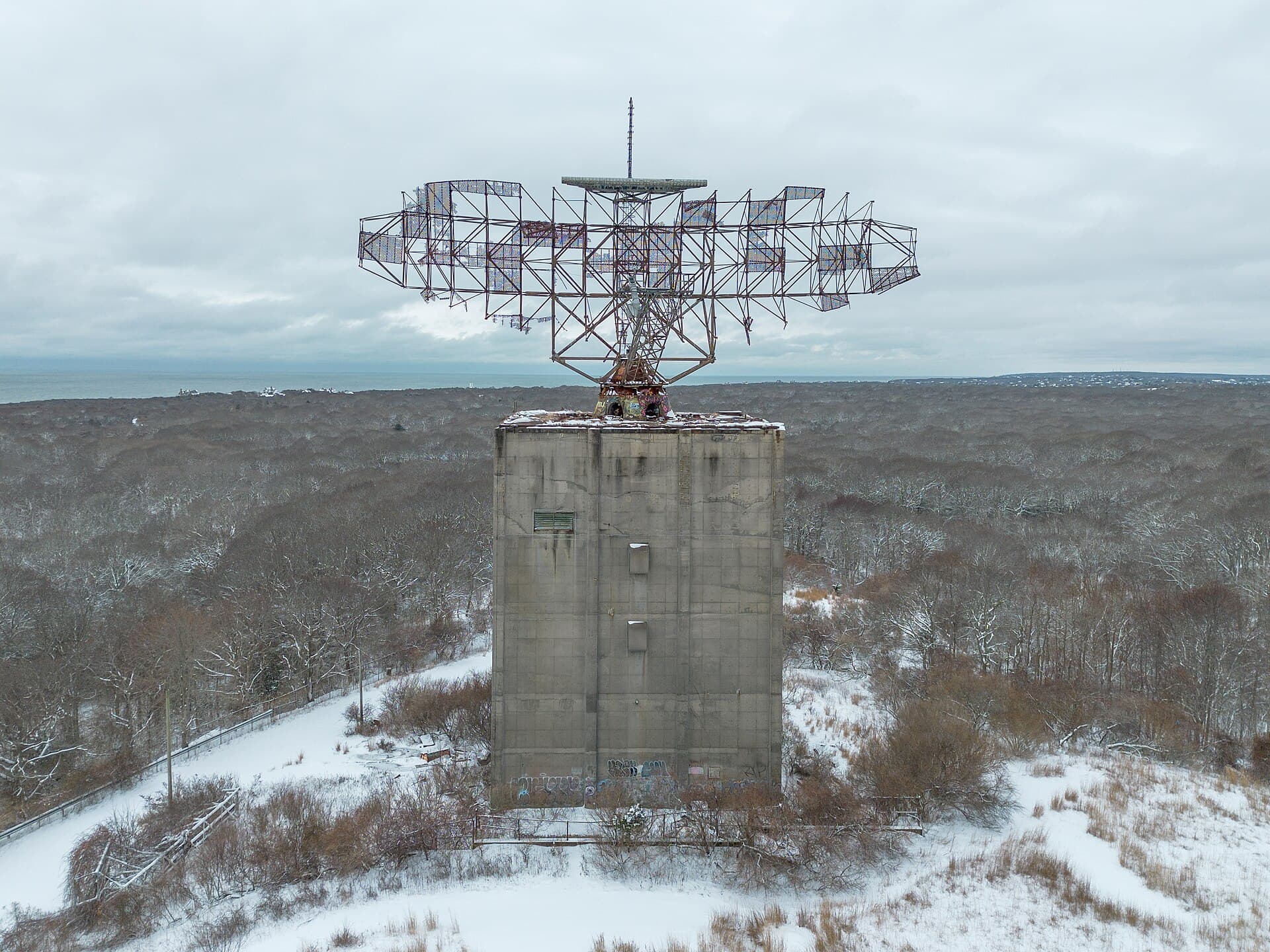
A huge radar antenna rises above Montauk’s trees, guarding a military mission that ended decades ago.
Camp Hero, on eastern Long Island, is a former military installation now preserved within a New York state park. Its concrete batteries and radar tower attract visitors interested in abandoned places, but the public experience centers on designated trails and exterior views.
The documented history is unusual enough without adding secret experiments. The Army once disguised parts of the post as a seaside village, then the Air Force turned the location into an important lookout for approaching aircraft.
Camp Hero began with a wartime disguise
The Army commissioned Camp Hero in May 1942 to defend the coast against enemy ships and submarines. Its major batteries included 16-inch and six-inch guns.
To make the installation less obvious from the air, military buildings borrowed the appearance of an ordinary coastal settlement. Observation structures resembled cottages, and the gymnasium looked like a church.
A New York State Parks historical marker records this camouflage and identifies the surviving gymnasium as a remnant of the original military downtown.
The disguise gives familiar architecture an unexpected meaning. A churchlike building might suggest worship, but here its appearance served a defensive purpose.
The marker also explains the name: Camp Hero honored Major General Andrew Hero Jr., a former chief of Coast Artillery. The name did not originate with a secret project or a fictional character.
Heavy guns gave way to a different threat
After World War II, the coastal artillery mission declined and the guns were removed. The site’s location still mattered, but the danger planners watched for increasingly came through the air.
The Army Corps of Engineers’ historical documentation records multiple military uses and transitions. Camp Hero was not one installation performing the same task for its entire life.
Radar operations and antiaircraft defenses reflected a new era of concern about long-range bombers. Different military services used portions of the property, which helps explain why timelines sometimes present more than one end date.
A battery closure, a radar shutdown, and a final administrative transfer need not occur in the same year. Broad references to the base ending in the early 1980s capture the transition without forcing those separate events into one moment.
The radar tower became the lasting landmark
The enormous AN/FPS-35 radar structure is the feature most closely associated with Camp Hero today. It belongs to the Cold War chapter, not the original World War II artillery system.
The state’s historical marker dates its construction to 1960. From a public viewpoint, its large antenna and supporting tower still communicate the scale of the air-defense mission.
Yet the most useful historical evidence often shows ordinary work. The Montauk Library’s archival guide highlights photographs taken inside the station by longtime employee Edwin Crasky in 1980.
Those images preserve equipment, buildings, and working surroundings near the end of the military period. They offer a grounded way to imagine the people behind the radar rather than treating the structure as an unexplained object.
Why Camp Hero attracts so many legends
Camp Hero has become closely linked with conspiracy stories commonly grouped under the Montauk Project. The library documents strong public interest in those stories and their connection with popular entertainment.
That cultural influence is real. It does not establish that the extraordinary claims happened.
The important distinction is between evidence that a story became famous and evidence that its events occurred. Military records, historic photographs, and state interpretation document coastal artillery and radar work. They do not substantiate tales of time travel.
The setting naturally encourages imagination: closed doors, empty gun positions, and a striking antenna create unanswered visual questions. Historical research can answer many of them without turning speculation into fact.
What the park protects today
New York State Parks describes a 415-acre landscape with maritime forest, freshwater wetlands, ocean views, and dramatic bluffs.
The military remains occupy only part of that setting. Trails support walking and other permitted activities, while birdwatching and shoreline scenery provide reasons to slow down between historic features.
This broader landscape changes the mood of a visit. The radar can dominate a photograph, but on foot the coast, vegetation, and open sky become just as important.
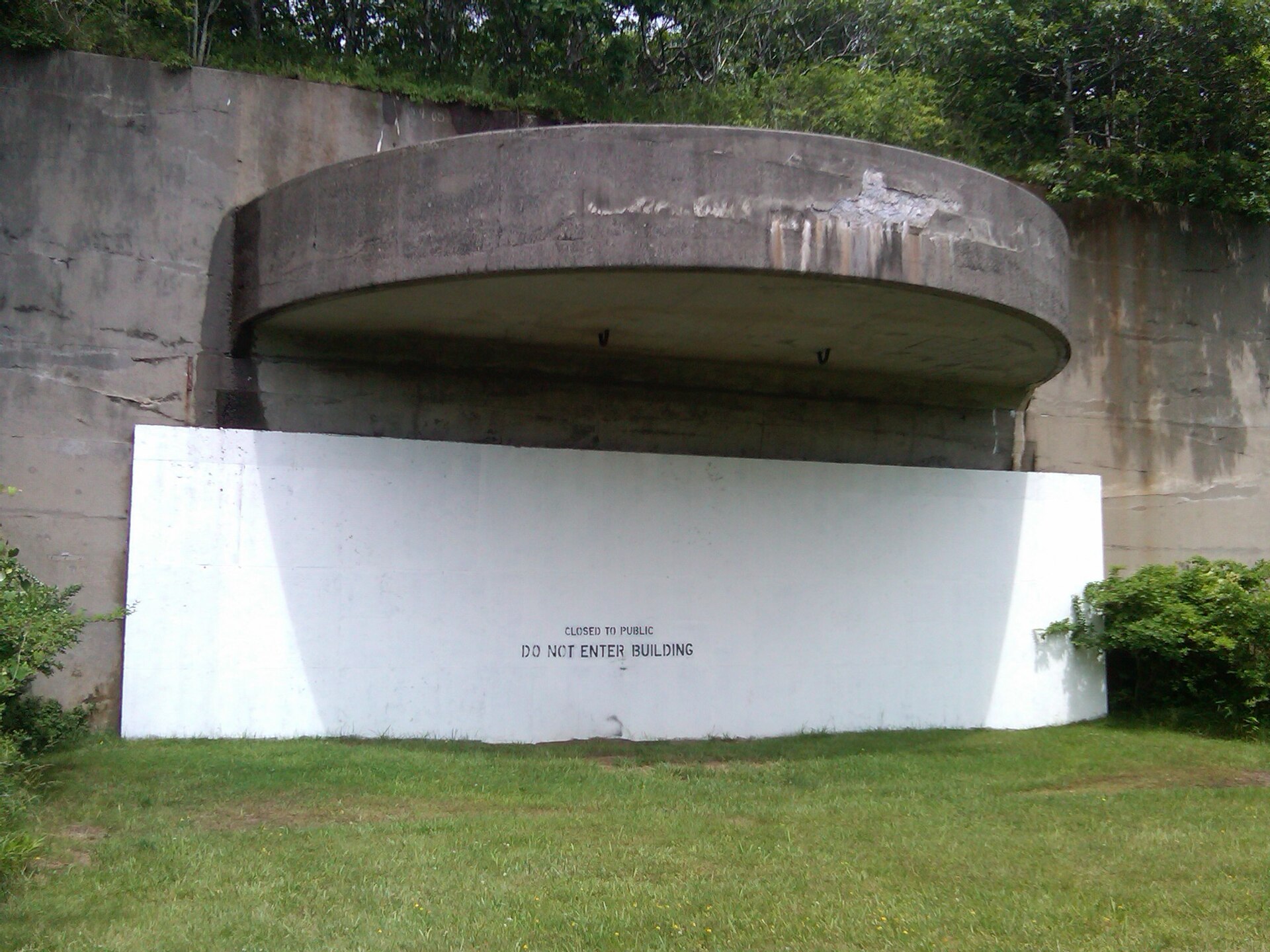
The body photograph shows a closed Battery 112 entrance in 2011. Its condition and signs should not be read as an invitation to search for a way inside.
Plan an exterior-focused visit
Use the official trail map and check current notices before setting out. General day-use activities run from sunrise to sunset. Special fishing access has separate permit rules and should not be confused with permission to explore the former base after dark.
Swimming is not permitted. Stay back from bluff edges and follow signs around military structures.
Bring suitable footwear and weather protection for exposed sections. Avoid making radar-tower entry the goal of the trip; public park admission does not establish access to restricted buildings.
Camp Hero is most compelling when its real layers remain visible: wartime camouflage, Cold War surveillance, civilian work, and a coastal landscape now open for public enjoyment.
Frequently asked questions
Is Camp Hero open to visitors?
Yes, designated areas of Camp Hero State Park are open under current park rules. Check alerts and the official map before visiting.
Can you enter the radar tower?
Do not assume so. Public park access does not authorize entry into restricted military structures.
Are the Montauk Project stories proven?
The official historical sources reviewed document military defense work, not the extraordinary claims associated with those stories.
Can you swim at Camp Hero?
No. New York State Parks states that swimming is not permitted.
Image credits
Featured image: Hayden Soloviev, CC BY 4.0. Body image: Transpoman, CC BY-SA 3.0.

