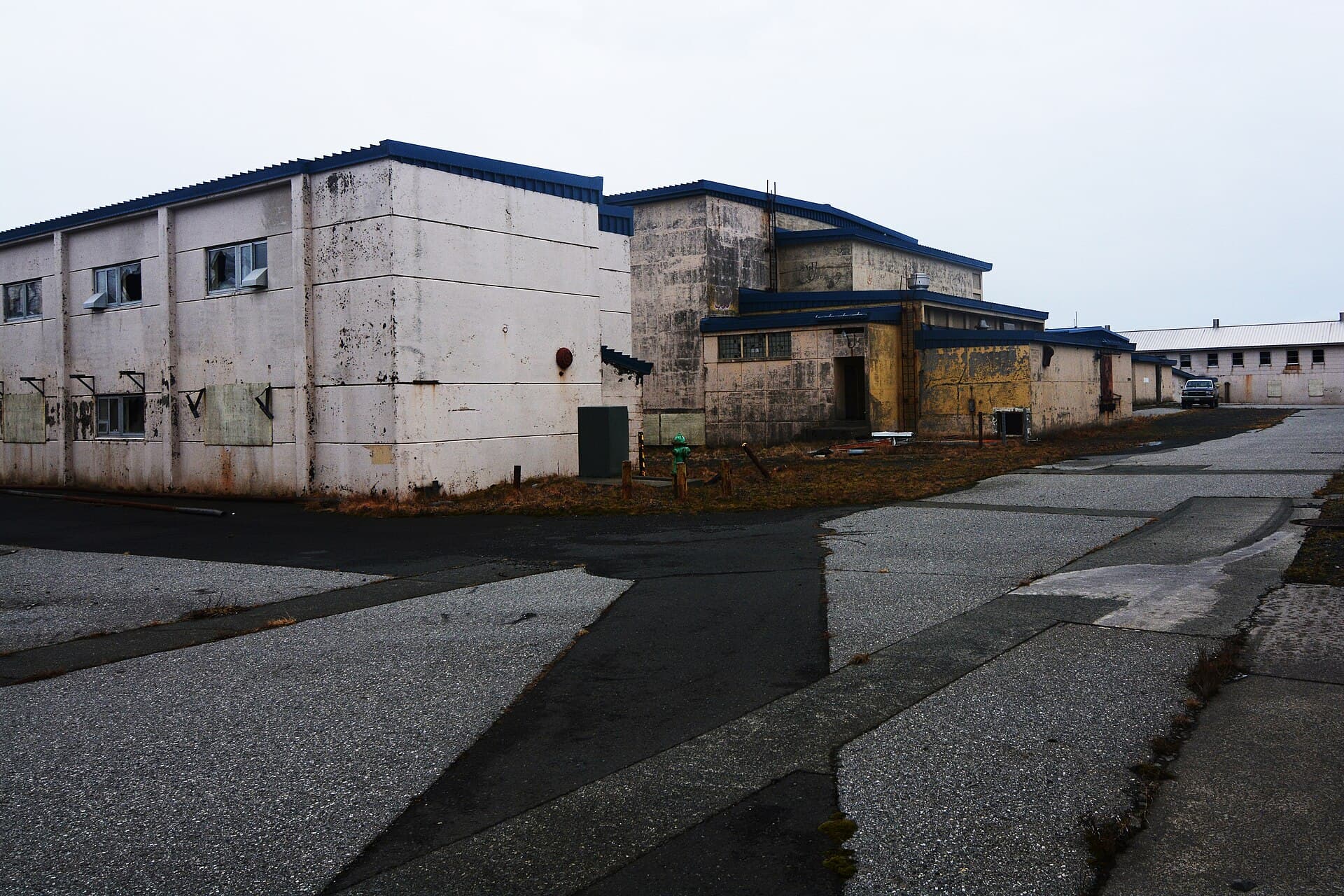
On a remote Aleutian island, empty military buildings stand beside a community that never completely disappeared.
Adak Naval Air Facility was a major American military installation in Alaska. Its operational mission ended on March 31, 1997, leaving a large built landscape behind. Today, Adak combines occupied properties, vacant structures, an active airport, private land, and areas still affected by military cleanup.
It is not an unrestricted ghost town. Understanding that mixed status is essential to understanding both its history and any potential visit.
Why the military came to Adak
Adak lies in the Aleutian island chain, roughly 1,200 miles west-southwest of Anchorage. During World War II, that remote position became strategically important.
American forces established an airfield in 1942 as part of the campaign against Japanese occupation of Attu and Kiska. The island provided a base closer to the fighting in the western Aleutians.
The Alaska Department of Environmental Conservation traces this military development and its long environmental aftermath.
An airfield required much more than a runway. Housing, fuel storage, maintenance, roads, and utilities grew around the mission. The scale of those supporting needs helps explain why so many structures remained after the military departed.
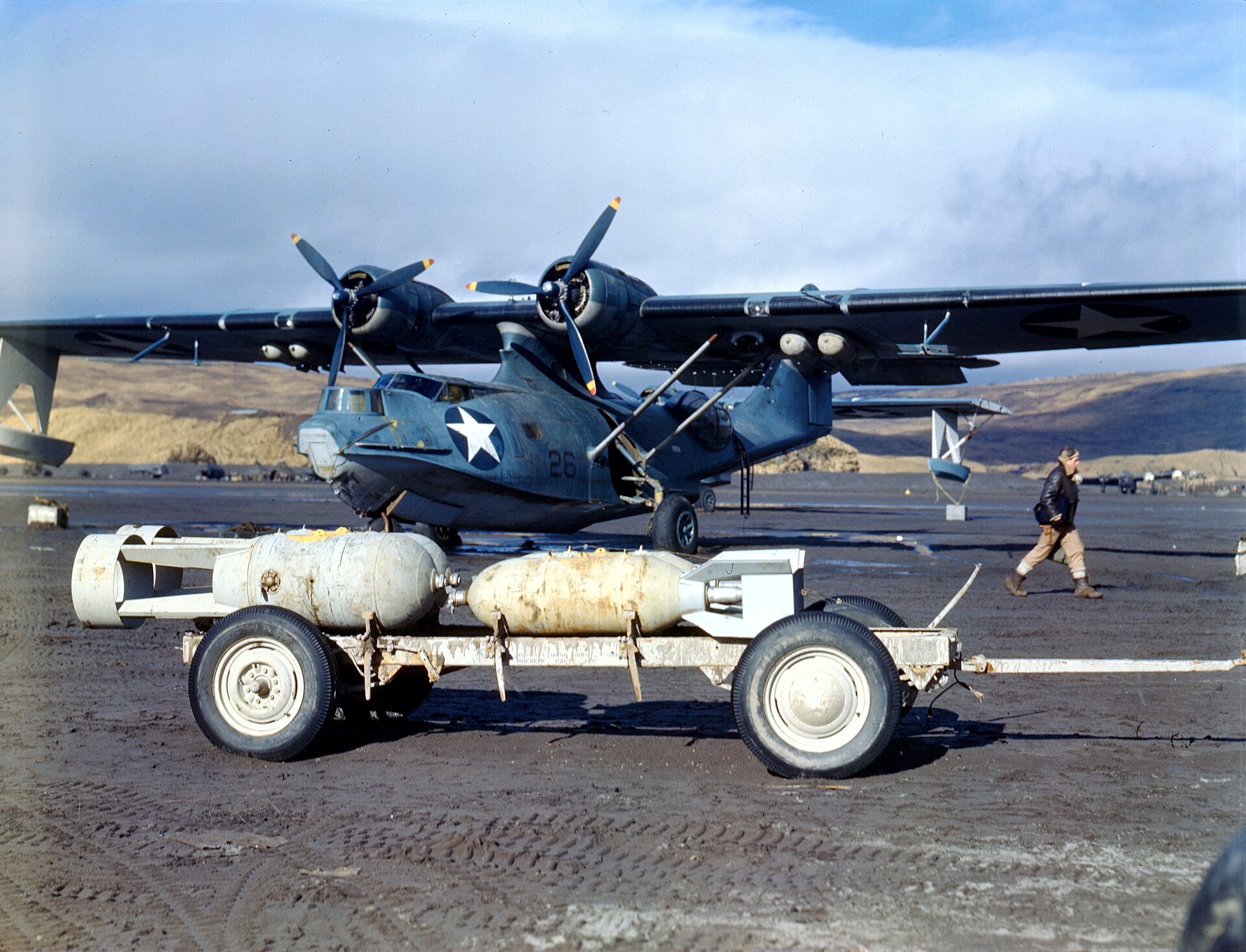
The wartime photograph below shows a Navy PBY Catalina being armed at Adak in 1943. It records the island as a working base, rather than the empty landscape familiar from modern ruin photography.
A wartime base found a Cold War purpose
Adak’s importance continued after World War II. The Air Force used the installation before the Navy took control in 1950.
During the Cold War, the base supported surveillance and antisubmarine operations across the North Pacific. Its remoteness became an advantage for military coverage, even while making ordinary life dependent on a long supply chain.
A congressional hearing on Adak’s transition describes the importance of those missions and the challenge of turning a military community toward civilian uses.
The buildings in contemporary photographs were therefore part of a functioning settlement. Their purpose was tied to people working, studying, maintaining equipment, and raising families in a distant outpost.
Seeing only broken windows can flatten that history. The empty structures are the aftermath of a large organization leaving, not evidence that the island was always deserted.
Why Adak Naval Air Facility closed
The end of the Cold War changed American military priorities. Adak’s closure followed the base realignment and closure process in the 1990s.
Dependents had departed by 1994. The installation was selected for closure in 1995, and its operational mission ended in March 1997.
The Navy’s official closure and cleanup page explains that the transfer of land and the completion of environmental work did not happen all at once.
Some property passed into new ownership, while other areas remained under Navy responsibility. That uneven transition produced the mixed landscape visitors see in photographs today.
A vacant building does not reveal its owner, condition, or legal access. Nor does it show whether nearby land contains restrictions connected with past military activity.
The island’s story is larger than the base
Adak belongs within the ancestral homeland of the Unangax̂ people. Military construction was a significant interruption in a much longer relationship with the islands.
The Aleut Corporation’s Adak information emphasizes that continuing connection alongside present-day land management and economic activity.
The corporation owns extensive land, while other property falls under different ownership or management. Recreational permits apply to specified land uses. They do not grant permission to enter former military buildings.
This distinction is especially important because online photographs can make building exploration appear routine. A photographer’s presence at a location is not proof that another visitor has permission to enter it.
Adak’s living community deserves the same respect as the historical landscape. Homes, businesses, and working facilities are not props in an abandoned-base story.
What remains, and what is still being addressed
The featured 2015 photograph shows a vacant military structure with weathered walls and damaged paving. It captures one part of Adak’s post-military landscape, not the condition of every property today.
Cleanup and monitoring remain important. Alaska’s environmental agency and the Navy document contamination concerns and areas affected by unexploded military material.
Some transferred property remains subject to controls or monitoring. Other land retains tighter restrictions. Visitors should use current official guidance rather than treating an old map as a complete picture of access.
Do not disturb unfamiliar objects, enter restricted areas, or move debris as a souvenir. The visible ruin is only one part of the site’s legacy.
Planning a responsible visit
The City of Adak’s visitor guidance describes the practical limits of traveling to a remote island. Confirm transportation, lodging, food supplies, and local services before arrival.
Prepare for limited communications and medical resources. Arrange any required land-use permits and ask the appropriate owner about the specific places you hope to see.
There is no need to force entry into a building to appreciate Adak’s story. The relationship between the airfield, surrounding settlement, and immense North Pacific setting already explains much of its past.
Adak is most memorable when viewed as a place still changing: an Indigenous homeland, a former military hub, and a living community sharing the same ground.
Frequently asked questions
When did Adak Naval Air Facility close?
Its operational mission ended on March 31, 1997. Property transfers and cleanup continued afterward.
Is Adak completely abandoned?
No. Adak has residents, businesses, an airport, and working facilities alongside vacant military properties.
Does a recreation permit allow building entry?
No. The Aleut Corporation specifically distinguishes land-use permission from permission to enter its buildings.
Can visitors explore anywhere on the island?
No. Ownership, permits, cleanup restrictions, and military hazards affect access. Confirm the rules for each proposed destination before visiting.
Image credits
Featured image: Paxson Woelber, CC BY-SA 4.0. Body image: U.S. Navy photo 80-G-K-8149, Public domain.

