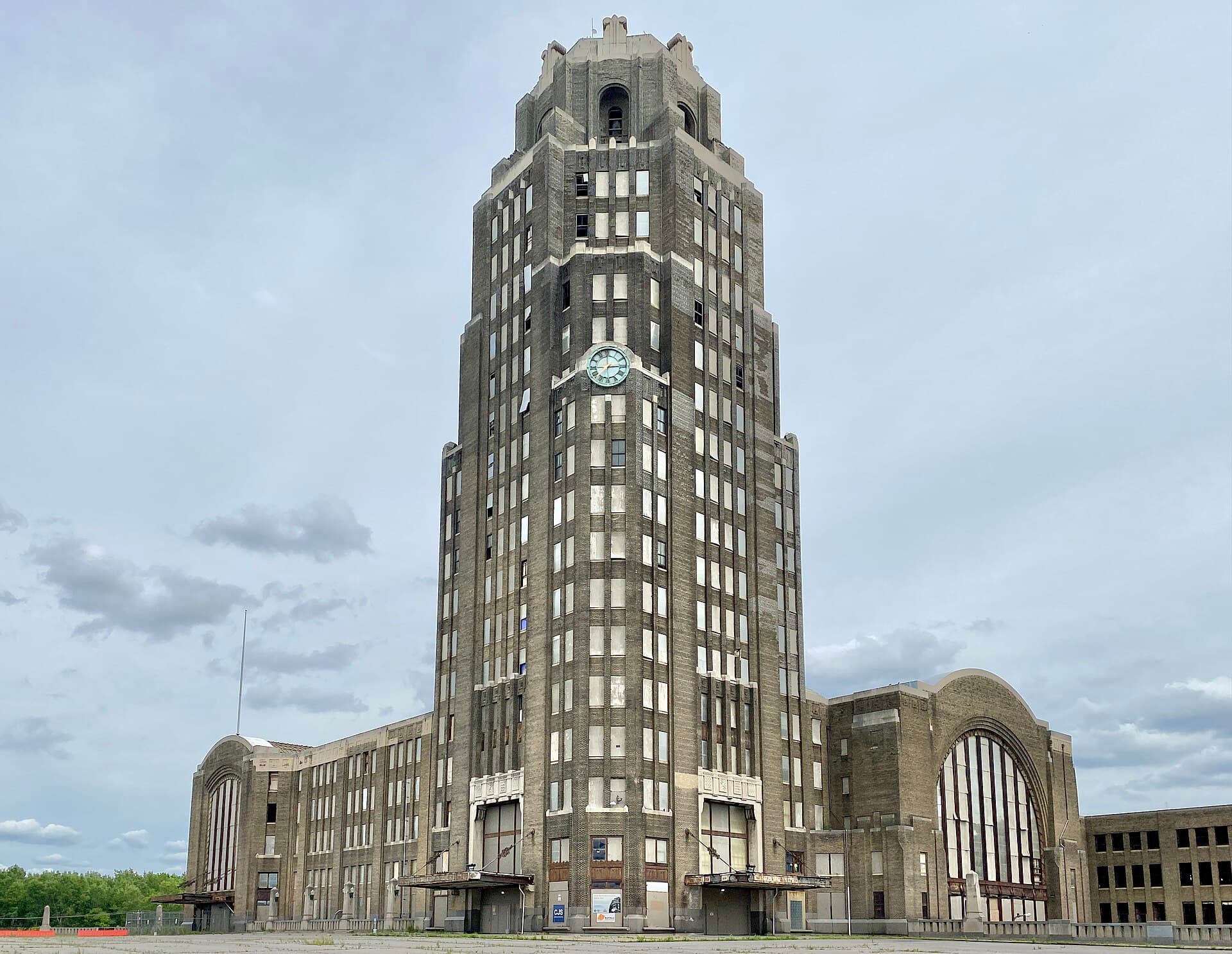
Buffalo’s great railway tower still rises above a station that has not served passengers since 1979.
Buffalo Central Terminal is a historic rail complex in the Broadway-Fillmore neighborhood of Buffalo, New York. It opened in 1929 and is now undergoing a long process of preservation and reuse. Its interior is currently closed for critical repairs, while outdoor activities and interpretation continue.
That last point matters if you are planning a visit. Older photographs of indoor events and tours show real uses, but they do not establish present access.
Buffalo Central Terminal was built for big numbers
The terminal opened at a moment when a monumental station could express a city’s confidence in its future. Its scale extended well beyond the tower visible in most photographs.
The official history describes a facility designed to accommodate more than 200 trains and 10,000 passengers a day. Those are design figures, not a claim that the station consistently reached that traffic. Terminal history and restoration timeline
Look at the exterior and the ambition is clear. Vertical lines draw the eye toward the clock, while broad arched ends mark the large spaces below. The tower gives the complex a recognizable silhouette even from a distance.
The last train did not end every problem
Passenger service ended on October 28, 1979, with Amtrak using other Buffalo-area stations. The terminal’s former connection to its train concourse was removed in 1981, allowing taller freight equipment to pass.
The complex entered the National Register of Historic Places in 1984. In 1997, the nonprofit Central Terminal Restoration Corporation acquired the main terminal property and began the sustained effort to protect it. Official historical timeline
These dates describe several different kinds of change: the end of passenger use, physical alteration, recognition, and new stewardship. Combining them into a single “abandoned in 1979” caption misses much of the story.
A historic designation can recognize importance, but it cannot repair a roof by itself. Ownership and a workable restoration program are separate parts of survival.
A photograph from the station’s working years
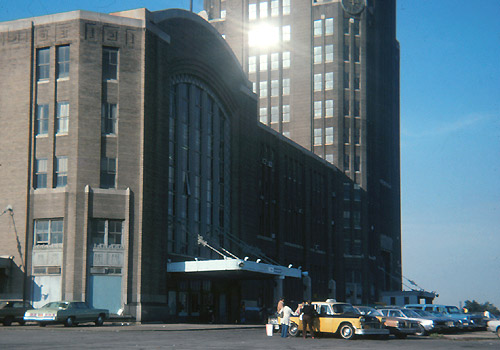
The supporting photograph shows the terminal entrance in August 1976, three years before the last passenger service. Cars near the entrance offer a simple reminder that the place once belonged to ordinary journeys.
The featured image, taken in 2022, shows the tower and concourse exterior decades later. Together, the photographs make the passage of time visible without inventing the experience of a particular traveler.
The comparison also encourages a closer look. The building’s large-scale geometry survives, while small details of use change around it. A recognizable exterior does not mean the interior is ready for unrestricted occupation.
A future shaped with the neighborhood
The terminal’s master plan emerged from a year-long collaborative process. It proposes phased reuse, with public gathering and event spaces helping bring activity back before later parts of the complex are developed. Community master plan
The plan treats the site as part of Broadway-Fillmore, rather than simply a striking object for visitors to photograph. That emphasis matters because a building this large affects its surroundings whether it is active or vacant.
Current development information lists possible uses including housing, food-related activity, workspaces, retail, and community services. These are elements of a redevelopment program, not a list of businesses already open inside. Development and construction information
The challenge is to find uses that can support the building while preserving features that make it distinctive. A restored clock or repaired wall is visible progress, but long-term survival also depends on what happens there each week.
What visitors can do now
The operator’s current FAQ states that the interior is closed during critical repairs. Do not expect to arrive for an unscheduled indoor tour.
Outdoor programming on the Great Lawn provides another way to experience the site when events are offered. Check the event calendar and access notices rather than assuming an older annual schedule still applies. Current access FAQ
The terminal also offers outdoor audio interpretation. This can help connect the large exterior spaces with their history while interior work continues. Official terminal website
Remain in permitted areas and respect work zones and rail property. An unobstructed view of a building is not an invitation to cross into its closed spaces.
A rewarding visit can begin with the tower, then widen to the neighborhood around it. The terminal’s future depends on that wider view: how a former transportation landmark can become useful again to the people who live nearby.
Its next chapter is still being built. That makes honest descriptions of what is open, what is planned, and what remains unfinished more interesting than declaring either total abandonment or a completed comeback.
Frequently asked questions
Can you tour the interior of Buffalo Central Terminal?
The operator currently says the interior is closed for critical repairs. Check its official notices before planning any indoor visit.
When did passenger trains stop using the terminal?
The final passenger service departed on October 28, 1979. Buffalo-area rail travel continued through other stations.
Is the terminal being demolished?
The main terminal is the focus of preservation and reuse work. Consult the operator for specific construction projects across the wider campus.
Are the proposed shops and housing already open?
The development program describes planned uses. Do not treat those proposals as completed visitor amenities.
Image credits
Featured image: w_lemay, CC BY-SA 2.0.

Body image: Hikki Nagasaki, Public domain.
