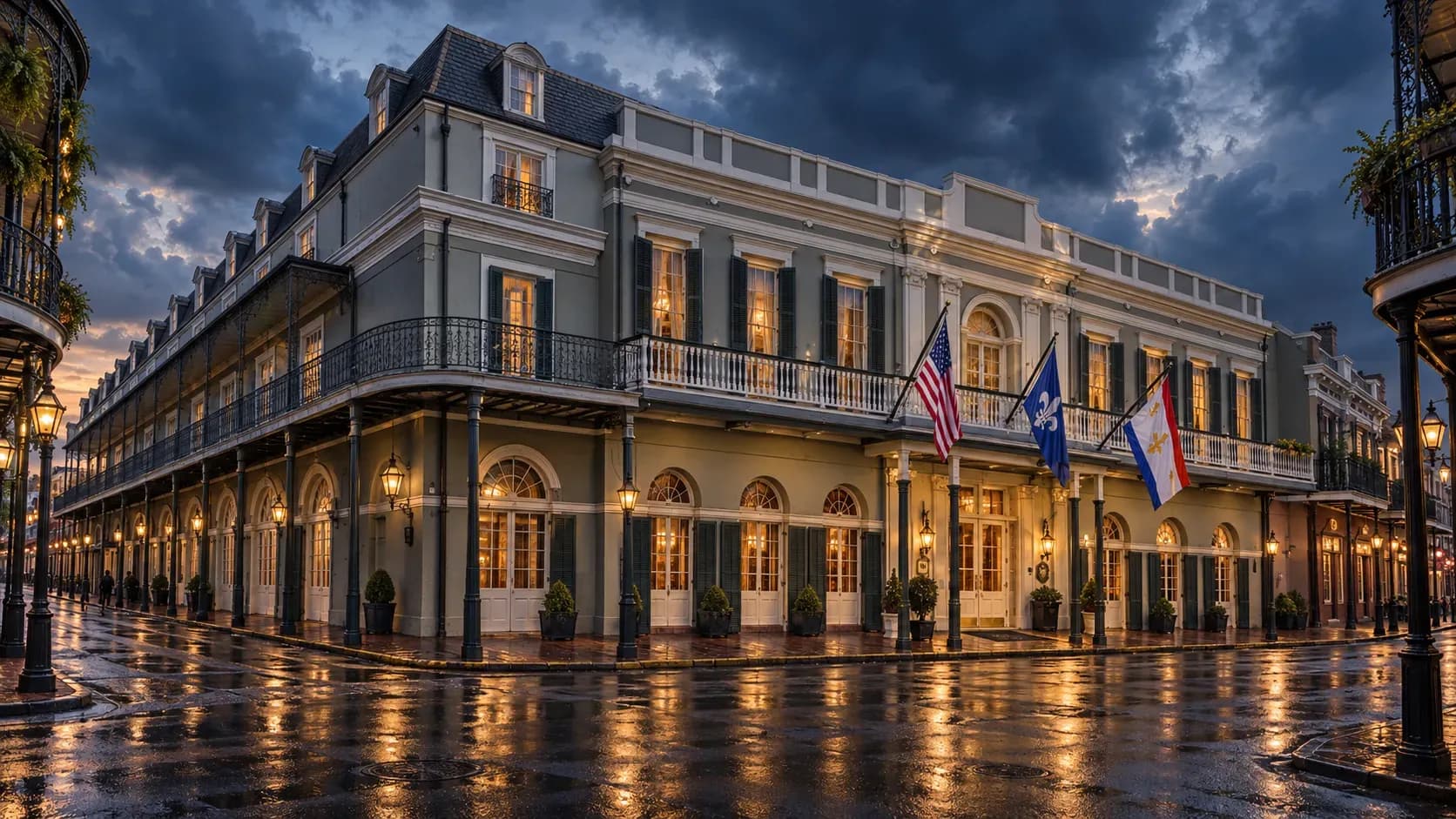
The Bourbon Orleans Hotel hides more than two centuries of history behind its elegant French Quarter facade.
At 717 Orleans Street, the hotel stands between the noise of Bourbon Street and the galleries of Royal Street. Guests sleep near a preserved ballroom once connected to a major theater, a former convent, and a school for Black girls.
Its legends include a ghostly dancer, a wounded soldier, spectral children, and a watchful nun. Yet the real history is more complicated than the haunted-hotel stories suggest. It includes destructive fires, elite Creole entertainment, racial barriers, religious service, historic preservation, and a modern hotel built partly over an orphanage site.
So, is the Bourbon Orleans Hotel really haunted? The records confirm an extraordinary past. The ghosts remain a matter of personal experience and folklore.
Why Is the Bourbon Orleans Hotel Famous?
The Bourbon Orleans Hotel is famous for three reasons: its French Quarter location, its historic Orleans Ballroom, and its paranormal reputation.
The hotel sits behind Jackson Square, close to St. Louis Cathedral and Bourbon Street. Its balconies, courtyard, decorative ironwork, and grand interiors give it the appearance visitors expect from old New Orleans.
Ghost tourism expanded its fame beyond the city. The hotel openly shares stories about a Confederate soldier, children in the corridors, female apparitions, and a dancer beneath the ballroom chandelier. The New Orleans tourism board now lists it among the French Quarter’s best-known haunted hotels.
Unlike an abandoned asylum or ruined prison, this haunted destination remains a working upscale hotel. Visitors can spend the night, attend an event, or listen for unexplained footsteps without giving up modern comforts.
The Story Behind the Legend
From Theater District to Grand Ballroom
The story begins before the current hotel existed. Construction on the original Théâtre d’Orléans started in 1806. War delayed its opening until 1815, and a fire destroyed it the following year.
Entrepreneur John Davis purchased the property in 1817 and began rebuilding. The new theater and adjoining Orleans Ballroom became important gathering places for Creole society. Operas, masquerades, carnival celebrations, and formal balls filled the complex.
Some histories connect the ballroom with the city’s so-called quadroon balls. These events involved free women of color and wealthy white men within New Orleans’ unequal racial system. Popular retellings often romanticize those relationships, overlooking the limited choices and power imbalances women faced.
Another major fire destroyed the theater in 1866. The ballroom survived, leaving part of the entertainment complex standing while the surrounding property entered a new chapter.
A Convent, School, and Orphanage
On September 14, 1881, the Sisters of the Holy Family purchased the former ballroom property for $21,000. The sale even excluded five central gas chandeliers, according to research from the Orleans Parish Civil District Court Notarial Archives.
The Sisters transformed the property into their motherhouse and moved St. Mary’s Academy there. Founded by Henriette DeLille and other free women of color, the religious order served Black residents during slavery and segregation.

St. Mary’s Academy gave Black girls access to education when many institutions excluded them. The Sisters later established St. John Berchmans Asylum for Girls on adjoining land. The hotel’s present courtyard and pool occupy part of the former orphanage area.
This history matters because paranormal accounts often reduce the Sisters and children to unnamed ghosts. They were members of a real community with an important role in New Orleans. The history of St. Mary’s Academy continues well beyond its years on Orleans Street.
The Birth of the Bourbon Orleans Hotel
The Sisters sold the property to the Bourbon Kings Hotel Corporation in 1964. Developers planned a new hotel while preservationists pushed to protect the surviving ballroom.
City approval required the project to restore the historic space. The resulting development preserved the ballroom building but constructed much of the hotel on the former asylum site. This distinction is important. The property’s history reaches into the early 1800s, but the entire guest-room complex is not an untouched 1817 structure.
The Bourbon Orleans Hotel officially opened on July 18, 1966. Mayor Victor H. Schiro participated in the ceremony, and a priest from nearby St. Louis Cathedral blessed the hotel. DiamondRock Hospitality Company acquired the property in 2021.
Why People Think It Is Haunted
The best-known legend centers on a lone dancer in the Orleans Ballroom. Witnesses reportedly see her moving beneath the chandelier before she disappears. Other accounts describe rustling curtains or the sense that someone is hiding behind the draperies.

Guests and employees have also reported children’s footsteps, a little girl rolling a ball, and female figures dressed like nuns. Storytellers often connect them to the school, convent, and orphanage years.
A third legend concerns a Confederate soldier called “The Man.” He reportedly appears on the third and sixth floors, sometimes wearing a uniform. Online stories also identify Room 644 as unusually active, although the hotel’s published historical account does not verify the dramatic death stories attached to that room.
These are recurring witness stories, not confirmed supernatural events. Public accounts rarely provide names, exact dates, photographs, or records connecting an apparition to a specific person.
The setting also offers ordinary explanations. Old buildings produce unfamiliar sounds, while elevators, plumbing, neighboring rooms, street noise, and expectation can shape what guests notice. Sleep paralysis may explain some nighttime sensations. None of this proves every report false, but it keeps the evidence in perspective.
Can You Visit the Bourbon Orleans Hotel Today?
Yes. The Bourbon Orleans is an operating hotel at 717 Orleans Street in New Orleans. Visitors can reserve standard rooms, balcony rooms, and suites. The property also has dining, live music, a fitness center, and a courtyard pool.
The historic ballroom functions mainly as an event venue, so access may depend on the hotel’s schedule. Do not assume that booking a room includes unrestricted access to private event spaces.
The hotel currently promotes a haunted-history experience connected with a local tour provider. Tour arrangements, room rates, parking fees, and packages can change. Check the hotel’s official visitor information before traveling.
Guests must be at least 21 to check in. Accessible rooms are available. Travelers sensitive to noise should also consider that rooms facing Bourbon Street may hear nightlife, especially during busy weekends and festivals.
Is the Bourbon Orleans Hotel Worth Visiting?
Yes, especially for travelers who want history and ghost lore in the same location. The ballroom and the Sisters of the Holy Family story give the property more substance than a typical haunted-hotel attraction.
Paranormal enthusiasts can spend the night where sightings are still reported. History lovers can explore a site that shifted from entertainment to education, charity, and hospitality. Casual visitors gain an excellent French Quarter location, although quiet sleepers should choose their room carefully.
The hotel is creepiest when its polished appearance clashes with its stories. You may not meet the ballroom dancer, but the documented past is powerful enough without her.
Frequently Asked Questions
Is the Bourbon Orleans Hotel really haunted?
The hotel has a strong paranormal reputation and many reported experiences. No publicly available evidence scientifically confirms that ghosts cause them.
What ghosts are reported at the hotel?
Stories describe a ballroom dancer, a Confederate soldier, children, and women believed to resemble nuns from the property’s convent era.
Was the Bourbon Orleans always a hotel?
No. The site included a theater and ballroom, followed by a convent, school, and orphanage. The present hotel opened in 1966.
Can nonguests enter the Orleans Ballroom?
The ballroom is an event venue, not a permanently open museum. Contact the hotel before visiting if seeing the room is important.
Did children die at the orphanage?
Children lived under the Sisters’ care, but widely repeated mass-death stories are not supported by the property records reviewed for this article.