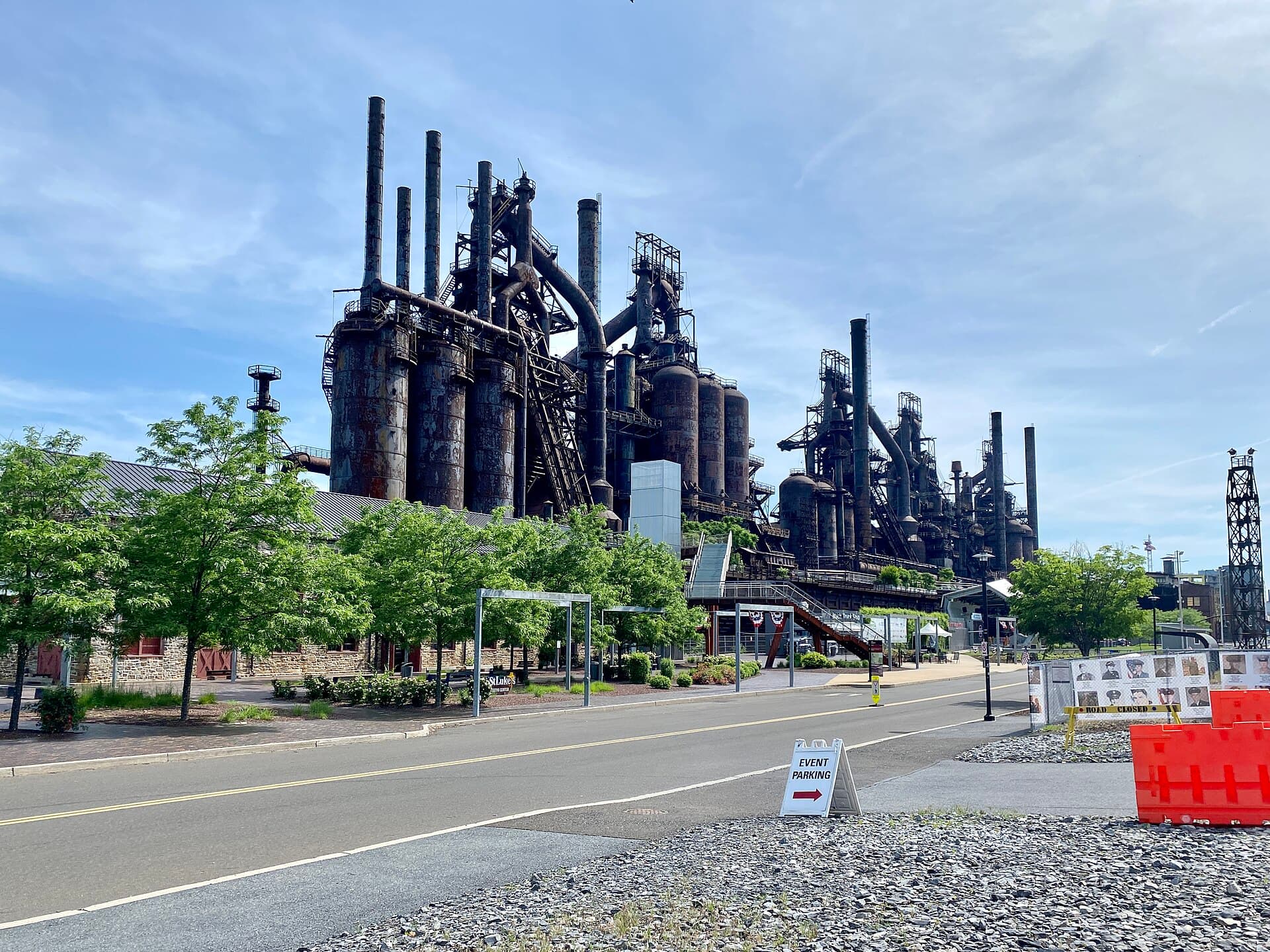
The furnaces no longer glow, but crowds still gather beneath Bethlehem’s most powerful skyline.
The Bethlehem Steel plant in Pennsylvania stopped making steel in 1995. Today, part of the former industrial property is SteelStacks, an active arts and cultural campus. Five preserved blast furnaces stand above concerts, public spaces and an elevated walkway.
This is a place where the word “abandoned” tells only one chapter. Visitors can experience a carefully reused portion of the site, while other buildings and parcels have separate owners, conditions and access rules.
What the Bethlehem Steel plant produced
The South Bethlehem works formed part of an enormous integrated manufacturing operation. Ore, fuel, furnaces, rail lines and workshops supported one another. The Historic American Engineering Record describes a plant that produced structural steel, naval equipment, forgings and specialized products. Library of Congress engineering history
That range makes the surviving skyline more meaningful. The furnaces were one stage in a much larger chain of work, not five isolated monuments.
Blast furnaces made iron from ore with coke and limestone. Other departments turned that material into steel and finished products. Knowing the difference helps visitors read the site: a furnace and a rolling mill had different jobs, even when both belonged to the same company.
The company’s products traveled far beyond the Lehigh Valley. ArtsQuest connects Bethlehem steel with bridges, skyscrapers and naval ships, including the Golden Gate Bridge and Chrysler Building. The familiar structures make an otherwise distant industrial process easier to picture. ArtsQuest’s SteelStacks history
Reading a landscape built for work
The preserved complex looks complicated because it was. Pipes, towers, stairs and platforms connected places where workers controlled heat, air and raw materials.
From ground level, the structures can seem like one wall of metal. A closer view reveals layers: heavy vessels, narrow walkways and repeated columns, each shaped around a practical task.
The photographs here were taken in 2022. They show the site during its cultural-campus era, rather than an untouched factory immediately after closure.
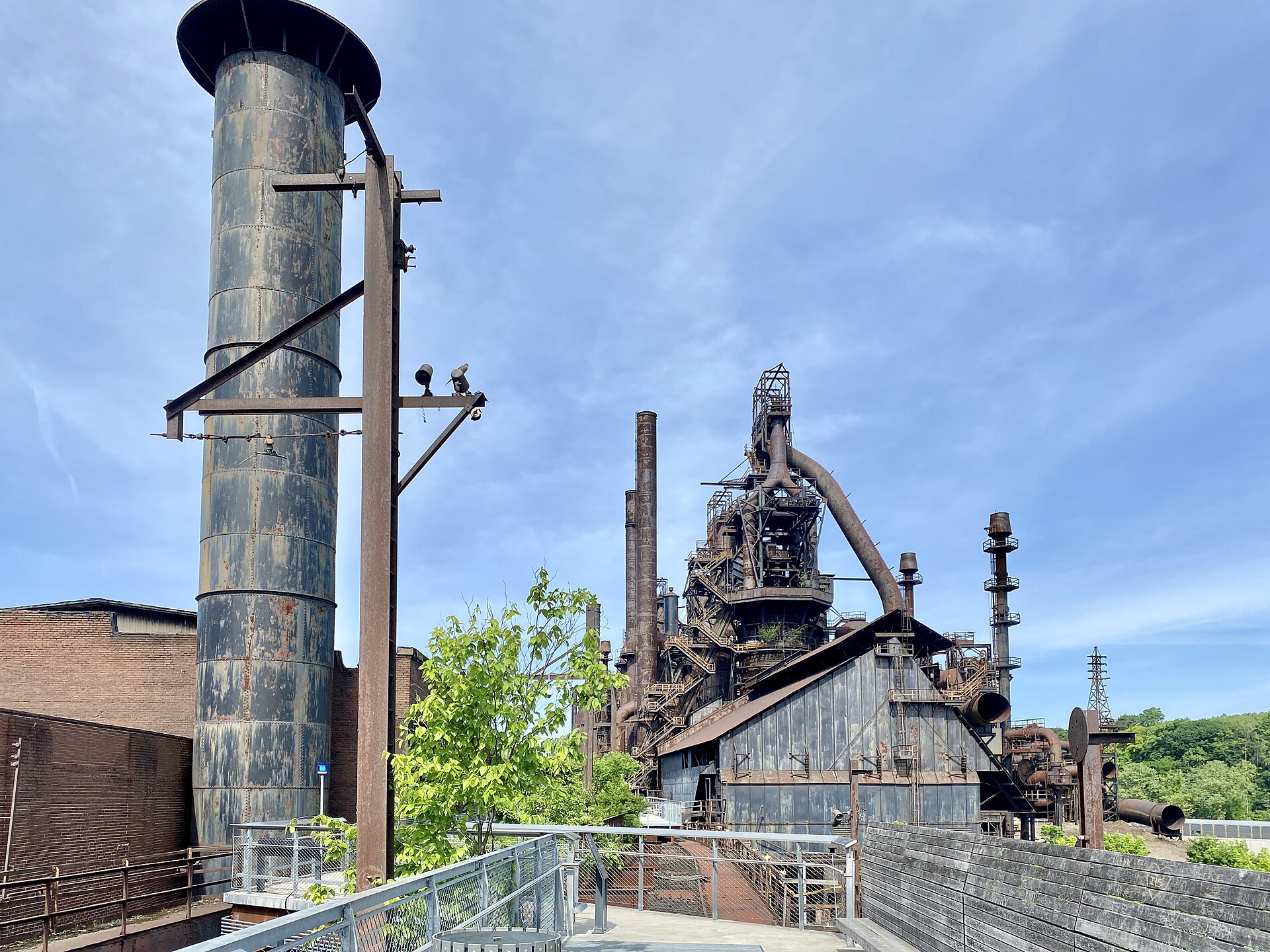
Industrial photographs often leave out the scale of human effort. Even a huge furnace depended on people who inspected equipment, handled materials, maintained machinery and understood small changes in a dangerous process.
When production fell silent
Steelmaking ended in 1995, after a long period of industry restructuring and financial pressure. The closure date for steel production should not be confused with the later end of every activity on the sprawling property.
Bethlehem’s redevelopment authority records that a preservation and reuse initiative was already being organized in 1996, before the plant’s final closure in 1997. That overlap matters: planning for a different future began while the industrial ending was still unfolding. Bethlehem Redevelopment Authority history
The challenge extended beyond empty buildings. A major employer had helped shape the city’s identity. Finding a new use for the land also meant deciding what the city wanted to remember.
The unlikely sound of a new beginning
SteelStacks opened in 2011. ArtsQuest’s contemporary annual report describes the launch of the ArtsQuest Center and the return of public activity to a place once defined by manufacturing. ArtsQuest 2011 report
The furnaces became the backdrop to performances rather than obstacles to be hidden. New construction and older industrial structures were allowed to share the same view.
The National Endowment for the Arts examined this transformation as an example of culture helping a community reuse difficult industrial land. Its account emphasizes the choice to engage with the plant’s history rather than erase it. National Endowment for the Arts
That approach gives a concert here an unusual setting. The audience gathers beneath machinery built for an entirely different kind of noise.
Walking the former material route
The Hoover-Mason Trestle offers another way to understand the site. It once carried raw materials toward the furnaces. Its reuse introduced a pedestrian promenade alongside the industrial remains.
Engineering firm SGH describes the project as a roughly half-mile elevated route that brings visitors close to structures difficult to understand from below. Hoover-Mason Trestle project
This is a designed public route, not permission to enter nearby factory buildings. Barriers and designated paths separate visitor areas from preserved equipment and restricted spaces.
Check current walkway information and weather-related closures before traveling. A scheduled performance and an outdoor historical walk may have different access arrangements.
Planning a visit
Start with ArtsQuest’s current SteelStacks calendar and the regional tourism office’s Hoover-Mason Trestle information. Choose an event, a daytime walk or both.
Allow time to look slowly. Follow a pipe with your eyes, notice how rails approach the furnaces, and compare the height of a person with the equipment overhead.
The reward is not discovering a secret ruin. It is seeing how a city kept a difficult, important part of its past visible while making room for people again.
Frequently asked questions
Is Bethlehem Steel still operating here?
No steel is produced at the former Bethlehem plant. Steelmaking ended in 1995.
Is SteelStacks abandoned?
No. It is an active arts and cultural destination on part of the former industrial property.
Can you enter the blast furnaces?
Ordinary visitor access is limited to designated public areas and authorized programs, not unrestricted entry into equipment.
What is the Hoover-Mason Trestle?
It is a former industrial material route adapted into an elevated public walkway beside the preserved furnaces.
Image credits
Featured image: w_lemay / Wikimedia Commons, CC BY-SA 2.0. Bethlehem Steel’s preserved blast furnaces and public campus in May 2022.

Body image: w_lemay / Wikimedia Commons, CC BY-SA 2.0.
