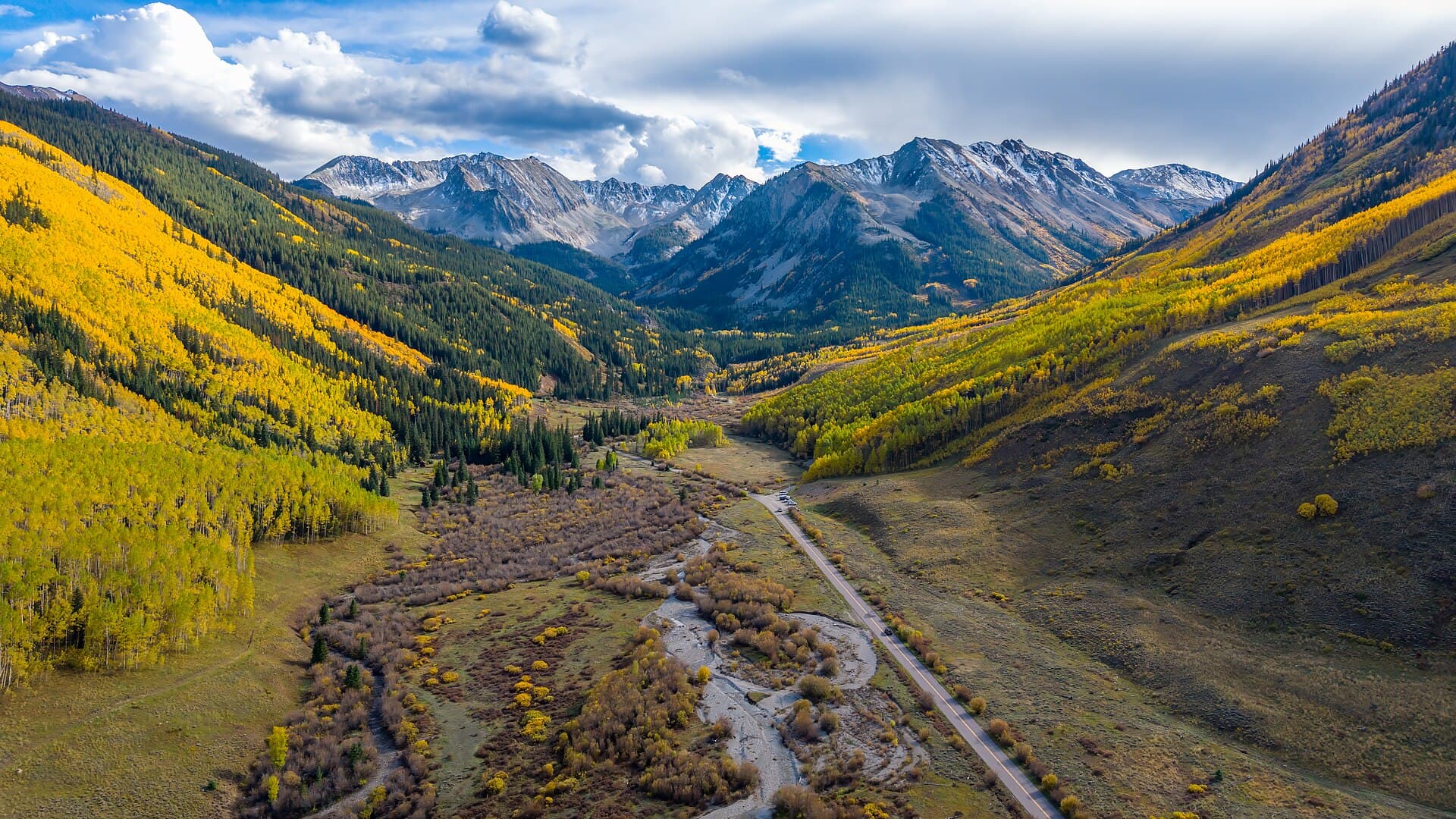
Aspen became famous, while nearby Ashcroft kept the quieter remains of a silver dream that did not last.
Ashcroft ghost town lies in Colorado’s Castle Creek Valley, about eleven miles up Castle Creek Road from the roundabout at Aspen’s western entrance. It grew during the silver boom around 1880 and declined as its mines disappointed and activity shifted elsewhere.
Today, Aspen Historical Society manages the townsite under a U.S. Forest Service permit. Restored and relocated buildings, trails, and interpretation make it a place to study, not simply an abandoned collection of cabins.
Before the prospectors arrived
The Castle Creek Valley was part of the ancestral landscape used by Ute people. Its history did not begin with the arrival of miners.
Aspen Historical Society’s account places the mining boom alongside the displacement and forced removal of Ute people during the same period.
That context changes the usual story of a town appearing in an empty wilderness. The landscape already had meaning and use before prospectors claimed mineral opportunities.
A responsible history can hold both realities together: the ambitions of the mining settlement and the losses imposed on people who were already connected to the region.
The peaceful setting today should not flatten that complicated beginning into a simple tale of discovery.
A promising start in the silver country
Prospectors Charles Culver and W. F. Coxhead helped establish the camp that became Ashcroft after silver was found in the upper valley in 1880.
The settlement was initially known as Castle Forks City. People laid out streets and organized the beginnings of civic life while expectations were still high.
A mining town needed more than ore. Merchants and service providers created a place where prospectors could obtain supplies and continue working.
The historical newspaper survey of Colorado records Ashcroft’s early civic and commercial growth. Its account helps show that even a short-lived boom could generate the institutions of a substantial community.
That is part of Ashcroft’s appeal. The remaining structures hint at how quickly people could move from a rough camp to the idea of a permanent town.
Why Aspen survived and Ashcroft struggled
The local ore deposits did not support the lasting prosperity boosters had expected. As mining weakened, people and activity moved toward Aspen.
The Society of Architectural Historians’ Ashcroft history also highlights transport. A railroad reached Aspen in 1887, strengthening its position as the area’s main smelter town.
That connection mattered because extracting ore was only part of the business. Material still needed processing and transport at a cost that allowed the operation to survive.
Ashcroft’s story therefore involves both geology and infrastructure. A promising deposit could attract a settlement, but the settlement still needed a workable long-term place in the regional economy.
The two towns’ different futures make a memorable comparison. One became a famous destination, while the other became a place where the earlier mining era remained more visible.
The valley had other lives after mining
Ashcroft’s history did not end when the original boom faded. Later decades brought new ideas about recreation and the use of the valley.
The historical society records a 1930s ski-development effort and wartime training by soldiers of the 10th Mountain Division nearby. Stuart Mace later established Toklat Lodge across the road and helped care for the area.
These later chapters complicate the idea of a ghost town frozen at the instant its miners departed. People kept finding reasons to use and protect the landscape.
The National Register nomination documents its historical significance, while the preservation visible today reflects choices made well after the mining period.
Recognizing those choices makes the site more interesting. The buildings survive because later people considered them worth keeping.
Reading the cabins as evidence
A visit rewards attention to the structures themselves: their size, construction, and placement in the meadow.
Some buildings have been restored or relocated. The historical society identifies that openly, which helps visitors avoid assuming every structure remains exactly where and how miners left it.
The archival study “The Skeletal Shell Game” examines how preservation shaped the way Ashcroft’s history is presented.
Its broader lesson is useful at any historic site. A preserved place is also an interpretation. Decisions about which buildings to save and which period to emphasize influence what later visitors understand.
Read signs alongside the physical evidence. Empty spaces, foundations, and modest structures can reveal as much as the most photogenic cabin.
Planning a visit to Ashcroft ghost town
Use Aspen Historical Society’s current page for admission and docent arrangements. As checked on November 2, 2026, it lists $5 adult admission, with an honor-system option when a docent is absent.
Dogs are not permitted in the ghost town. Follow marked routes and any restrictions on entering buildings.
The Aspen Chamber’s Castle Creek guide places Ashcroft within the broader valley landscape. Check seasonal road and weather conditions rather than assuming a description of fall scenery applies year-round.
Bring layers and allow time for a quiet walk. Avoid treating private or neighboring facilities as part of the historic site without checking their access rules.
Ashcroft is compelling because the valley’s beauty and the town’s failed promise remain visible together. The cabins do not need an invented haunting. The documented lives and changing ambitions of the place already give them depth.
Frequently asked questions
How far is Ashcroft from Aspen?
The historical society places it eleven miles up Castle Creek Road from the roundabout at Aspen’s west entrance.
Why was Ashcroft abandoned?
Its mining prospects weakened, and economic activity shifted toward Aspen. The population declined over time.
Who manages Ashcroft ghost town?
Aspen Historical Society operates and preserves the site under a U.S. Forest Service permit.
Can dogs visit the ghost town?
No. The historical society’s current visitor rules prohibit dogs in the townsite.
Featured photograph: RON RAFFETY. Original image and details. CC BY-SA 4.0. Photograph predates this article; it is not a real-time view.
