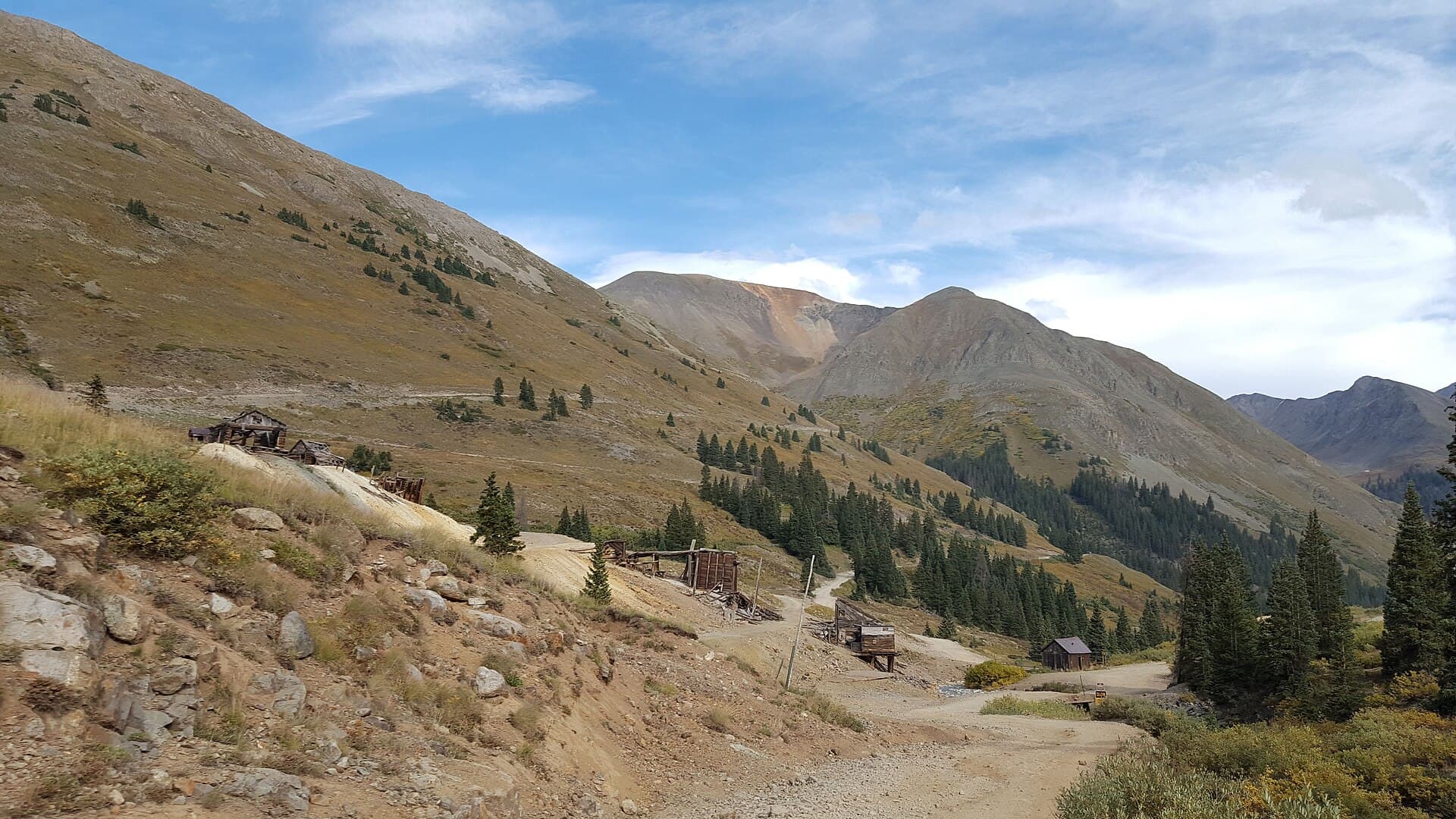
At Animas Forks, the empty houses stand more than two miles above sea level.
Animas Forks is a former mining town in Colorado’s San Juan Mountains, northeast of Silverton. Established in the 1870s, it grew around mining and milling, then faded as investment and production weakened. By the 1920s, it was a ghost town.
Its surviving buildings sit along the Alpine Loop road system. The setting is spectacular, but access depends on seasonal conditions, and the historic site should not be treated as an all-weather roadside stop.
Building a town at 11,200 feet
The Bureau of Land Management’s history dates the first log cabin to 1873. By 1876, the settlement had cabins, a hotel, a store, a saloon, and a post office.
At roughly 11,200 feet, ordinary daily tasks took place in an unusually demanding environment. A town here needed more than mineral promise. It needed enough confidence to keep people building, supplying businesses, and returning after difficult seasons.
The broad mountain setting makes the buildings look small. That visual contrast helps explain why Animas Forks stays in the memory: domestic structures stand against a landscape that never became easy to inhabit.
The mines brought both work and speculation
Mining and ore processing supported the town’s growth, but optimism sometimes ran ahead of results.
A 1901 U.S. Geological Survey report describes unsuccessful mills and speculative development in the district. Its account is a reminder that a busy mining settlement was not necessarily a profitable one.
Building a mill could signal confidence without proving that nearby ore would support it. Investment, geology, and processing methods all had to work together.
Visitors see the result with hindsight. The people who built here were choosing between uncertain possibilities, often before they could know whether an investment would pay.
A newspaper in the high mountains
Animas Forks supported a newspaper, the Animas Forks Pioneer, from 1882 to 1886.
The Colorado newspaper history survey records its publication dates and identifies George N. Raymond as publisher and editor.
That small detail changes the town’s image. A newspaper suggests a community interested in business, information, local affairs, and its place in a wider world.
Imagine the contrast without inventing a scene: printed news circulating among buildings surrounded by high mountain terrain. The publication is evidence that residents regarded this as a functioning town, not simply a temporary camp.
Its short run also fits the larger pattern. Institutions appeared while the settlement had momentum, then struggled as that momentum weakened.
Winters tested the settlement
BLM records that residents commonly moved down to Silverton for winter. It also recounts an 1884 blizzard lasting 23 days, with snow so deep that people dug routes between buildings.
That account should be attributed rather than turned into an embellished survival story. The documented conditions are striking enough.
Seasonal movement shows how residents adapted to the place. Leaving during the hardest months was part of living in a mountain economy.
For modern visitors, it also provides a useful lesson. Historic houses and a marked road do not make the mountains forgiving.
The town’s setting has not lost its power to complicate travel simply because the mines have closed.
The Gold Prince Mill offered a final hope
The construction of the Gold Prince Mill in 1904 briefly renewed activity. It closed in 1910, and much of its machinery was later moved to Eureka.
An Environmental Protection Agency regional mining-history report places that closure within Animas Forks’ early-twentieth-century decline.
The equipment’s removal is an especially telling detail. Machinery had value even when the town could no longer support its original use.
A ghost town is therefore not always a place where everything was simply left behind. Some of its most useful parts traveled elsewhere.
What remains can be as much a record of removal as abandonment. Foundations and empty spaces help tell that story alongside the buildings still standing.
Preservation made today’s visit possible
Animas Forks has benefited from organized stabilization rather than surviving entirely without intervention.
The San Juan County Historical Society’s 1997 newsletter records grant-supported work with BLM. Later, Mountain Studies Institute documented another stabilization project completed in 2014.
That continuing care matters in a place exposed to severe winters. Roofs and walls require attention if the public is to keep learning from them.
Respect closures and structural limits. Do not climb on buildings or remove objects, even when an item appears small or ordinary.
The survival of the town depends on many such decisions, including the choices made by each visitor.
Reaching Animas Forks responsibly
Check current road conditions with local land managers before leaving Silverton. BLM describes a summer approach from Silverton, but that description is not a guarantee of conditions on a particular day.
Do not assume the entire Alpine Loop is suitable for the same vehicle. Routes over the higher passes can demand different equipment and experience.
Carry water, warm layers, and a plan for changing weather. Allow enough time to turn back rather than pressing on because the destination looks close on a map.
Animas Forks rewards an unhurried visit. Its strongest story is the effort required to place a community here, and the equally deliberate work now required to keep its remains standing.
Frequently asked questions
How high is Animas Forks?
BLM lists its elevation at approximately 11,200 feet above sea level.
Why was Animas Forks abandoned?
Mining and milling became less profitable, major facilities closed, and the town lost its economic purpose.
Can any car reach Animas Forks?
Do not assume so. Suitability depends on the approach, weather, road condition, and vehicle. Check current local guidance.
Is Animas Forks a winter road-trip stop?
It should not be planned as a routine winter drive. High-elevation snow and seasonal road conditions govern access.
Featured photograph: D&RG Railfan. Original image and details. CC BY 3.0. Photograph predates this article; it is not a real-time view.
