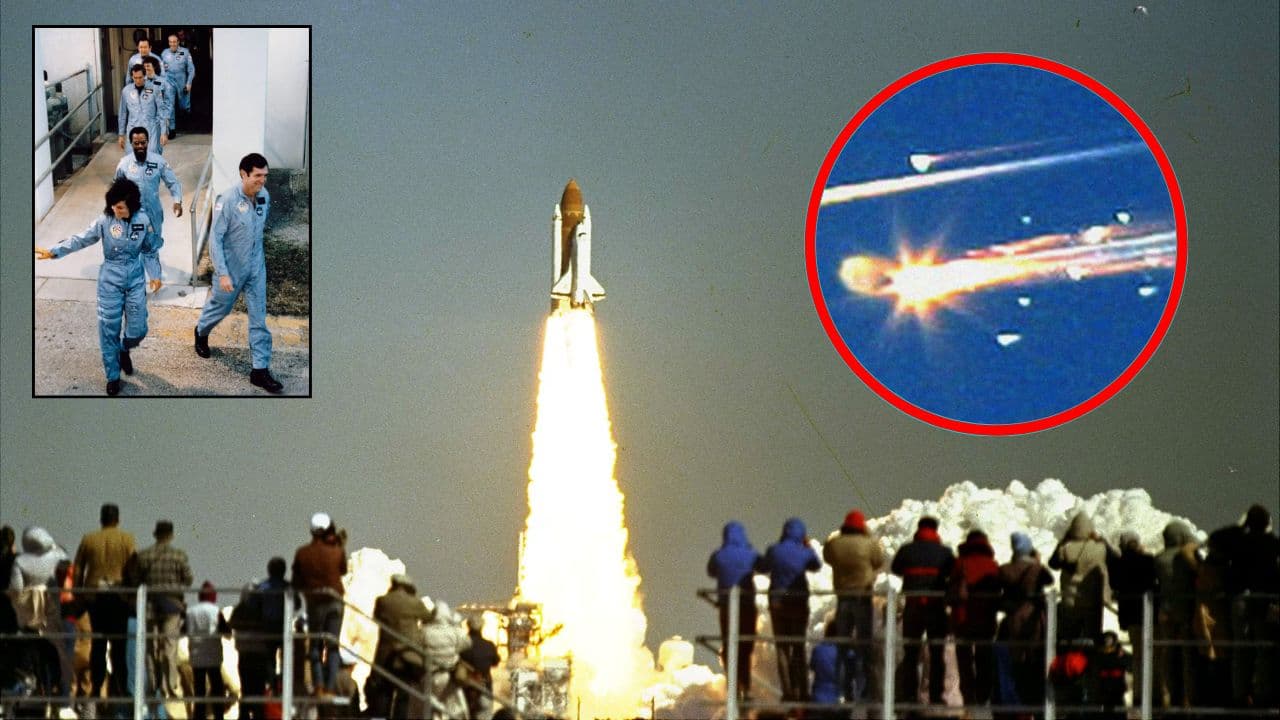
Forty years ago today, the world watched in disbelief as NASA’s space shuttle Challenger broke apart in the sky over Florida. The explosion happened just 73 seconds after liftoff from Kennedy Space Center on January 28, 1986. All seven crew members on board were killed.
The disaster struck during what many saw as the height of America’s space shuttle program. After the Apollo moon landings ended in 1972, NASA’s reusable shuttle was meant to make spaceflight routine. When the first shuttle flew in 1981, it reignited public excitement about human space exploration.

A Mission Meant to Inspire the Public
The Challenger launch, known as mission STS-51-L, was supposed to be a moment of celebration. It marked the 25th flight of the shuttle era and included the first Teacher in Space mission. Christa McAuliffe, a social studies teacher from New Hampshire, had been chosen from more than 11,000 applicants.
Millions of students across the United States watched live as Challenger lifted off. Instead of a lesson from orbit, they witnessed one of the most devastating moments in modern American history. The explosion was broadcast worldwide and became instantly etched into public memory.

What Caused the Challenger Explosion
After the disaster, President Ronald Reagan ordered an independent investigation. The Rogers Commission later concluded that a failure in one of Challenger’s solid rocket boosters caused the explosion. A rubber seal known as an O-ring failed to seal properly in the unusually cold Florida weather.
Hot gases escaped through the damaged seal and ignited the shuttle’s external fuel tank. This chain reaction caused Challenger to disintegrate at an altitude of about 46,000 feet. The findings are detailed in NASA’s official accident report. (NASA)
The Seven Astronauts Lost
The crew of Challenger included Commander Dick Scobee, Pilot Michael Smith, and mission specialists Ronald McNair, Ellison Onizuka, Judith Resnik, Gregory Jarvis, and Christa McAuliffe. They ranged in age from 32 to 49 and came from diverse professional backgrounds.
Their deaths were mourned across the nation. Three days later, President Reagan addressed the country, calling the astronauts “pioneers” and honoring their courage. (Reagan Library)
How the Disaster Changed NASA
The Challenger disaster exposed serious flaws in NASA’s decision-making culture. Investigators found that engineers had raised concerns about the O-rings before launch, but those warnings were not acted on. As a result, NASA grounded the shuttle fleet for nearly three years.
Flights resumed in 1988 after major design changes and safety reforms. The shuttle program would eventually complete 135 missions before ending in 2011. Yet the lessons from Challenger continued to influence spaceflight policy for decades. (New York Times)
A Legacy That Still Matters
The Challenger explosion remains one of the most pivotal events in U.S. space history. It reminded the nation that space exploration carries real risks, even during routine missions. The tragedy reshaped how NASA approaches safety, transparency, and accountability.
Forty years later, as new astronauts prepare for missions to the Moon and beyond, the legacy of Challenger endures. The seven crew members are remembered not only for how they died, but for their belief that exploration, even when dangerous, is worth pursuing.