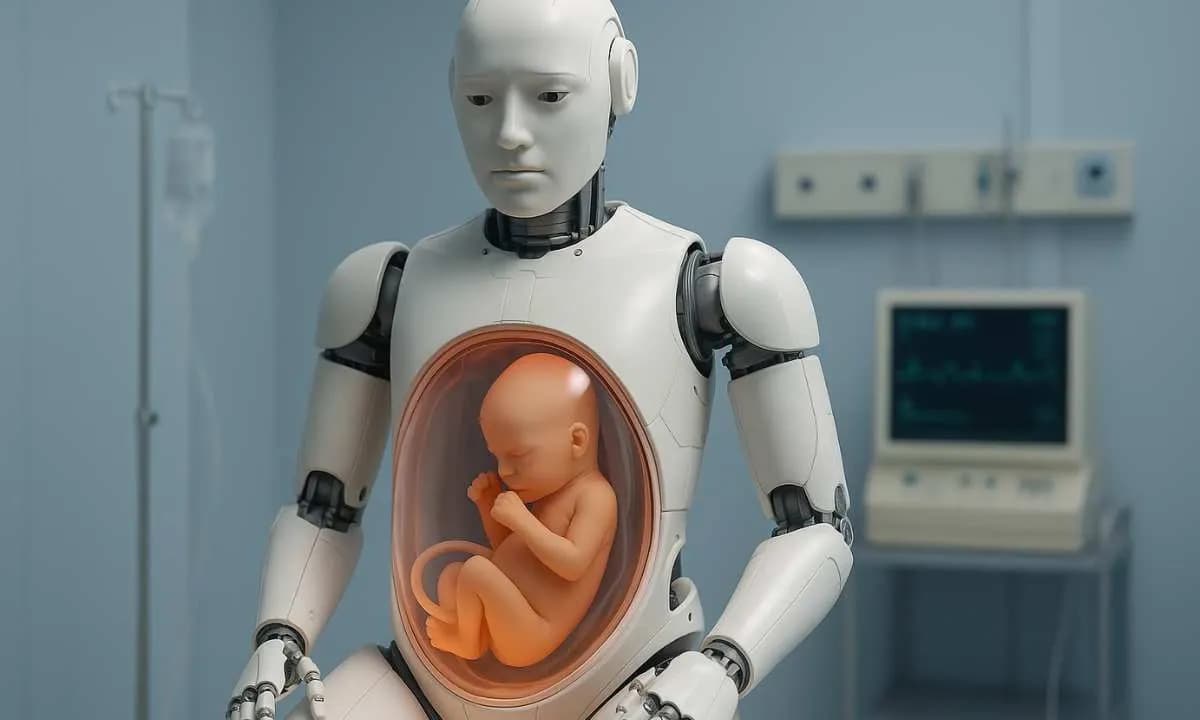
What once sounded like a science fiction plot is now being built in a lab in Guangzhou, China. A local tech company called Kaiwa Technology, led by Dr. Zhang Qifeng, has announced plans for the world’s first pregnancy robot—a humanoid machine equipped with an artificial womb. The robot is designed to carry a fetus for ten months, nourish it with nutrients through a hose that functions like an umbilical cord, and then give birth to a live baby.
Dr. Zhang, believes this could transform reproductive medicine. For couples facing infertility, the chance to have a child carried by a humanoid may sound like a miracle.
The prototype is expected to be ready within a year, with a projected price of around 100,000 yuan (about $14,000). That’s far cheaper than surrogacy, which in the United States can cost up to $200,000.
The concept is not entirely new. In 2017, researchers at the Children’s Hospital of Philadelphia created an artificial womb called a “biobag.” Inside it, a premature lamb survived for weeks, even growing wool during the process.
That experiment showed that a fetus could continue developing outside a mother’s body when placed in a fluid-filled environment that mimics the womb. Dr. Zhang’s project is pushing this idea further by combining that artificial womb technology with robotics, making the gestation process interactive and full-term rather than partial.
Inside the robot, the fetus would grow in artificial amniotic fluid while receiving nutrients through the abdomen. The system is designed to copy natural pregnancy as closely as possible. Unlike neonatal incubators, which only support babies after partial gestation, this machine aims to take over the entire process from conception to delivery.
However, one of the biggest unanswered questions is how exactly the egg and sperm will be fertilized and implanted inside the robot. Dr. Zhang has not revealed those details yet.
While the idea offers hope, it has already stirred heated ethical debates. Many people wonder what it means for parenthood if robots can carry children. Critics question whether a fetus growing in a machine can truly experience the same biological and hormonal environment it would inside a human body.
Medical experts warn that factors like maternal hormone secretion and emotional bonding are not easily replicated by technology. Some see it as a liberation for women who no longer want to face the physical burdens of pregnancy, while others fear it could lead to what one writer called “the end of women.”
Chinese authorities are taking the debate seriously. Dr. Zhang has confirmed that he has held discussion forums with policymakers in Guangdong Province and has already submitted proposals for laws and regulations. The aim is to prepare for the social, legal, and medical implications before such robots ever reach families.
The timing of this innovation is tied to a growing demographic challenge. Infertility rates in China rose from 11.9% in 2007 to 18% in 2020. At the same time, the country’s birth rate has been declining. Cities like Beijing and Shanghai have already included fertility treatments like IVF in medical insurance to help families. A machine that could safely carry pregnancies might offer another option to couples who have tried and failed with existing methods.
Public reaction in China has been intense. On Weibo, the announcement trended with thousands of comments.
“Women have finally been liberated” and “It’s good that women don’t have to suffer.”
Some users celebrated the idea, saying.
For people struggling with infertility, the news sparked emotional hope.
“I tried artificial insemination three times but failed all of them. Now I have a chance to have a baby.”
one commenter saying.
Others were more cautious, asking, “Where do the eggs come from?” and questioning whether the experience of motherhood could ever be replaced by a machine.
The discussion also goes beyond reproduction. It touches on deeper questions about identity, family, and human connection. Could children born from robots be seen differently? Would the bond between parent and child change? And if the technology is successful, who gets access to it first—wealthy families, or those most in need?
At the 2025 World Robot Conference in Beijing, Dr. Zhang presented his bold vision, describing the robot as “not just an incubator but a life-sized humanoid capable of replicating pregnancy from conception to birth.”
He insists that the technology is already “mature” and only needs integration into a humanoid system. A working prototype could appear as soon as next year, with mass production possible soon after.
For now, the pregnancy robot is still in development, and many details remain unknown. But one thing is certain: it has already captured global attention. The idea of life being nurtured inside a machine blurs the line between science and society, sparking equal measures of hope, curiosity, and unease. Whether it becomes the future of reproduction or remains a controversial experiment, this project is a glimpse into how far human innovation is willing to go to challenge the limits of nature.
Disclosure: We may earn a commission when you make a purchase through the ads.