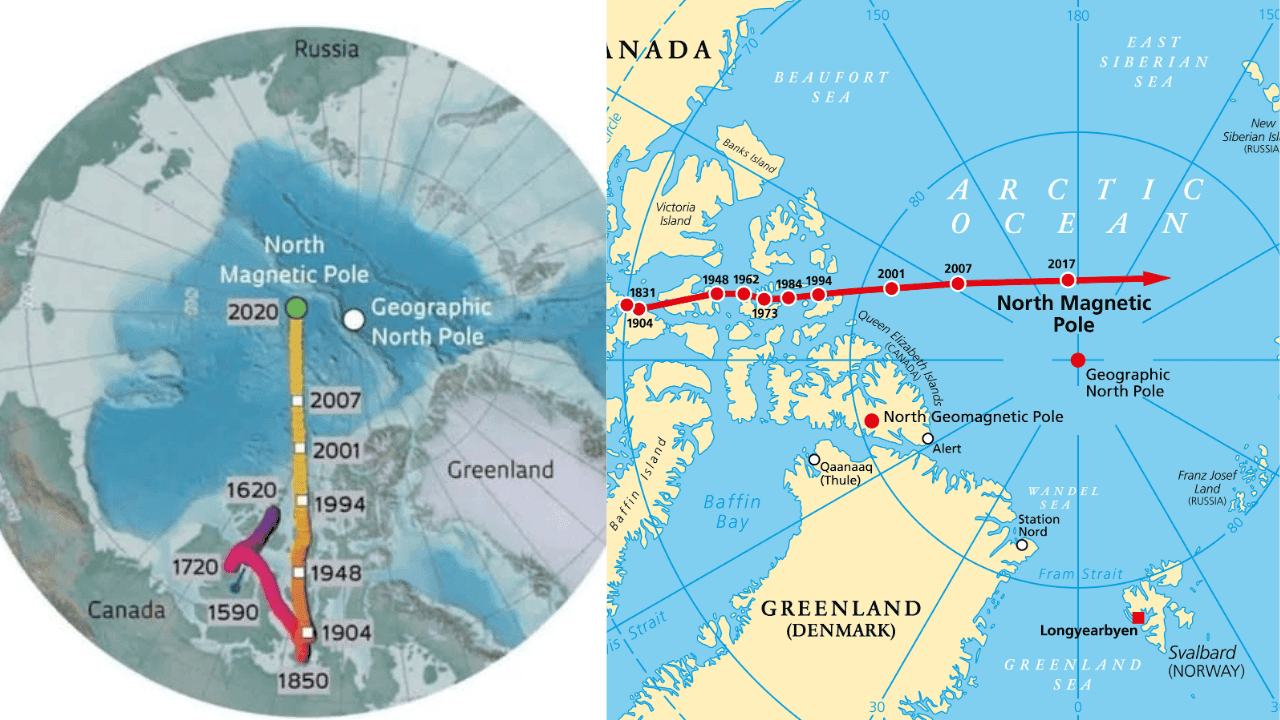
For generations, compass needles have quietly pointed towards the North Magnetic Pole, that elusive spot in the Arctic where Earth’s magnetic field behaves somewhat differently. But recently, this iconic marker has gone off-script, leaving the world baffled and increasingly concerned about its unpredictable trajectory.
As of 2025, the North Magnetic Pole, once drifting steadily from Canada towards Siberia, is now speeding along at approximately 55 kilometers (34 miles) per year. This rapid movement poses questions not only for navigation systems used in everyday life but also for wildlife that depend on the magnetic field for migration and orientation. What’s driving this sudden spurt toward Russia? Scientists have focused their research on the Earth’s molten iron core, where dynamics remain a mystery.
The pole’s movement isn’t just a minor geographical hiccup. It’s a testament to the volatile nature of Earth’s magnetic field—an aspect of our planet that constitutes a fierce shield against solar radiation, essential for life as we know it. Advances in both satellite technology and the study of ancient compass readings and volcanic rocks allow researchers to track its daily wobbles within an oval path, revealing the dynamic nature of this vital force.
Imagine living in a world where not only your compass but the very biological compass of migratory creatures suffers a directional crisis. Animals like sea turtles and salmon clandestinely read the Earth’s magnetic field to find their way home across vast oceans. Even slight shifts could throw their navigation networks into chaos, disorienting generations of migratory patterns that have survived through millennia. As these species attempt to adapt to rapidly changing landscapes, the implications could be dire.

‘This is more than just an inconvenience for navigators. This could disrupt the delicate balance of ecosystems,’ warns Dr. Thomas Zhang from NOAA. ‘The fact that animals rely on these magnetic cues means that a change in the field could impact not only populations but ecosystems as a whole.’
Scientists are quick to note that our planet has experienced geomagnetic reversals before—events when the magnetic north flips with the south. The last major reversal, the Brunhes-Matuyama transition, took place around 780,000 years ago. During this period, the world faced significant environmental changes. Many experts speculate if we are on the brink of another decay or shift, but the timeline of such events is hard to predict.
As the North Magnetic Pole marches closer to Siberia, researchers are feverishly working to understand the cause of its drastic movements. Using satellite imagery, they analyze magnetic shifts daily, attempting to map the ever-changing face of our planet. This is an urgent call for humanity to pay attention to the Earth under our feet, pondering the balance between humanity and nature.
The implications of this rapid drift also touch technology. As GPS systems recalibrate, from airplanes to marine navigational tools, society must remain vigilant. The march of the North Magnetic Pole is a wake-up call—a reminder that nature often dances to its own rhythm, independent of our human systems.
‘We must keep up with these changes if we want to coexist with our planet,’ concludes Dr. Zhang. The question of whether we can adapt quickly enough lingers in the air.
In a world where constant change is the only certainty, how do we prepare for the unexpected? As the North Magnetic Pole continues its unpredictable journey, will humans rise to meet the challenges or falter in confusion as the world spins on?

Disclosure: We may earn a commission when you make a purchase through the ads.