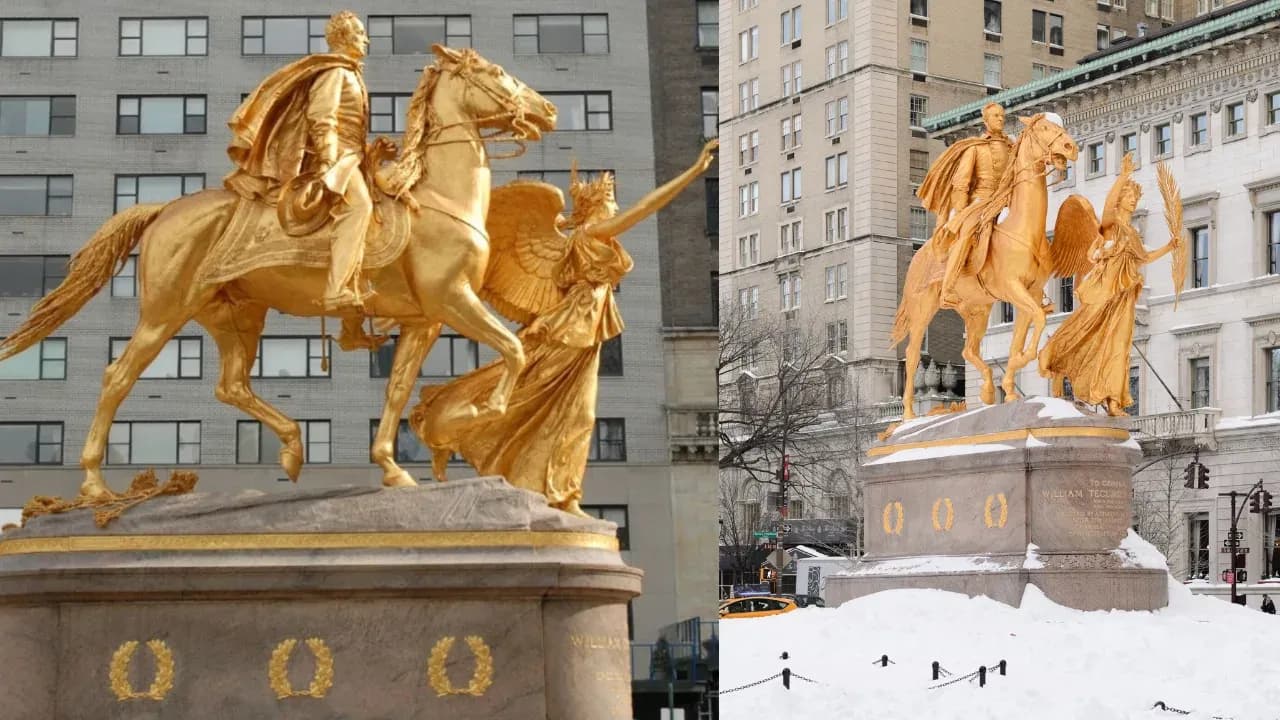
At the corner of Central Park and Fifth Avenue, a golden statue stops people in their tracks. Tourists snap photos, locals pass by with curiosity, but few know the wild stories hidden beneath that glimmering surface. The William Tecumseh Sherman monument isn’t just a tribute to a Civil War general; it’s a masterpiece layered with secrets, symbolism, and over a century of New York City history. Here are five facts that will make you see this statue in a whole new light.
1. It’s Covered in Real Gold, and That Almost Didn’t Happen
The statue of General William Tecumseh Sherman at Grand Army Plaza glistens with a gold finish that catches everyone’s eye, but that wasn’t always the plan. Sculptor Augustus Saint-Gaudens originally designed it in bronze. When he proposed covering it in 24-karat gold leaf, critics called it excessive and “too showy” for a war memorial.
But Saint-Gaudens believed the gold wasn’t about wealth. It was about honor. To him, Sherman’s controversial legacy needed a bold visual statement. Today, that shimmering gold is one of the most photographed features near the southeast corner of Central Park. It’s also one of the few fully gilded outdoor monuments in the city.
2. The Horse Was Sculpted Using a Real Skull
Saint-Gaudens didn’t just sculpt from memory. To get Sherman’s horse just right, he conducted deep anatomical studies, including examining real horse skeletons and using an actual horse skull for reference.
The horse’s name was “Duke,” and it wasn’t just any horse. It was modeled after the type Sherman rode during his famed March to the Sea. The result is an animal that feels alive—its muscles taut, its stride forward, its posture disciplined. The detail is so accurate, equine experts still praise the realism over a century later.
3. The Goddess of Victory Was Modeled After a Black Woman
The winged figure leading Sherman’s horse is Nike, the Greek goddess of victory. But this isn’t just mythology. Her face was based on Hettie Anderson, a prominent African-American model of the era.
Anderson was known in New York art circles for her poise and elegance. At a time when Black models were rarely acknowledged, Saint-Gaudens defied the norm by publicly praising her contributions. Her likeness gave Victory a dignified strength, lifting the symbolism of the statue from military conquest to something more universal: resilience, grace, and justice.
Many historians now consider this one of the earliest high-profile depictions of a Black woman in American public art.
4. It Took 21 Years to Shine Again, at a Cost of $1.75 Million
Over the decades, pollution and time dulled the statue’s brilliance. By the early 2000s, it was still admired but no longer radiant. Then, in 2013, the city launched an ambitious $1.75 million restoration project to bring the monument back to life.
The entire surface had to be cleaned, repaired, and then regilded by hand, one delicate sheet of gold leaf at a time. Experts worked for months, restoring not just the shine but the artist’s original vision.
Today, it gleams once more, a beacon of history glowing beside Central Park’s busy entrance.
5. Moving the Statue Took a Metal Track and Surgical Precision
In 1913, the statue needed to be slightly repositioned to better align with the redesigned layout of Grand Army Plaza. But this wasn’t a simple shift. The statue, composed of bronze and gold and weighing several tons, had to be moved without damaging its base or figure.
Engineers constructed a metal track system to roll it slowly across the plaza. Even a small crack could have caused catastrophic damage. The project required partial dismantling of the pedestal, round-the-clock oversight, and painstaking precision.
It’s a little-known story of how preserving history sometimes requires moving mountains—or at least monuments.
Final Thoughts
The William Tecumseh Sherman statue isn’t just a tribute to a general; it’s a layered work of art, rich with untold stories. From its golden finish to the hidden identities of its models, every detail holds meaning. It’s not just something to admire as you pass, it’s something to understand.
So next time you’re near Central Park, stop for a moment beneath the golden shine. You’re not just seeing a statue, you’re witnessing a quiet masterpiece of American art, memory, and imagination.