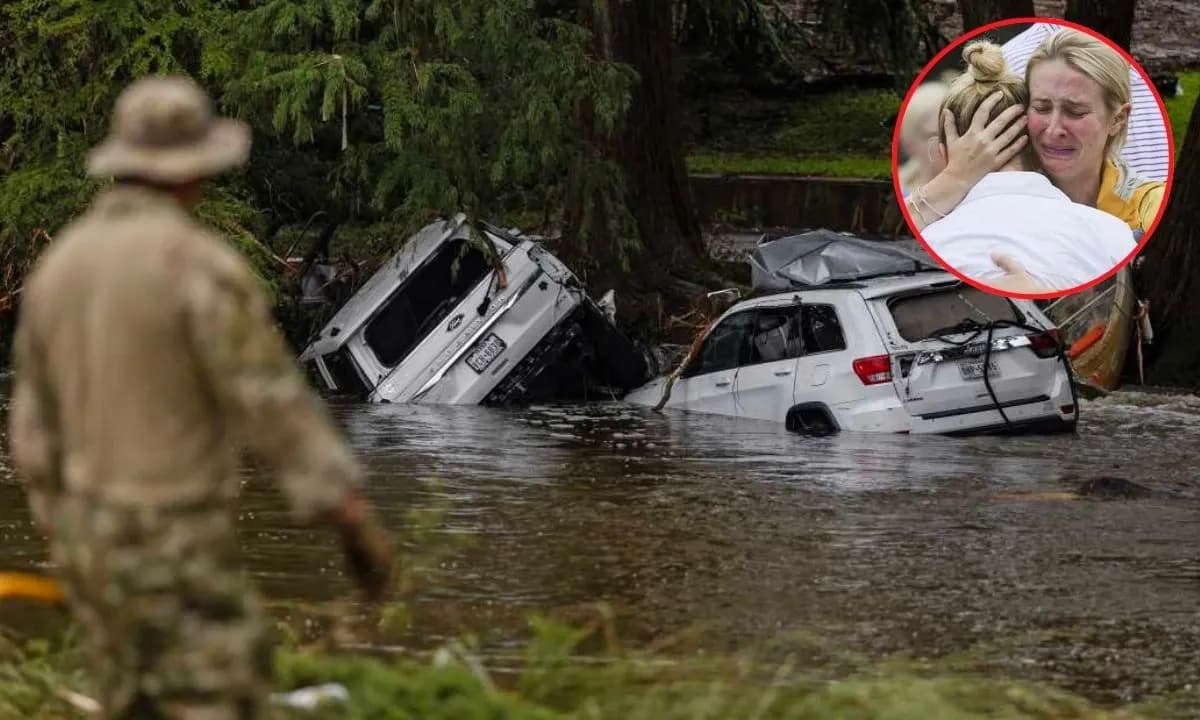
In the early hours of July 4, what should have been a peaceful celebration turned into a nightmare along the Guadalupe River in Central Texas. Without much warning, historic floods ripped through Kerr County and nearby areas, leaving behind a trail of devastation, sorrow, and uncertainty. Now, 11 days later, the official death toll stands at 132 people across six counties—and the fate of about 100 others still remains unknown.
Most of those still missing were visitors who had come to enjoy the long holiday weekend. Many were camping, staying in RVs, or attending riverside events, including fireworks and concerts. Kerr County Judge Rob Kelly explained that they simply don’t know how many people were in the area that night.
“We’ve heard accounts of trailer after trailer after trailer being swept into the river with families in them. Can’t find trailers.”
Kerr County Judge Rob Kelly.
The storm’s timing made it even deadlier. It hit in the predawn hours, when people were asleep and unaware. The terrain of the Texas Hill Country—rocky and close to the Gulf—combined with intense rain turned the Guadalupe River into a rushing, destructive force. The area is known as “flash flood alley” for a reason. Over the years, hundreds have lost their lives to sudden floods here. But what happened on July 4 could become the second deadliest natural disaster in Texas history, behind only the 1900 Galveston hurricane.
Governor Greg Abbott, who visited the flood-struck regions, confirmed that 97 people are still unaccounted for in Kerr County alone, with a few more in neighboring counties. He acknowledged that some of these reports could be duplicates or errors, but stressed that the search and rescue operation remains ongoing and round-the-clock.
Search teams are facing many challenges. Many of the missing didn’t check into hotels or official campsites. That means there’s little to no documentation of their presence. As a result, family and friends reporting them missing are often the only way officials know someone might be unaccounted for.
Some missing people turned out to be listed twice, once as missing and once as deceased. Others were later found safe. As officials clean up and sort through debris, the number of missing could change—but for now, uncertainty lingers.
The ground itself is part of the problem. Vehicles and entire trailers are buried under piles of debris and thick mud, making it extremely difficult for crews to conduct thorough searches. Torrential rains continued to fall in the days after the flood, further delaying recovery. Rivers remain swollen. Soil is saturated.
Just this Tuesday, more rainfall—between 1 and 4 inches—was forecast across 12 already-impacted counties. The National Weather Service warned that even small downpours could cause sudden river rises and flash floods. And now, extreme heat is setting in, with temperatures climbing toward 100°F, making recovery work even more dangerous.
Despite the grim outlook, help is pouring in from all over the country. States like California, Virginia, Oklahoma, Florida, New York, Indiana, Alabama, and Maine have sent rescue teams, search dogs, and equipment. Governor Abbott thanked fellow governors on social media, highlighting the national unity during the crisis.
The state has also begun providing financial help. The Texas Health and Human Services Commission awarded nearly $1.9 million in emergency grants to hospitals in Kerrville and Llano. These funds will cover repairs, support staffing needs, and help keep essential operations running.
Kerrville’s Peterson Regional Medical Center will receive $1.5 million, while Llano Regional Hospital gets $396,000. Health workers have been working around the clock to treat injuries and trauma from the flood.
Small businesses, too, are getting support. A nonprofit called LiftFund is offering grants up to $10,000 and interest-free loans up to $50,000 to businesses affected by the floods in Kerr and nearby counties. Many lost not just property, but also loved ones or employees. The money is meant to help them clean up, reopen, and stay afloat. Assistance is being provided in person at Happy State Bank through Thursday.
But life is not just about recovery—it’s also about healing. In Kerrville, where the emotional toll is heaviest, the city is trying to bring people back together. On July 18, “Movies in the Park” will return—not in the regular location, but on a baseball field to avoid flooded areas.
“We believe that such moments of togetherness are vital for healing. We hope you will join us for a peaceful evening under the stars.”
The parks department wrote
While the official missing person count dropped from the original 161, experts say it’s still too early to know the full picture. Lucy Easthope, an international disaster recovery adviser, says that sometimes it takes weeks or even months for the Earth to yield all the victims of a flood. In past disasters—like the Hawaii wildfires in 2023—the number of missing peaked early on and was later clarified. The same will likely happen here.
One place that suffered deeply is Camp Mystic, where at least 27 children and counselors were killed. This camp was directly in the path of the flood, and many of the victims were swept away before anyone could react. The horror of that loss still echoes throughout the state.
Even President Donald Trump visited Kerrville and spoke to residents, saying the actual number of missing may be higher than reported.
“They’re getting that count, but the count they don’t have is how many are still missing, with a lot of lives, a lot of young angels,”
President Donald Trump
As the floodwaters slowly recede and teams work through piles of mud and shattered lives, one thing remains certain: this disaster is far from over. Families still wait for news. Crews still comb the wreckage. And a state once again comes together, facing the long road to recovery with a mix of sorrow, hope, and determination.