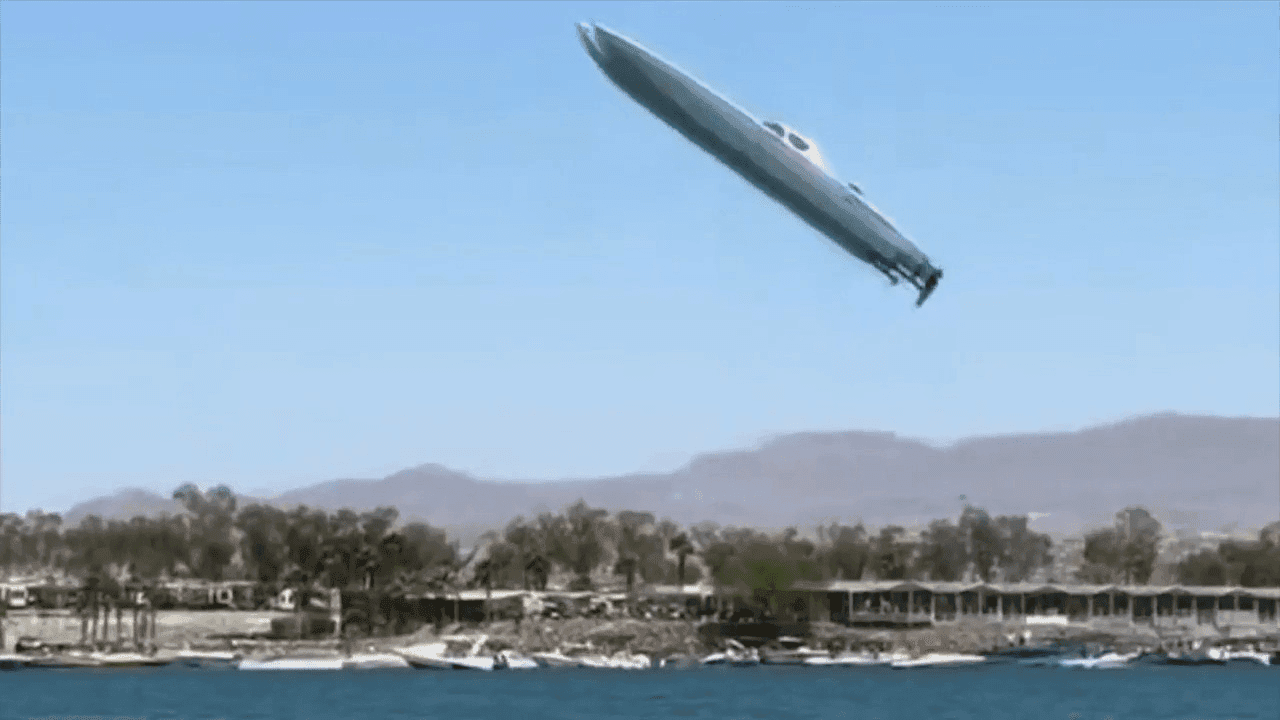
In an extraordinary turn of events at Lake Havasu, Arizona, a speedboat took an unexpected flight during a high-speed race, captivating onlookers and etching its mark in racing history. Racing at an astounding 200 mph, the speedboat executed a complete backward flip midair before crashing back into the lake. Astonishingly, this dramatic spectacle contributed to its victory, as the vessel managed to cross the finish line first, leaving spectators and competitors in awe.
The incident occurred during an annual speedboat race on a three-quarter-mile course, renowned for testing the limits of both machine and human perseverance. The speedboat, a state-of-the-art twin-hull Skater, is constructed to lift off and hydroplane across the water’s surface, a design feature leveraged to its fullest under windy conditions and through strategic propeller adjustments. Wearing harnesses and helmets, the crew aboard survived the spectacular crash with minor injuries, described as ‘just a little banged up’ in social media reports by the Freedom One Racing Team, evoking relief for those following the event live.
Despite the alarming flip, the speedboat clocked an impressive speed of 200.1 mph, securing its victory in the contest. Ray Lee, Publisher of Speedboat Magazine, noted that conditions such as wind and engine trims likely led to the boat’s airborne moment. Nevertheless, these very conditions did not deter its triumphant finish, showcasing the thrilling unpredictability of speedboat racing.
Historically, speed racing events have often flirted with danger, testing the mettle of the bravest racers and the most advanced hydro vehicles. This race added another page to the chronicles of thrilling speed encounters at Lake Havasu, setting a poignant reminder of the thin line between engineering marvels and the unpredictability of nature. As course lengths and speeds push boundaries—once extending over a mile and yielding velocities beyond 240 mph—safety measures are paramount. The use of reinforced cockpits equipped with underwater gear emphasizes the inherent risks associated with the sport.
Moving forward, the tale of this midair flip could usher in discussions about future design adaptations, course regulations, and safety protocols in high-stakes racing. Will this incident catalyze a new wave of technological advancements in speedboat design? Or will it prompt a reevaluation of race conditions to balance thrill with safety? As speedboat racing grows, these questions linger, inviting enthusiasts and experts alike to ponder the future of the sport.
In retrospect, the midair flip of this speedboat at Lake Havasu is more than a recount of an accidental airborne maneuver; it symbolizes the spirit of competitive racing where innovation and boldness surge beyond conventional horizons.