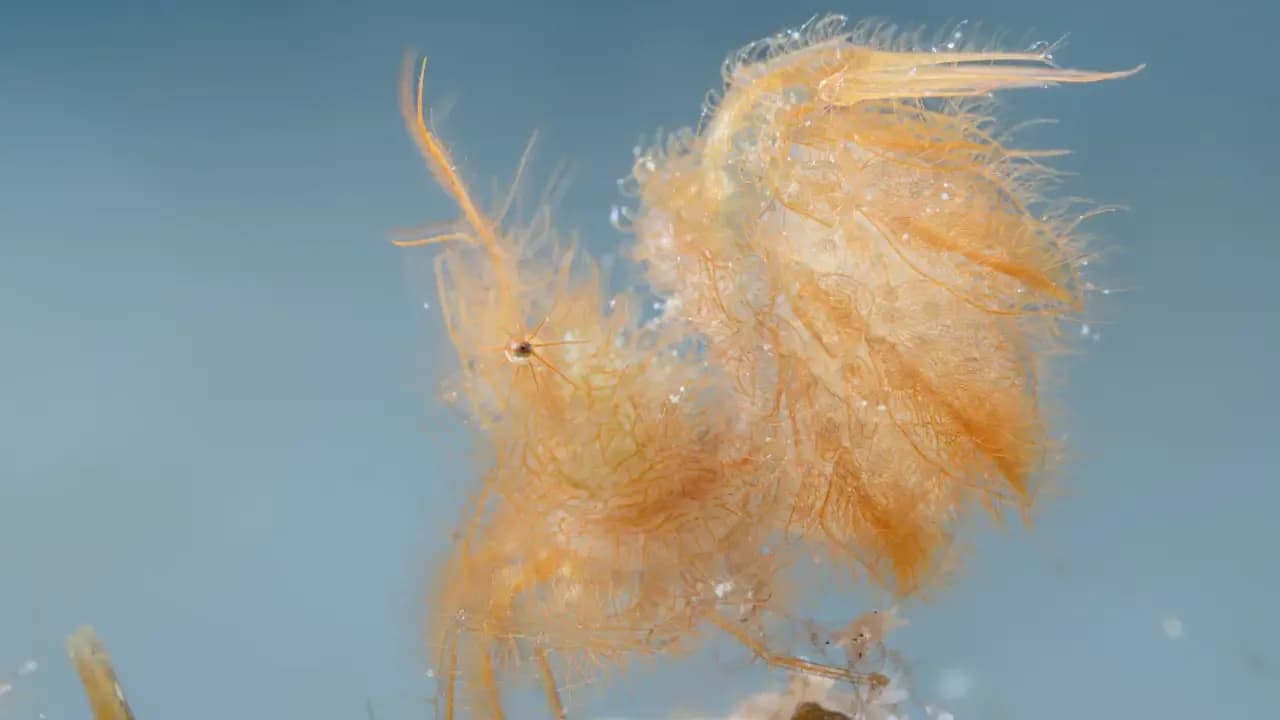
In the vibrant but fragile ecosystem of Indonesia’s Lembeh Strait, one of the ocean’s most extraordinary creatures thrives almost unnoticed. Known as the Hairy Shrimp (Phycocaris simulans), this microscopic crustacean, no larger than 3 to 6 millimeters, with rare individuals reaching 1 centimeter has captured the attention of underwater photographers and marine biologists around the world.
Despite its nearly invisible presence, the Hairy Shrimp is instantly recognizable to those lucky enough to find it. Its entire body is covered in fine, hair-like filaments, giving it the appearance of drifting algae. With coloration that ranges from vibrant red to green, yellow, or brown, it blends seamlessly with its surroundings an evolutionary advantage that allows it to hide in plain sight.
This unique camouflage is what earned it the nickname “algae shrimp.”
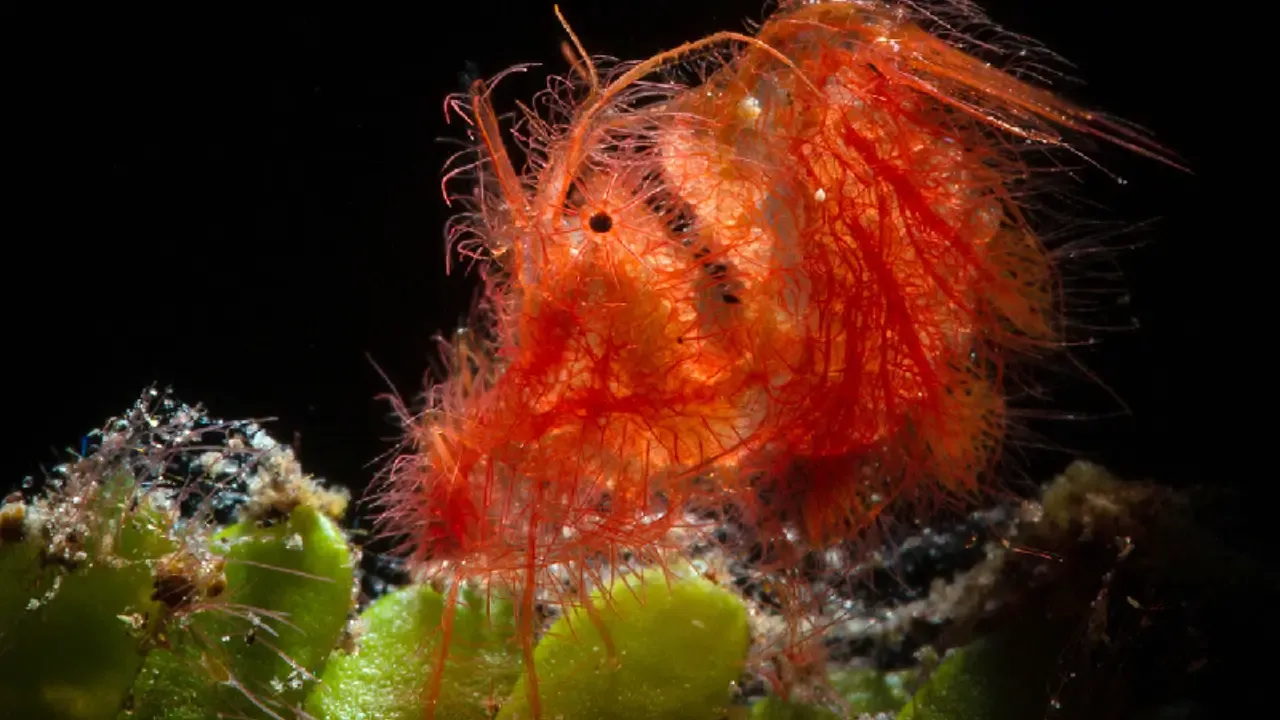
Found not only in Indonesia but across the Indo-West Pacific including Malaysia, Bali, Taiwan, and even the Red Sea, the Hairy Shrimp prefers to live in shallow reef zones, drifting algae beds, coral rubble, and rocky crevices.
Rather than swim actively, it often relies on water currents to move, swaying gently in the surge. When stationary, its upright-held tail serves as a useful identifier, especially for researchers and underwater macro photographers.
This tiny marvel is non-aggressive and feeds primarily on microscopic algae, plankton, and suspended detritus particles floating through the water column. Its size, however, places it near the bottom of the food chain. Almost any slightly larger predator, including fish, cephalopods, and crustaceans, can and often does make a meal of the Hairy Shrimp.
Even so, its survival strategy is remarkable. Females are capable of carrying a visible clutch of translucent eggs beneath their abdomens. With a careful eye or the help of high-magnification photography divers can sometimes spot these eggs before they hatch.
Once released, the larvae drift freely with the current until they grow large enough to settle onto the ocean floor and continue the cycle of life.
Recent reports suggest that Phycocaris simulans may not be alone. Sightings in distant waters and subtle physical differences have led some scientists to suspect there may be closely related species or variants yet to be formally classified. However, thorough genetic analysis is still needed to confirm this.
As climate change and human activity continue to threaten marine habitats, the existence of creatures like the Hairy Shrimp reminds us of the ocean’s hidden complexity.
Its minuscule size and cryptic behavior make it easy to overlook, yet it plays a quiet role in the broader reef ecosystem contributing to biodiversity, nutrient cycling, and the natural wonder that defines life beneath the surface.
So next time you peer into a patch of swaying algae, remember: what looks like a strand of seaweed might just be one of the ocean’s tiniest marvels. Hidden in the current, the Hairy Shrimp is a living example of nature’s creativity on the smallest scale.