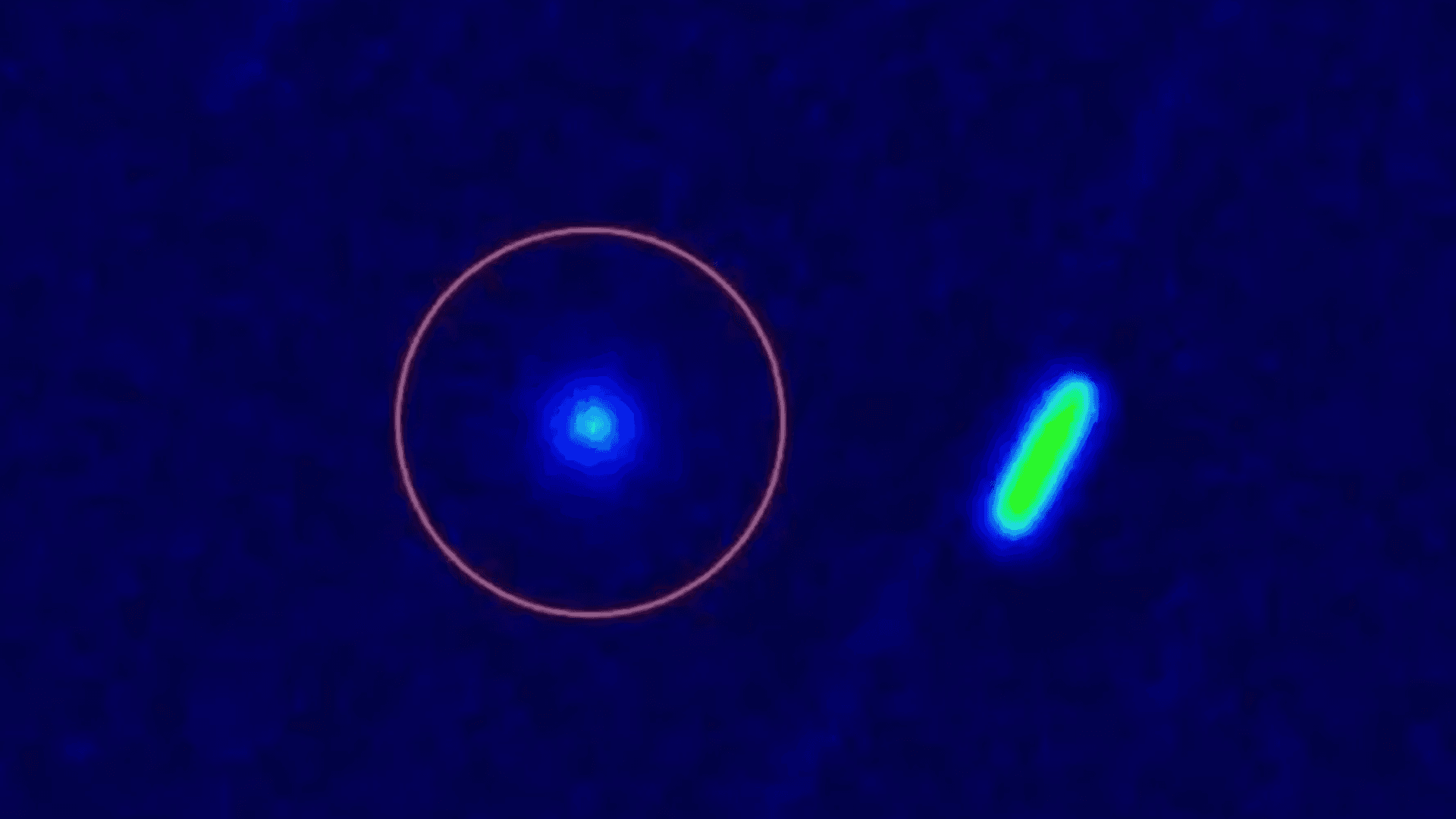
New telescope images of the interstellar object 3I/ATLAS have revealed a surprising “set of jets,” leading some scientists to question whether the Manhattan-sized body could be an artificial alien craft. The discovery has renewed excitement about possible extraterrestrial technology traveling through our solar system.
The photos, taken on November 8, show at least seven visible jets extending from the object — some pointing toward the Sun, known as “anti-tails.” Harvard astrophysicist Dr. Avi Loeb analyzed the images and suggested that the jets could come from “a set of thrusters used for navigation of a spacecraft.”

Alien Thrusters or Natural Ice Jets?
While the idea of alien propulsion captured attention online, Loeb also acknowledged a more conventional explanation. He noted that the jets might be caused by “pockets of ice on the surface of a natural cometary nucleus” reacting to sunlight. To confirm whether 3I/ATLAS is natural or technological, Loeb said researchers should measure the outflow velocity, mass flux, and chemical composition of the jets in the coming weeks.
“It would be easy to test whether 3I/ATLAS is natural or technological,” Loeb wrote. “Let us hope 3I/ATLAS will not deliver any unwanted gifts to Earth during the holiday season.”
The interstellar object is expected to make its closest approach to Earth on December 19, according to NASA trajectory data.

Second Interstellar Object Adds to the Mystery
The discovery of another unusual object, C/2025 V1, described as “nearly interstellar,” has intensified speculation. Some online theorists suggested the two objects might be related or part of a coordinated event. However, Loeb rejected that idea based on orbital data.
“C/2025 V1 is not related to 3I/ATLAS if it did not employ non-gravitational propulsion,” Loeb explained. “The closest separation of the two orbits is 75 million kilometers, and the objects were never closer than 225 million kilometers from each other.”
Why 3I/ATLAS Matters
3I/ATLAS is only the third confirmed interstellar object detected entering our solar system, following 2017’s ‘Oumuamua and 2019’s 2I/Borisov. Like its predecessors, it appears to have an unusual acceleration pattern that defies simple gravitational modeling. Loeb, who previously argued that ‘Oumuamua might have been an alien probe, has called 3I/ATLAS “a chance to test our openness to the unknown.”
With December’s close approach fast approaching, scientists around the world are preparing to observe the object using advanced telescopes. Whether 3I/ATLAS is a natural comet or something far more extraordinary remains to be seen — but for now, it has reignited humanity’s fascination with the possibility that we are not alone.