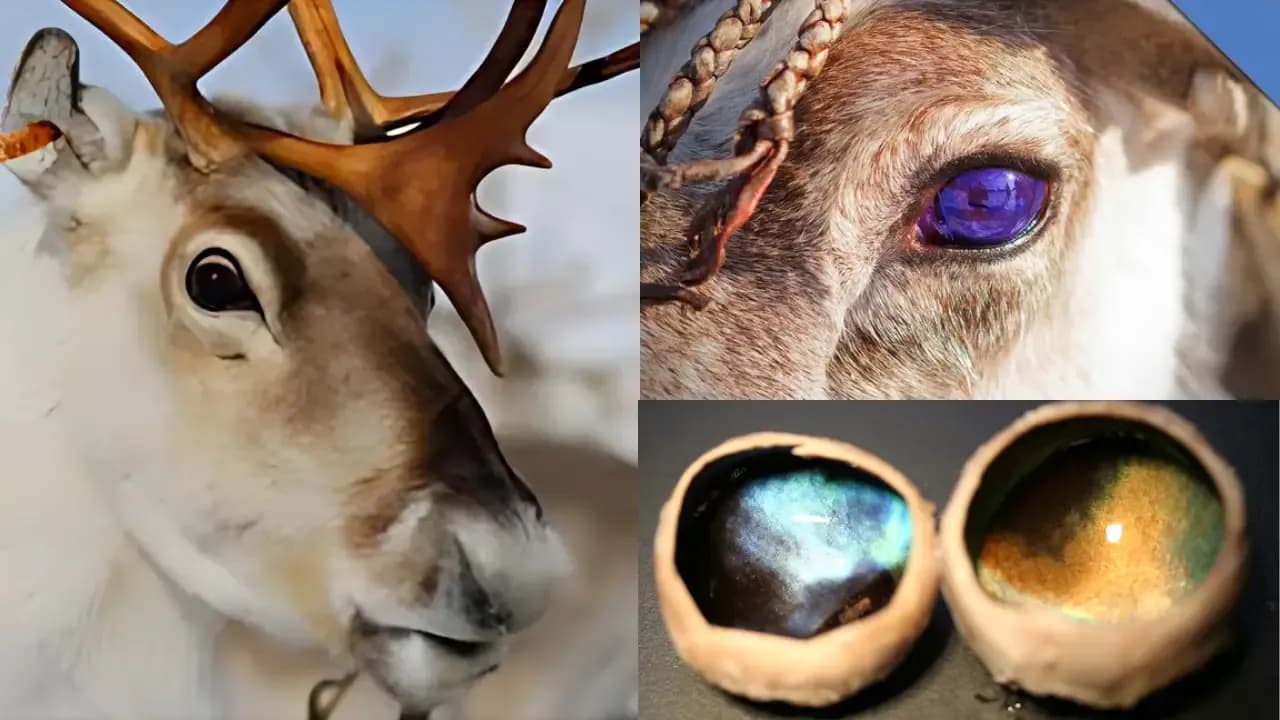
In the heart of the Arctic’s long winter darkness, a remarkable transformation takes place in the eyes of reindeer, turning them into nature’s very own night-vision specialists.
Unlike any other mammal known, these creatures undergo a remarkable transformation: the color of their eyes shifts with the seasons. During the summer, reindeer eyes glow a golden hue, reflecting much of the bright sunlight that bathes the tundra. But as winter sets in, their eyes turn a deep, mysterious blue. This change isn’t just for aesthetics; it’s a vital adaptation for survival.
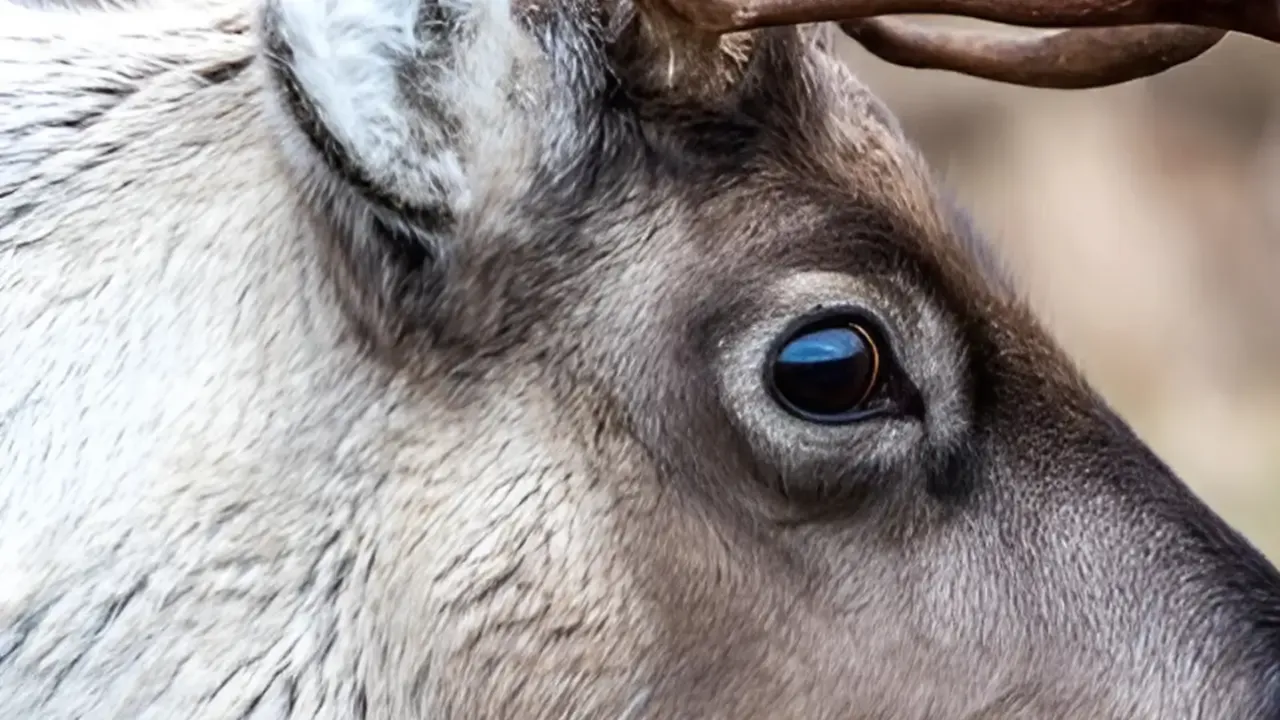
They’re the only mammals known to do this — nature’s real-life night-vision goggles!
Image credit: James McKay
As the Arctic sun disappears, the tapetum lucidum: a layer in many animals’ eyes responsible for improved night vision, changes color in reindeer. In the endless light of summer, this layer is a reflective gold, much like the eyes of other mammals.
Yet, come winter, the tapetum becomes a deep blue. Professor Glen Jeffery from the UCL Institute of Ophthalmology explains that this alteration increases retinal sensitivity, crucial for spotting predators or food in the dim Arctic twilight.
This change allows reindeer to navigate the bleak, sunless expanse, as the blue tapetum scatters available light more effectively than the golden one. ‘Without this adaptation, reindeer would struggle to detect threats and essential food like lichens, ‘ Jeffery notes.
As the pupils of reindeer dilate to accommodate the dark, the pressure inside their eyes increases. This pressure shift compresses the collagen fibers in their eyes, altering the light wavelengths they reflect from gold to blue.
While the adaptation is advantageous, it poses challenges. The reindeer are perpetually edging towards conditions akin to glaucoma due to their eyes’ adaptation mechanism. Yet, their survival strategy depends heavily on their ability to adjust visually to extreme conditions.
Reindeer eyes are a testament to evolution’s brilliance, capturing the blue wavelengths of the Arctic’s winter glow. This capability is not just important for their survival but also tells a story of resilience and adaptation that scientists like Jeffery find endlessly fascinating.
As the brightness of the human-made world encroaches upon the reindeer’s habitat, with power lines that unnaturally illuminate nights, their remarkable eyes face new threats. These eyes, evolved to detect the faintest slice of light in a barren, icy desert, might not withstand these modern challenges.
This tale of reindeer eyes is more than about color change; it speaks to the intricate balance of nature and the eternal dance of adaptation. How much longer can these Arctic dwellers continue their spectral miracle amidst growing environmental pressures?
While humans rely on flashlights and tools to navigate the Arctic winter, these animals have evolved a biological solution that turns their eyes into living, adaptive goggles.
In the battle between biology and environment, reindeer are the only mammals known to change eye color with the seasons, prove that nature is still the most brilliant engineer.