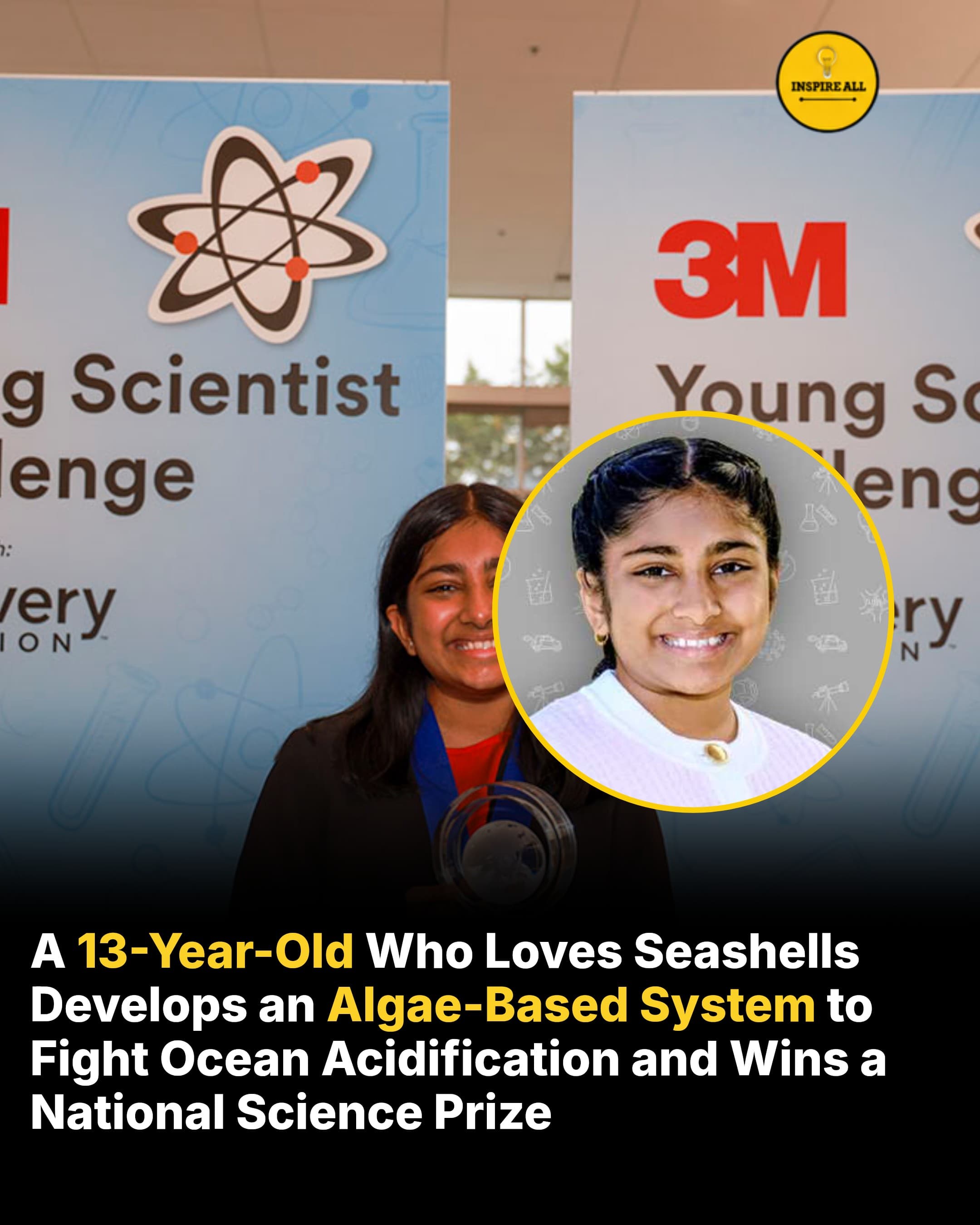
Raji Doshi’s interest in seashells led her toward an experiment with algae and a natural mineral. Her project earned the 2026 3M Young Scientist Challenge grand prize.
Raji Doshi was 13 when she won the 2026 3M Young Scientist Challenge for research into ocean acidification. Her experimental system pairs algae with aragonite, a form of calcium carbonate, to investigate ways of improving seawater chemistry.
According to 3M’s October 14 winner announcement, she received $25,000 and the competition’s title of “America’s Top Young Scientist.” The final events took place October 12 and 13 in St. Paul, Minnesota.
Her mentor linked the project’s origins to something personal: Raji loved collecting seashells and was concerned about the effects of acidification on shells and the animals inside them.
From a collection to a research question
Raji’s Young Scientist Lab profile describes a student who wanted to move beyond learning about a problem in class.
In her account, entering the competition gave her a reason to design an experiment, collect data and test whether an idea could withstand scrutiny. She also emphasized communicating science clearly and considering its practical impact.
The profile identifies Stanford Online High School as her school. Its age and grade listing differs from the later winner announcement, which describes her as a 13-year-old eighth grader. Those details refer to different stages of the competition record; this article uses the winner announcement for her age at the award.
Her stated ambitions extend beyond this project. In the same profile, she describes an interest in developing tools that could monitor ocean health and climate from space.
Why changing ocean chemistry affects shells
Ocean acidification begins with a familiar gas: carbon dioxide. When seawater absorbs it, chemical reactions increase hydrogen ions and lower pH.
As NOAA explains, those changes also reduce the carbonate ions available to organisms that build calcium carbonate shells and skeletons.
The term can be confusing. Ocean water remains alkaline on average, at around pH 8.1. “Acidification” describes the movement toward greater acidity, rather than a claim that the entire ocean has become acidic.
That change matters for organisms such as oysters and corals. Building and maintaining their protective structures becomes more difficult as seawater chemistry shifts.
NOAA also notes that algae and seagrasses use carbon dioxide for photosynthesis. Researchers are investigating whether cultivating seaweed can help slow acidification locally. This broader research context helps explain the biological part of Raji’s idea.
How algae and aragonite fit together
3M describes Raji’s project as a combination of macroalgae cultivation and natural calcium carbonate buffers. Algae provide a biological route for taking up carbon dioxide; the mineral component is intended to support alkalinity.
Over the summer, Raji worked with 3M product engineering specialist Deborah Isabelle. The company reports that her experiments showed improved algae biomass and lower dissolved carbon dioxide. She also developed a computational model to investigate an appropriate aragonite dose.
These are organizer-reported findings. The announcement does not establish that the system is ready for broad coastal deployment.
Why a promising experiment needs further testing
A change measured in an experimental system and a durable environmental benefit are different questions. Before describing a project as a coastal solution, evidence would need to establish how it performs over time and under changing real-world conditions.
Algae also require careful consideration. The Environmental Protection Agency explains that excessive algal growth can contribute to coastal acidification when it dies and decomposes, releasing carbon dioxide into the water.
That does not invalidate a managed algae experiment. It helps explain why the fate of the biomass and the surrounding ecosystem matter when assessing long-term benefits.
The sources reviewed here do not establish field-scale effectiveness, permanent carbon storage or independent replication of Raji’s results. Trending American has not tested the system.
An award for following curiosity
Raji’s achievement is concrete: she turned an interest into a research project and earned a national competition’s grand prize.
The larger environmental question remains open. Her work offers a starting point for further investigation into how biology and mineral chemistry might interact, with measurements needed to guide each next step.
A seashell collection gave her a reason to ask. Experiments gave her a way to begin answering.
Related reading: Himaja’s voice-controlled Braille printer and Esther Kimani’s solar-powered crop-alert system.
Featured graphic supplied by Inspire All; supplied photo credits: 3M and Young Scientist Lab. Project findings are attributed to the competition organizers; NOAA and EPA provide the broader scientific context.