
When you think of dangerous animal births, you might imagine predators or animals giving birth in the wild under threat from hunters. But nothing compares to the spotted hyena, whose birth process is often described as one of the most brutal in the animal kingdom.
Spotted hyenas live across much of sub-Saharan Africa. They’re famous for their “laugh-like” calls, their highly social clans, and—most unusual of all—the strange biology of their females. Unlike most mammals, female hyenas are larger and more dominant than males, and they rule their clans with absolute authority.
The reason lies in their biology: female spotted hyenas have testosterone levels three times higher than males, making them stronger, more aggressive, and firmly in charge. But this dominance comes with a serious cost—how they give birth.
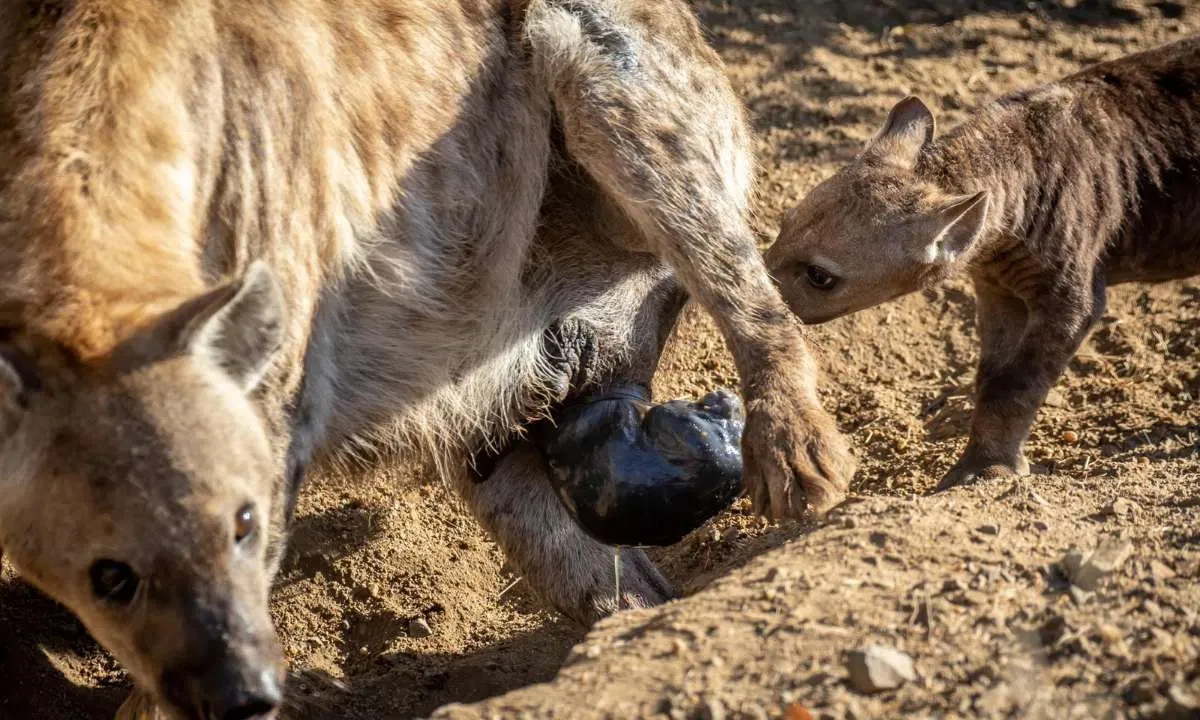
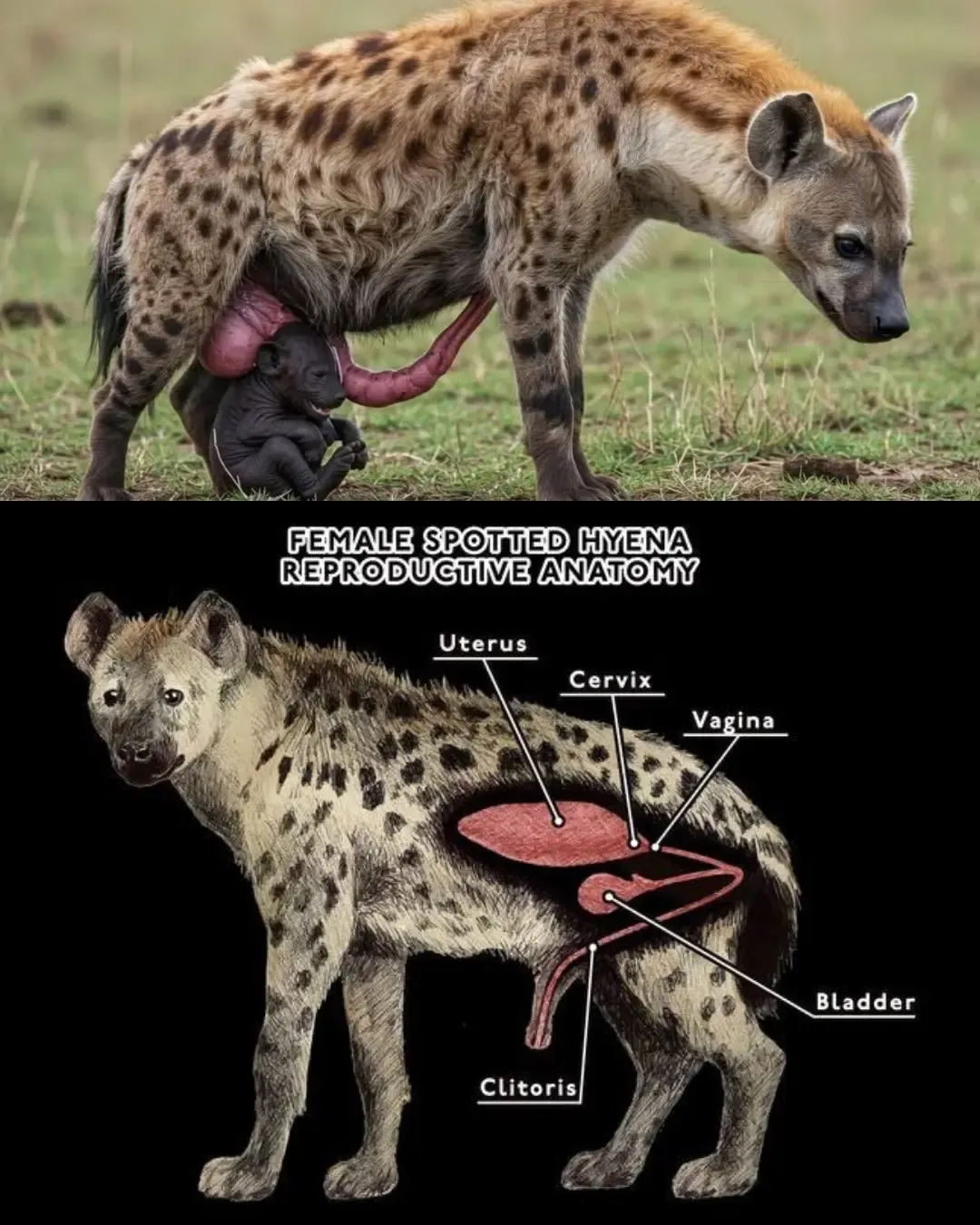
Instead of a vagina, female hyenas have what scientists call a “pseudo-penis.” It looks almost identical to a male’s organ, complete with a shaft and even something that resembles a scrotum. But in reality, it’s an elongated clitoris. Through this organ, females urinate, mate, and—most shockingly—give birth. The birth canal that runs through the pseudo-penis is only about an inch wide, forcing mothers to push out a cub weighing nearly 2 pounds through an impossibly narrow passage.
This bizarre anatomy is a byproduct of the high levels of testosterone the females are exposed to before they’re even born. That hormone exposure makes them muscular and aggressive, which ensures female-led clans and matriarchal power. But it also fuses their genitalia into this dangerous form.
In fact, one of the strangest parts of hyena biology is that males can’t force females to mate. The female must voluntarily retract her pseudo-penis—like pulling back a sleeve—before mating can even happen. It gives females complete control over reproduction, something rare in the animal kingdom.
Pregnancy lasts about 110 days, one of the longest gestation periods among carnivores. When the time comes, the mother retreats to a den—sometimes a private one if she’s lower ranking, or a communal den if she’s more dominant. There, she faces one of the most painful and deadly labors in nature.
First-time mothers almost always tear their birth canal to deliver, causing severe bleeding and infections. The risk of death is real: up to 18% of first-time mothers die while giving birth. For the cubs, the odds are even worse. About 60% of cubs in the first litter don’t survive, usually suffocating in the tight passage or becoming fatally stuck.
Those that make it into the world are already unusual. Hyena cubs are born with their eyes open, a full set of teeth, and dark fur. At just minutes old, they may already show aggression toward siblings. In same-sex litters, this can lead to deadly battles known as siblicide, where the stronger cub ensures more food and survival by killing the weaker one. Typically, females give birth to two cubs, but often only one survives the early weeks.

For the survivors, life is still tough, but hyena mothers are fiercely protective. They nurse their cubs on some of the richest milk of any carnivore, keeping them fed for 12 to 18 months. That’s one of the longest nursing periods in the animal kingdom. Cubs start tasting meat around 3 to 5 months old, but most continue nursing past their first year. By one year, they’re ready to follow their mothers on hunts and scavenging trips, learning the complex rules of clan life.
Spotted hyenas live in large clans that can have more than 80 members, and every female outranks every male. The alpha female leads the group, and her cubs inherit her high status. That dominance even shows in biology—high-ranking mothers pass on more hormones to their cubs during pregnancy, making them more aggressive and more likely to survive.
Despite the cruel odds at birth, spotted hyenas are remarkably successful as a species. They thrive across Africa, adapting to grasslands, savannas, and even human settlements. Scientists still debate why evolution took this path. Some argue the pseudo-penis evolved as a byproduct of high testosterone, others think it helps signal social rank during greetings, and some believe it disguises young females as males, protecting them from being killed by dominant rivals. Whatever the reason, it has left hyenas with the strangest and most dangerous reproductive system of any mammal.
The story of hyena birth is both shocking and fascinating. It shows how evolution can create extraordinary adaptations that give strength and dominance but also bring painful trade-offs. For hyenas, the price of female power is written into every birth. Yet, against the odds, these animals not only survive but thrive, raising cubs that grow into one of Africa’s most intelligent and formidable predators.
Disclosure: We may earn a commission when you make a purchase through the ads.