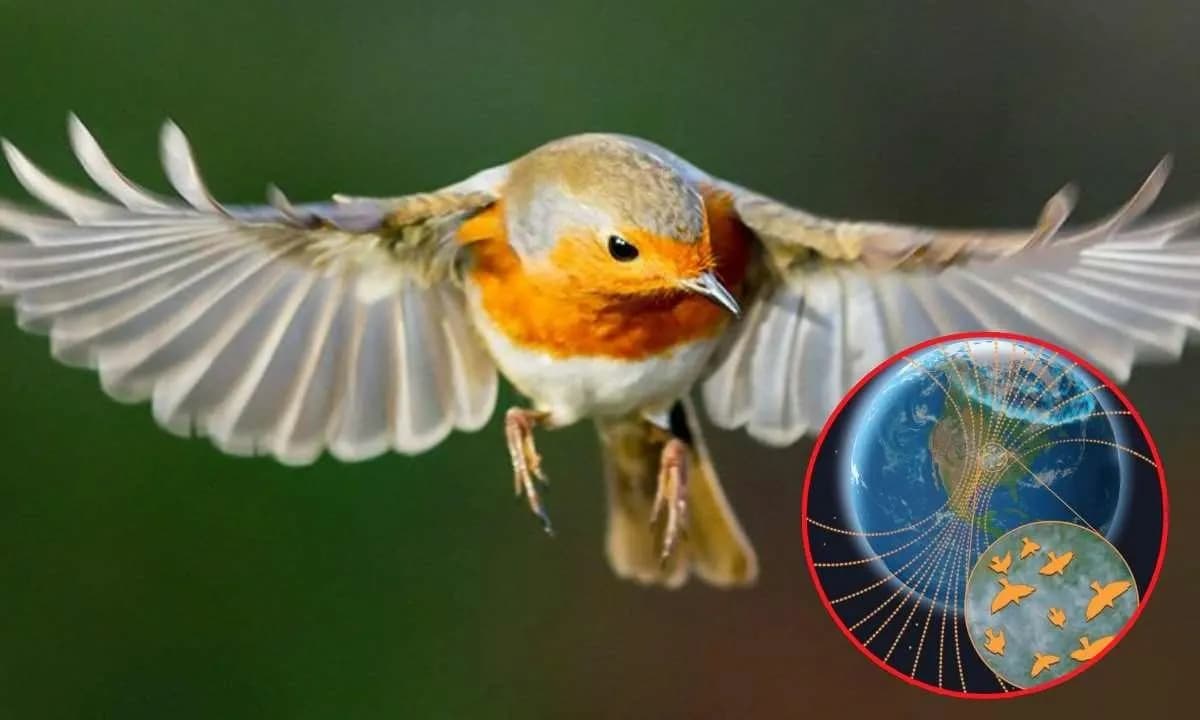
Migratory birds have long captivated our imagination, undertaking incredible journeys across continents. But the truth behind their navigational prowess is far more astonishing than we ever imagined. These feathered travelers can literally see Earth’s magnetic field, a feat rooted in the fascinating realm of quantum entanglement.
The journey of a migratory bird isn’t just a casual stroll; it’s a meticulously orchestrated flight across thousands of miles. Species such as the European robin possess an innate ability to navigate with astonishing precision. They travel from breeding grounds in Northern Europe to wintering sites in Africa, often covering distances of over 3,000 miles without ever losing their way. How do they accomplish this? The answer lies hidden in a light-sensitive protein in their eyes known as cryptochrome.
Cryptochrome is no ordinary protein. When light hits this special molecule, it triggers a quantum process. Specifically, it generates a pair of entangled electrons that react to the Earth’s magnetic field. Picture it as twins linked together across space; their movements are coordinated, no matter the distance. This radical pair model suggests that the birds’ ability to sense magnetism relies on the quantum properties of these particles, which behave differently under varying magnetic forces.
But what exactly is this radical pair model? In simple terms, it’s a mechanism that allows cryptochrome to evolve from a common state to a state influenced by external magnetic fields. When light activates cryptochrome, it simultaneously creates a pair of entangled radicals. As these electrons undergo different reactions based on the magnetic orientation, they effectively guide the bird’s flight direction. It’s a remarkable demonstration of how quantum mechanics can influence biological systems.
This intertwining of nature and physics reveals that birds are perhaps the original quantum engineers of our planet. Their unique visual perception, shaped by quantum processes, enables them to navigate through seemingly featureless terrain, such as vast oceans. The sight of magnetic fields through cryptochrome allows them to remain oriented and find their way, connecting them to an ancient navigation system that predates human exploration.
The implications extend far beyond avian biology. Understanding how birds utilize quantum mechanics to navigate not only sheds light on animal behavior but also opens new doors for technology. Researchers are keenly investigating how insights from avian navigation systems could inspire advancements in areas like robotics and artificial intelligence.
As we marvel at these migratory birds and their cryptochrome-powered sightings of Earth’s invisible pathways, we must ponder the broader implications of what this means for humanity. In a world continually seeking direction, perhaps we can learn from nature’s oldest navigators. How will this emerging understanding of quantum biology change our perspective on life and consciousness? Are we on the brink of a new chapter in the intersection of nature and science?