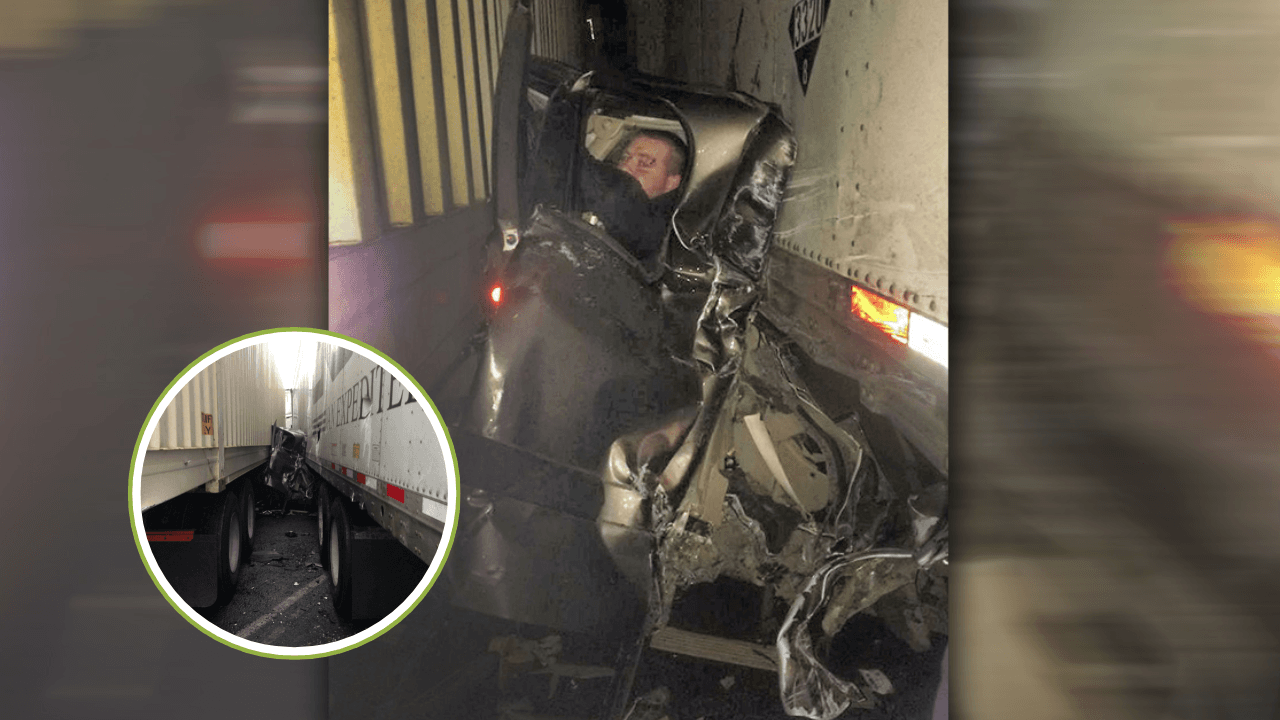
In what officials are calling one of the luckiest survivals ever recorded, a man in Oregon walked away with only minor injuries after being sandwiched between two semi-trucks during a 26-car pileup on Interstate 84.

The Chain-Reaction Crash
On a freezing January morning in 2015, slick black ice caused multiple vehicles to lose control on I-84 near Baker City. Among them was 27-year-old Kaleb Whitby, who was driving his pickup truck when a semi-truck jackknifed ahead of him. Unable to stop in time, Whitby’s truck slammed into the side of the big rig, flipping his vehicle onto its side.
Before Whitby could react, another semi-truck barreled down the icy highway and smashed directly into his truck, crushing it between the two trailers. Whitby later recalled that he closed his eyes, gripped the steering wheel, and prayed.
A Miracle Escape
When the dust settled, rescuers found Whitby trapped but alive inside what looked like mangled metal. The driver of one of the trucks began speaking with him, even asking permission to take a now-viral photo that captured Whitby’s head peeking out from the wreckage. It took first responders nearly 30 minutes to cut him free.
Against all odds, Whitby’s injuries were minor. “I’ve got two Band-Aids on my right ring finger, and a little bit of ice on my left eye,” he told The Oregonian. “Thank God that I’m still alive. Now I’ve got to go figure out why.”

Helping Others Before Heading Home
After being freed, Whitby didn’t immediately rush to the hospital. Instead, he helped assist other victims of the 26-car pileup before heading home to his pregnant wife and their 2-year-old son. Authorities confirmed that dozens of vehicles were damaged in the chain-reaction crash, though miraculously, no fatalities were reported.
The Physics of Survival
Experts noted that the design of Whitby’s pickup truck played a key role in his survival. The crumple zones — sections of a vehicle engineered to absorb impact — folded around him, redirecting the immense force of the semis away from his body. His case has since been cited as a dramatic example of both luck and engineering saving a life.
A Story of Hope
Whitby’s miraculous survival continues to resonate years later as one of the most unbelievable highway escape stories. For him, it was both a wake-up call and a blessing. “Thank God I’m still alive,” he said, a sentiment that captured the awe of first responders and readers across the nation.
The crash prompted fresh discussions about highway safety during icy conditions. Officials with the Federal Highway Administration continue to remind drivers of the dangers of black ice, which is nearly invisible but among the deadliest hazards on winter roads.