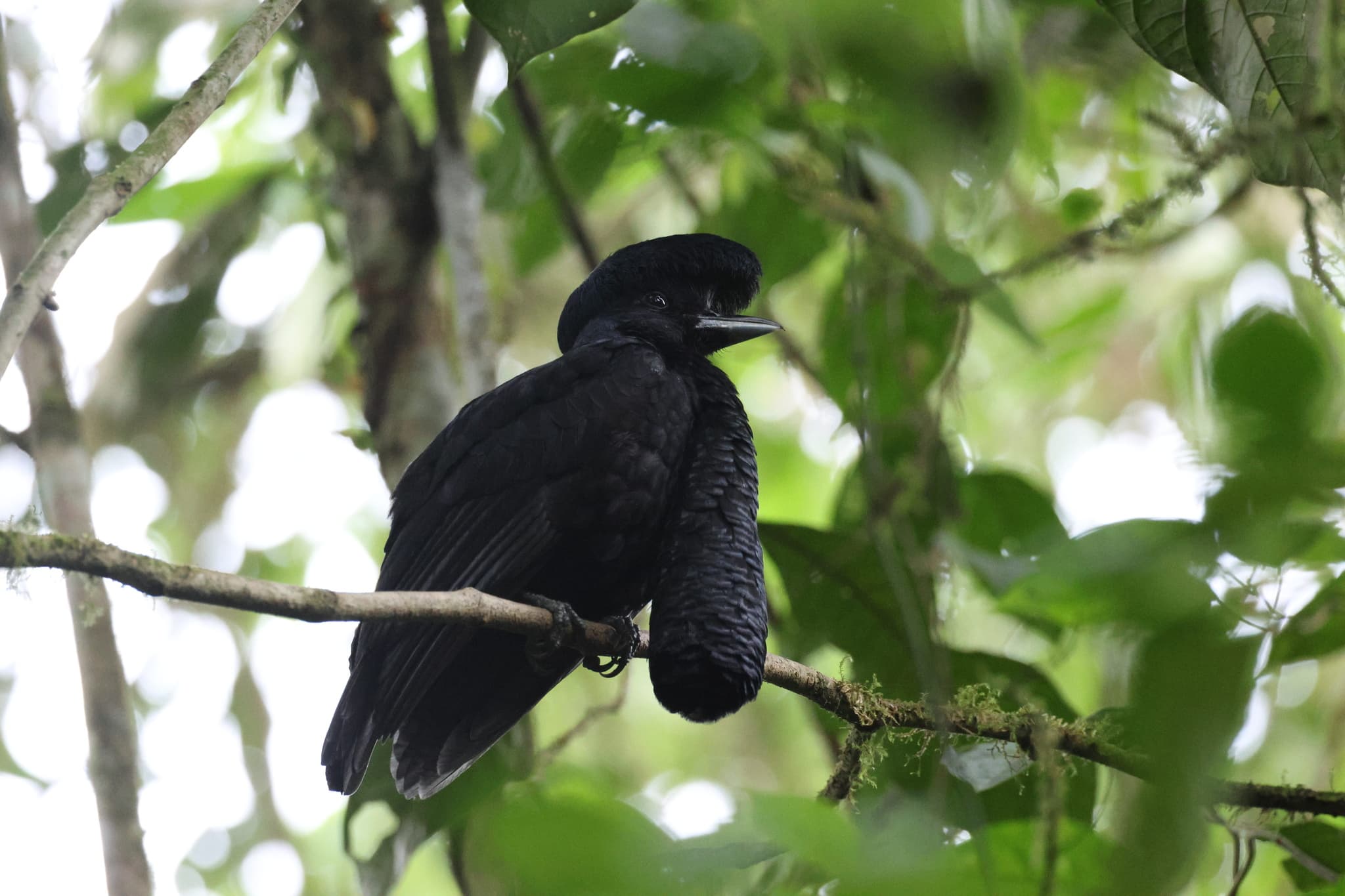
A black bird leans forward on a rainforest branch. Beneath its throat hangs a feather-covered wattle that can reach about 35 centimeters—nearly 14 inches—long. As the male prepares to call, he spreads his crest, stretches the wattle, and delivers a deep boom.
Meet the long-wattled umbrellabird, a forest bird whose appearance is only the beginning of its story.
A Bird With an Umbrella and a Hanging Wattle
The male's broad crest gives the umbrellabird its name. Below it, the long throat wattle creates an unmistakable outline.
That wattle can change length. Researchers observed males shortening it during longer flights and while preening. During display, males stretched it and fluffed its feathers. This changing shape is part of a remarkable courtship performance.
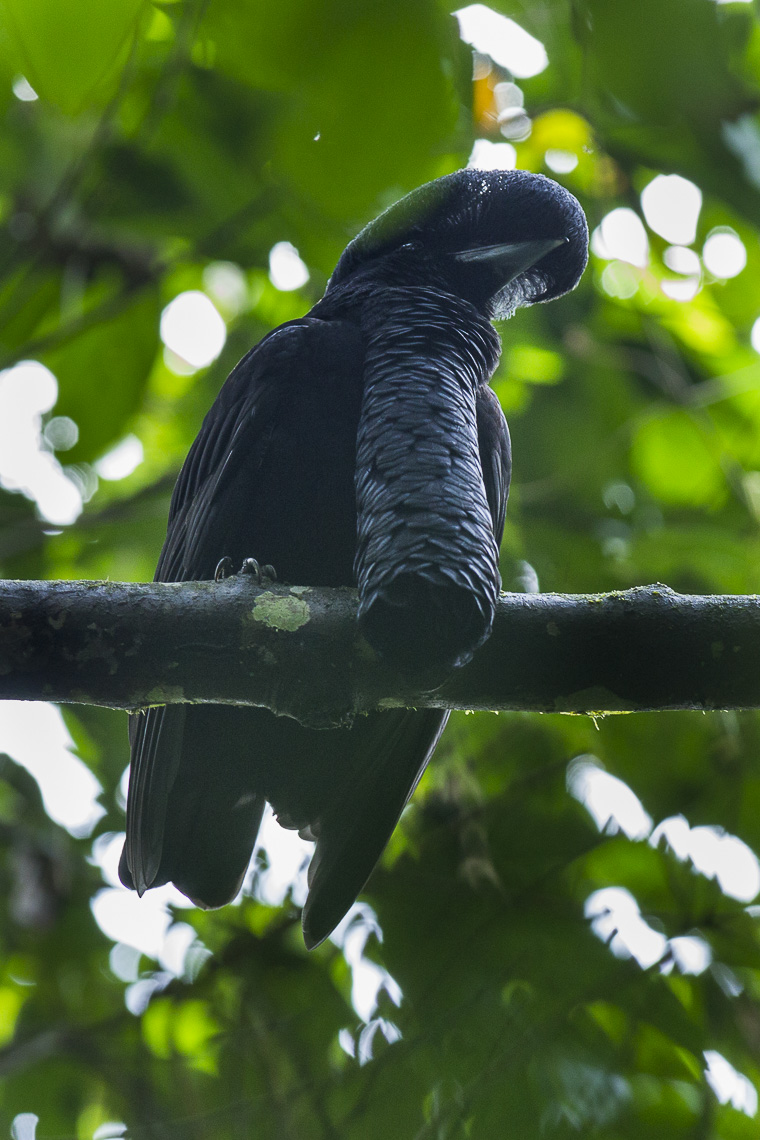
Image credit: Francesco Veronesi, original photograph, CC BY-SA 2.0.

Where Does the Long-Wattled Umbrellabird Live?
Its scientific name is Cephalopterus penduliger. The species lives in southwestern Colombia and western Ecuador, in wet forests along the western side of the Andes.
Field studies have recorded it in foothill and mountain forest, using the canopy and the layers beneath it.
A Forest Stage for Courtship
Males gather at display grounds called leks. Each performs in a small area, while females visit to mate. The spreading crest, hanging wattle, and low call turn a branch into a stage.
These observations come from field research published in Bird Conservation International.
The Quieter Story at the Nest
Away from those displays, researchers have documented a very different side of umbrellabird life.
In June 2002, a team found a nest on top of a tree fern near Mindo in northwestern Ecuador. Their observations suggested that the female handled parental care: no male was seen at the nest.
She brought food roughly once an hour, including invertebrates and small vertebrate prey. This single nest helped reveal how much work happens beyond the male's eye-catching performance.
It also shows why careful wording matters. One observed nest offers valuable clues, but it cannot describe every family. The published nesting study explains what researchers actually saw.
A Fruit Eater That Moves the Forest's Seeds
The umbrellabird's daily movements have a surprising link to the trees around it.
In a study published in Biotropica, scientists used radio tracking and feeding trials to investigate seed dispersal. Males carried seeds away from fruiting trees and deposited many at their display grounds. Females spread seeds more evenly across the landscape.
That means courtship behavior can help shape where seeds end up. A bird's search for food and a mate becomes part of the forest's future.
The study found no evidence that the higher seed density at leks reduced the chance of seedling establishment. Still, a dispersed seed is a possibility, not a guaranteed new tree. Read the seed-dispersal research for the full findings.
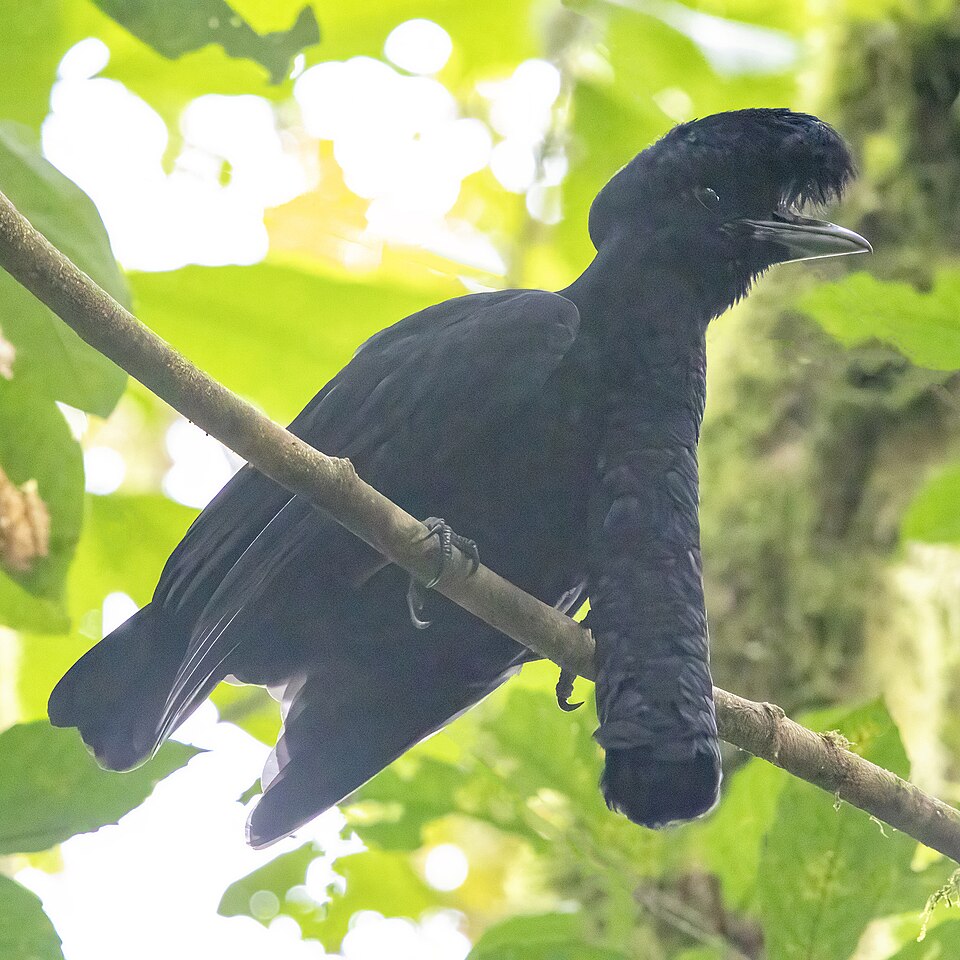
Image credit: Dan Vickers, original photograph, CC BY 4.0. Resized for display.

Why Its Forest Home Matters
Habitat loss and hunting have long been identified as threats to the long-wattled umbrellabird. Protecting forest means protecting feeding areas, display grounds, and nesting sites together.
Its importance also reaches beyond its striking appearance. Research on the tropical palm Oenocarpus bataua identifies the umbrellabird as a major seed disperser at the Ecuadorian study site. Keeping birds and trees connected helps preserve those living relationships. The palm-fragmentation study explores that connection.
More Than an Extraordinary Face
The hanging wattle may be what first catches your eye. Stay with this bird's story, though, and you find a female tending a hidden nest, seeds traveling through the forest, and courtship linked to the next generation of trees.
That is the wonder of the long-wattled umbrellabird: one remarkable animal opens a window onto a whole living world.
Featured photograph: Ryan F. Mandelbaum / Wikimedia Commons, CC BY 4.0.
