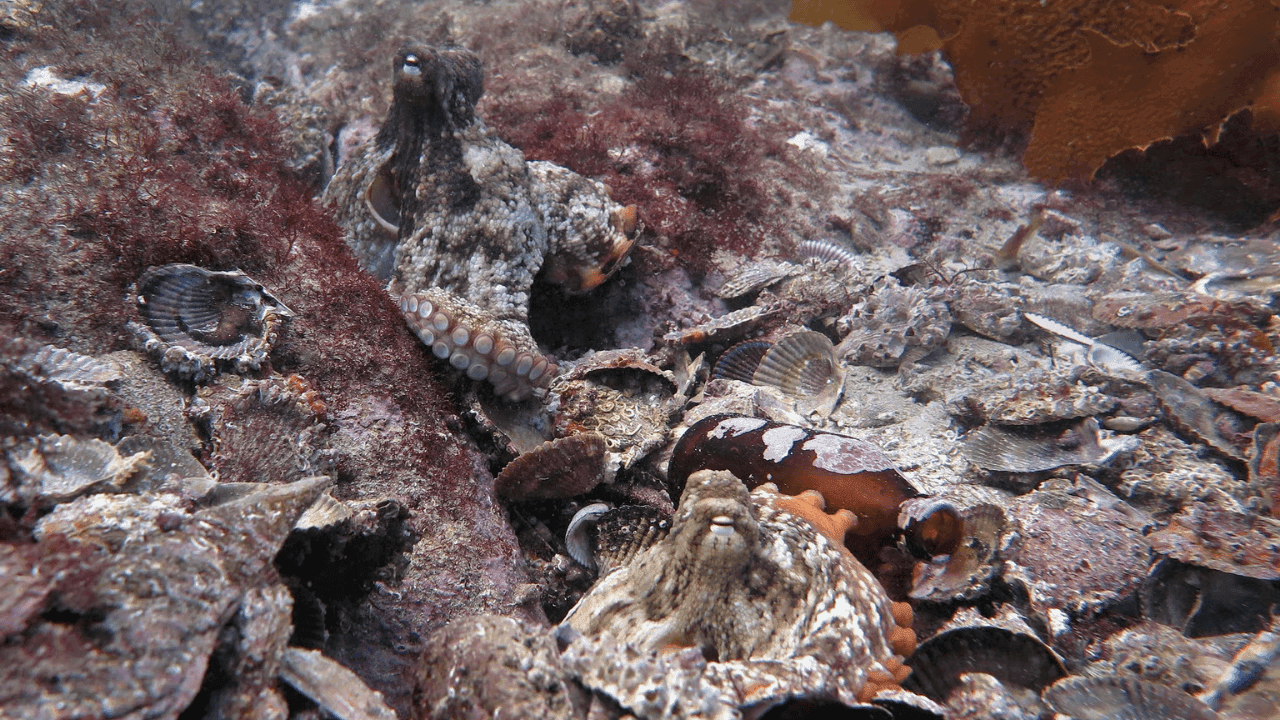
Imagine an underwater city bustling with life, built entirely by octopuses. Welcome to Octlantis, located off the coast of Jervis Bay, Australia. Here, gloomy octopuses (Octopus tetricus) build their own homes using shells, rocks, and debris, challenging our long-held belief that these creatures are strictly solitary. Instead of living alone in isolation, these octopuses gather together, constructing a unique underwater community.
Researchers from the University of Sydney and Alaska Pacific University stumbled upon this remarkable site, where they observed the octopuses engaging in surprising social behaviors. While scientists once thought these intelligent mollusks preferred solitude except to mate, their interactions at Octlantis have opened up a whole new world of possibilities.
During dives in the area, the researchers were stunned to witness intimate behaviors: octopuses were seen mating, using signals, and even squabbling over territory. This level of social complexity was unexpected and unveils an intelligence much deeper than scientists initially believed. As marine biologist David Scheel notes, ‘Octopuses can use behaviour that they don’t need when they’re solitary,’ indicating that communing isn’t just for survival; it hints at something more profound.
Unlike artificial habitats, Octlantis forms naturally, showcasing how these octopuses could create homes by repurposing the remnants of their environment. Shells and debris have been transformed into dens, fostering an intricate neighborhood where octopuses can choose to interact or retreat to their private spaces.
Up to 16 gloomy octopuses have been seen congregating in Octlantis at the same time. The researchers documented various interactions, revealing behaviors like squabbling, flirting, and forming a loose social structure. It becomes evident that these creatures are capable of much more than simple mating interactions. They engage in a rich tapestry of social behaviors that reflect an intriguing community life.
So, what does this mean for our understanding of marine life? The discovery of Octlantis illuminates the intricate social dynamics of gloomy octopuses and suggests that many marine creatures may exhibit social behavior that has yet to be extensively explored. The findings challenge the notion that evolution has led cephalopods to live only as solitary hunters.

Although Octlantis is not a city in the human sense, it offers inspiring evidence of how intelligent marine creatures might form loose communities similar to our own. Perhaps, if we look closely at the creatures around us, we can learn that social connection is deeply ingrained in the natural world.
As we think about Octlantis, one can’t help but wonder, are we undervaluing the social complexities of the animal kingdom? Just as these octopuses seem to engage in community life, what other surprising social behaviors are hidden in the depths of our oceans?
Disclosure: We may earn a commission when you make a purchase through the ads.