In early 2025, one of the most respected names in AI gave the internet a phrase it couldn't stop repeating. Andrej Karpathy, an OpenAI co-founder and Tesla's former director of AI, described a way of building software where you talk to an AI, accept what it writes, and "fully give in to the vibes." He called it vibe coding.
Twenty months later, the conversation among serious builders has moved on. The new phrase you'll see everywhere on X is harness engineering. If vibe coding was the moment everyone discovered they could build with AI, harness engineering is the skill that decides whether what they build actually works.
This guide explains what harness engineering is, why it matters, and how to think about it from first principles, without assuming you're an engineer.
Key takeaways
- Harness engineering is the practice of designing everything around an AI model so an agent works reliably: context, tools, the work loop, verification and guardrails.
- The core formula is Agent = Model + Harness. The model is swappable; the harness is what you build and own.
- Karpathy coined "vibe coding" in February 2025 and, a year later, proposed "agentic engineering" for the more disciplined professional version. Harness engineering is the practical skill behind it.
- The shift from hobbyist to builder is a shift from prompting to systems thinking.
- February 2025Karpathy coins "vibe coding"A post on X describes building software by describing it to an AI and barely touching the keyboard.
- November 2025Word of the YearCollins Dictionary names "vibe coding" its Word of the Year for 2025.
- February 2026"Agentic engineering"On the term's first anniversary, Karpathy suggests a new name for the more disciplined, professional version of working with AI agents.
- 2026Harness engineering goes mainstreamBuilders converge on a simple idea: an agent is a model plus a harness, and the harness is where the real engineering happens.
Vibe coding: the starting line
Vibe coding is wonderful. You describe an app, the AI writes it, you run it, and if something breaks you paste the error back in and try again. Weekend projects, prototypes and demos suddenly became possible for people who had never written a line of code.
But the cracks showed quickly. Within weeks of the term going viral, people were joking that vibe coding is easy and vibe debugging is the hard part. Projects that worked on Friday fell apart on Monday. Nobody knew why, because nobody had read the code.
Karpathy himself acknowledged the shift. In February 2026 he proposed agentic engineering as his preferred name for what professionals now do: directing AI agents as the default way of writing software, but with real oversight and expertise. The "engineering" part is the point. It's a discipline, not a vibe.
Harness engineering is the practical core of that discipline.
What is harness engineering?
Here's the one-line definition many builders now use:
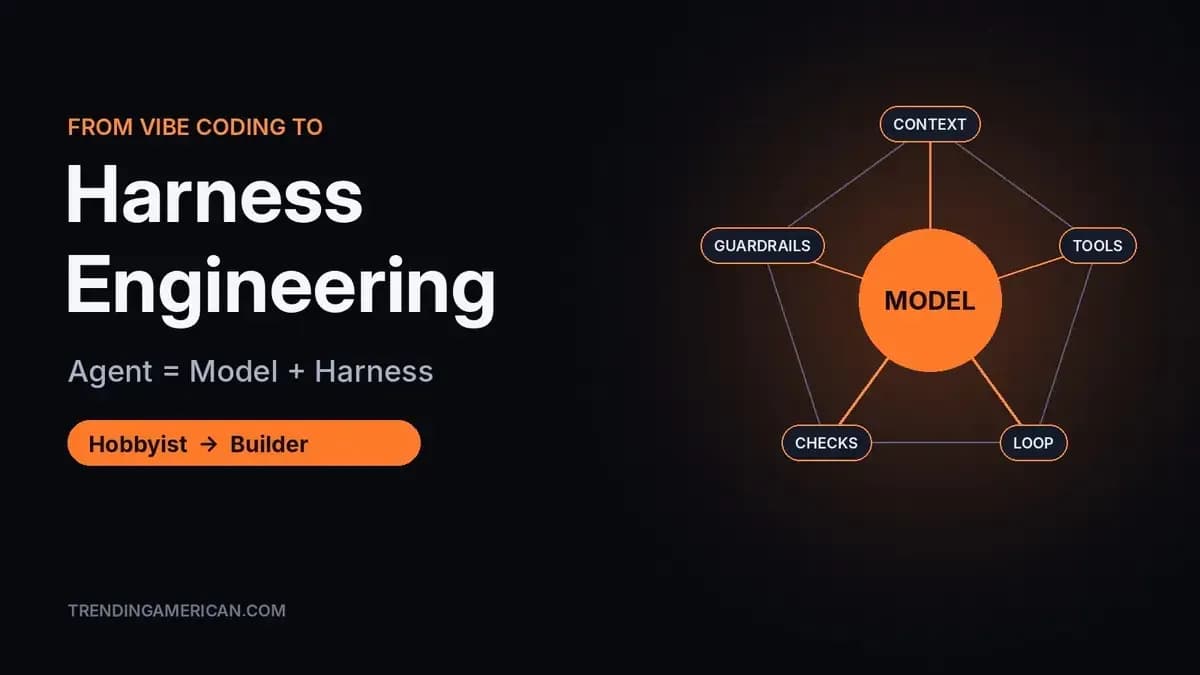
Agent = Model + Harness
The model is the AI itself, such as Claude, GPT or Gemini. The harness is everything else: the instructions it reads, the tools it can use, the information it's given, the loop it runs in, the checks that catch its mistakes and the rules that stop it from doing damage.
Harness engineering is the craft of designing that "everything else" on purpose.
The surprising lesson from teams running agents in production is that the harness often matters more than the model. As Google's Addy Osmani puts it, a decent model with a great harness beats a great model with a bad harness.
Prompt engineering vs. context engineering vs. harness engineering
| What it shapes | The question it asks | |
|---|---|---|
| Prompt engineering | The words of a single request | How should I phrase this? |
| Context engineering | The information the model sees | What does the model need to know right now? |
| Harness engineering | The whole system around the model | How does the agent run, check itself and stay safe? |
Each layer contains the one before it. A good harness still needs good prompts and good context, but it adds tools, loops, verification and guardrails on top.
Harness engineering explained like you're five
Imagine you have a horse that is incredibly strong and incredibly fast. But it can't see where you want to go, it forgets everything every few minutes, and it has no idea when the job is finished.
If you just yell "Go build a house!" and hope for the best, that's vibe coding. Sometimes you get a house. Sometimes you get a pile of wood in the wrong field.
Now give the horse:
- Reins, so it knows which way to go (clear instructions)
- A map, so it knows where things are (the right information)
- A toolbox, so it can actually do the work (tools)
- A checklist, so it knows when the job is done right (tests)
- A fence, so it can't run into the road (guardrails)
The horse didn't get any smarter. The harness made it useful. That's harness engineering.
The first principles of harness engineering
To really understand harness engineering, strip an AI model down to what it actually is: text goes in, text comes out. That's it.
On its own, a model has:
- No memory between conversations
- No hands (it can't run code or open files by itself)
- No eyes (it can't see whether its code worked)
- No sense of "done" (it can't check its own work)
Every one of those gaps has to be filled by something you build. That gives us the five building blocks of any agent harness:
| Building block | The question it answers | Examples |
|---|---|---|
| Context | What does the agent know? | Project specs, rule files like AGENTS.md, examples, relevant files |
| Tools | What can the agent do? | Run code, search the web, edit files, call APIs |
| The loop | How does it keep working? | Plan → act → observe the result → adjust → repeat |
| Verification | How does it know it's right? | Tests, linters, type checkers, a second "reviewer" agent |
| Guardrails | What must it never do? | Sandboxes, file permissions, human approval for risky steps |
If an agent fails, the cause can almost always be traced back to a weakness in one of these five.
Systems thinking: how builders see AI agents
The difference between a hobbyist and a builder isn't the prompt. It's whether they see the whole system. Four ideas make that shift click.
1. The loop is the product
Great results don't come from one perfect answer. They come from many cycles of act, look at what happened, correct. The more honest feedback the agent gets each cycle (a failing test, an error message, a screenshot), the better the final result. A builder's job is to make that feedback loop fast and truthful.
2. The bottleneck moves
When AI writes the code, writing code stops being the hard part. The scarce skills become describing clearly what you want and checking rigorously whether you got it. Specification and verification are the new craft.
3. Small errors compound
An agent might take 50 steps to finish a task. A small misunderstanding at step 3 can snowball into a broken project by step 50. That's why checks at every stage beat a smarter model that's only checked at the end.
4. Mistakes are signals, not accidents
This is the habit that defines real harness engineers. When an agent gets something wrong, you don't just fix the output. You ask what in the harness allowed this? Then you add the missing rule, the missing test or the missing piece of context, so it can't happen again. Over time the harness gets stronger with every failure.
- 1ModelEasy to swap as better ones arrive
- 5Harness building blocksContext, tools, loop, verification, guardrails
- ∞Improvement loopsEvery mistake makes the harness stronger
AI hobbyist vs. builder
| The AI hobbyist | The builder | |
|---|---|---|
| Focus | Finding the perfect prompt | Designing the system around the model |
| When it breaks | Re-prompts and hopes | Asks what the harness was missing |
| Quality check | "It seems to work" | Tests and reviews prove it works |
| Knowledge | Lives in their head | Written down in rules the agent reads every time |
| Results | Impressive demos | Reliable software people can depend on |
How to build your first AI agent harness
You don't need to work at a big AI lab to apply any of this. Start small:
Do this for a few weeks and you'll notice something: you're spending less time fixing the AI's output and more time designing how it works. That's the moment you stop being a vibe coder and start being a builder.
Frequently asked questions
What is harness engineering in simple terms?
It's designing everything around an AI model so it can do real work reliably: the instructions and information it gets, the tools it can use, the loop it works in, the checks on its output and the limits on what it can touch.
What does "Agent = Model + Harness" mean?
An AI agent is made of two parts. The model is the AI that reads and writes text. The harness is every other piece of the system. If you aren't changing the model, anything you build or configure is part of the harness.
Did Andrej Karpathy coin harness engineering?
No. Karpathy coined "vibe coding" in February 2025 and in February 2026 proposed "agentic engineering" for the more rigorous professional version. "Harness engineering" is a term the wider AI builder community adopted for the practical work of designing an agent's surrounding system.
Is vibe coding dead?
Not for prototypes, experiments and personal projects, where it's still a fast way to build. But for software people depend on, builders have moved toward agentic engineering, with tests, reviews and guardrails built into the harness.
Do I need to be a programmer to learn harness engineering?
No. The core ideas (clear instructions, the right information, a way to check results and sensible limits) apply to anyone directing AI agents. Technical skills help you build stronger harnesses, but the thinking comes first.
The bottom line
Vibe coding opened the door. It proved that almost anyone can build with AI. Harness engineering is what you need on the other side of that door, because models will keep getting better and keep getting swapped out, but the system you build around them is yours.
The AI is the engine. The harness is the car. Builders build cars.
Related: Elon Musk Floats an Amazon Rival After Amazon Blocks AI Shopping Bots