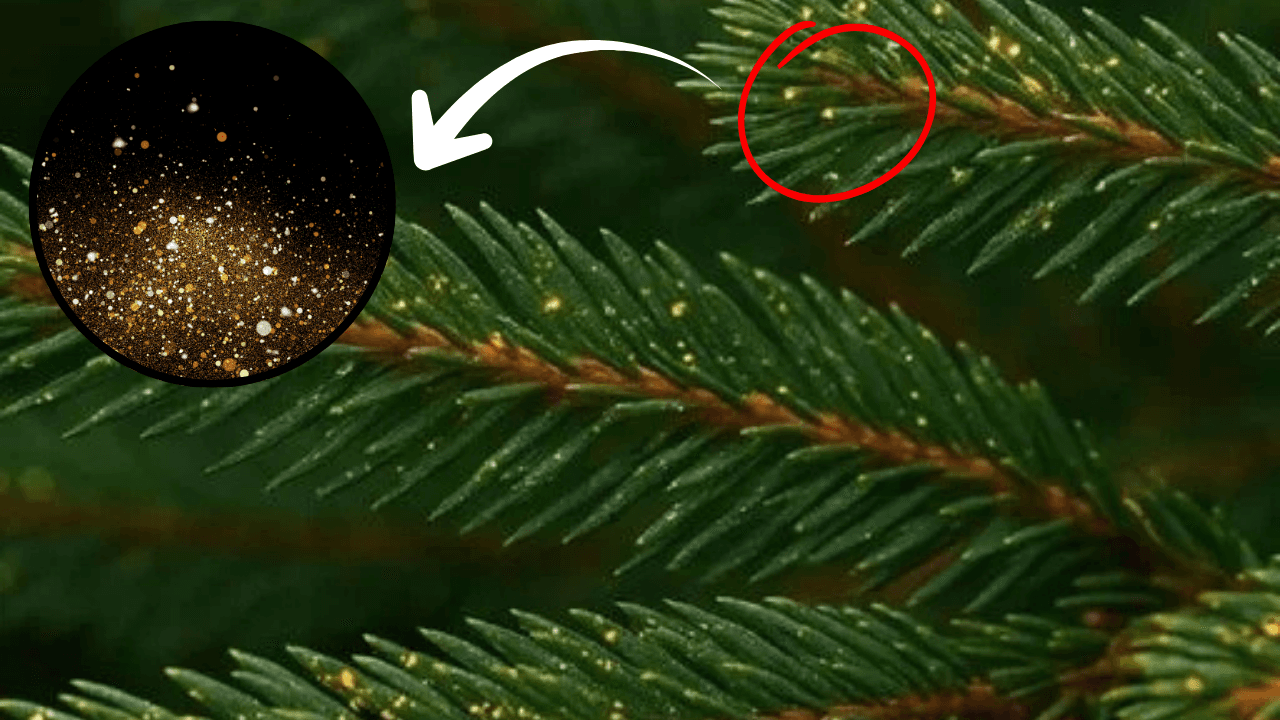
In the tranquil wilderness of northern Finland, a remarkable phenomenon has surfaced. Scientists from the University of Oulu and the Geological Survey of Finland have discovered that Norway spruce (Picea abies) needles harbor microscopic particles of gold. This dazzling find, published in Environmental Microbiome in August 2025, reveals that certain bacteria living quietly inside the trees might be turning dissolved gold into solid nanoparticles.
Using advanced scanning electron microscopy and energy-dispersive X-ray spectroscopy, researchers examined spruce needles collected from a gold-mineralized region in Northern Finland’s Central Lapland Greenstone Belt. Out of 23 trees studied, four showed clear signs of gold nanoparticles (Au-NPs) embedded in their tissues proof that the phenomenon, while rare, is very real.
The gold wasn’t visible to the naked eye, but it existed in nanoscale clusters, far smaller than a grain of dust. These tiny treasures point to an extraordinary biological partnership between tree and microbe.
The study suggests a process called biomineralization, a natural mechanism through which living organisms produce minerals, may be at work. The bacteria dwelling inside the spruce needles appear to transform dissolved gold ions from the soil into solid nanoparticles.
While the researchers stopped short of confirming the exact mechanism, they found a clear association between gold presence and specific bacterial taxa, including P3OB-42 (Myxococcales), Cutibacterium, and Corynebacterium. These microbes, known as endophytes, live inside plant tissues without causing disease and may unintentionally capture and mineralize gold as they process nutrients.
“Our results suggest that Au-nanoparticles are associated with bacteria like P3OB-42, Cutibacterium, and Corynebacterium in Norway spruce needles,” explained Dr. Lehosmaa, one of the study’s lead researchers.
This discovery isn’t just a biological curiosity—it could revolutionize eco-friendly mineral exploration. Traditionally, locating gold deposits requires invasive drilling and chemical sampling. But if trees can absorb traces of underground minerals and store them in their tissues, scientists might one day use vegetation as a natural sensor to map buried gold deposits.
Such biogeochemical exploration techniques could reduce environmental harm, making resource discovery cleaner and more sustainable.
Beyond gold, the study also sheds light on the deep cooperation between plants and microbes. It suggests that bacteria play a subtle yet vital role in Earth’s metal and carbon cycles, helping to shape ecosystems over millennia.
Although the study did not find evidence that gold particles serve as a defense mechanism against pathogens, the presence of these metals may still influence how plants respond to their environment, a topic scientists intend to explore further.
As the northern autumn descends on Lapland, the notion that spruce trees quietly collect microscopic gold deep within their needles feels almost mythic. Yet, it’s real proven by the delicate instruments of science.
The finding reminds us that nature still guards countless secrets, even in the most familiar landscapes. Beneath the soft green needles of a spruce tree, bacteria are at work slowly, invisibly turning the earth’s elements into hidden treasures.
What other mysteries might our forests hold? Perhaps, in the rustle of the pines, there are still clues to the unseen alchemy of life waiting to be discovered.