
Beneath the quiet forests and rolling ridges of the Appalachian Mountains, there’s something moving — slowly, silently, and on a timescale that makes even mountains seem impatient. Scientists have nicknamed it the Northern Appalachian Anomaly, or NAA.
It isn’t slime or molten lava racing toward the surface, but a massive body of unusually hot rock sitting about 124 miles (200 kilometers) beneath New England. And, over the next 10 to 15 million years, it’s creeping toward what will one day be the New York region.
Get Your Urgent News Out Fast
Breaking weather and crisis updates deserve instant reach. Share your announcement with journalists and news sites today and stay ahead of the conversation.
Send Your Updates → Trusted distribution. Quick turnaround. No fuss.The “blob,” as some call it, is enormous — stretching between 217 and 249 miles (350–400 kilometers) across. It sits in the asthenosphere, a semi-molten layer of the upper mantle, and it’s a thermal anomaly, meaning it’s hotter than the surrounding rock. The size and heat of this mass have long puzzled scientists, partly because it lies under a part of the continent that has been tectonically quiet for 180 million years.
For decades, many believed the anomaly formed when the North American continent broke away from northwest Africa about 180 million years ago during the breakup of the supercontinent Pangaea. But recent research, published in Geology on July 29, suggests a different origin story.
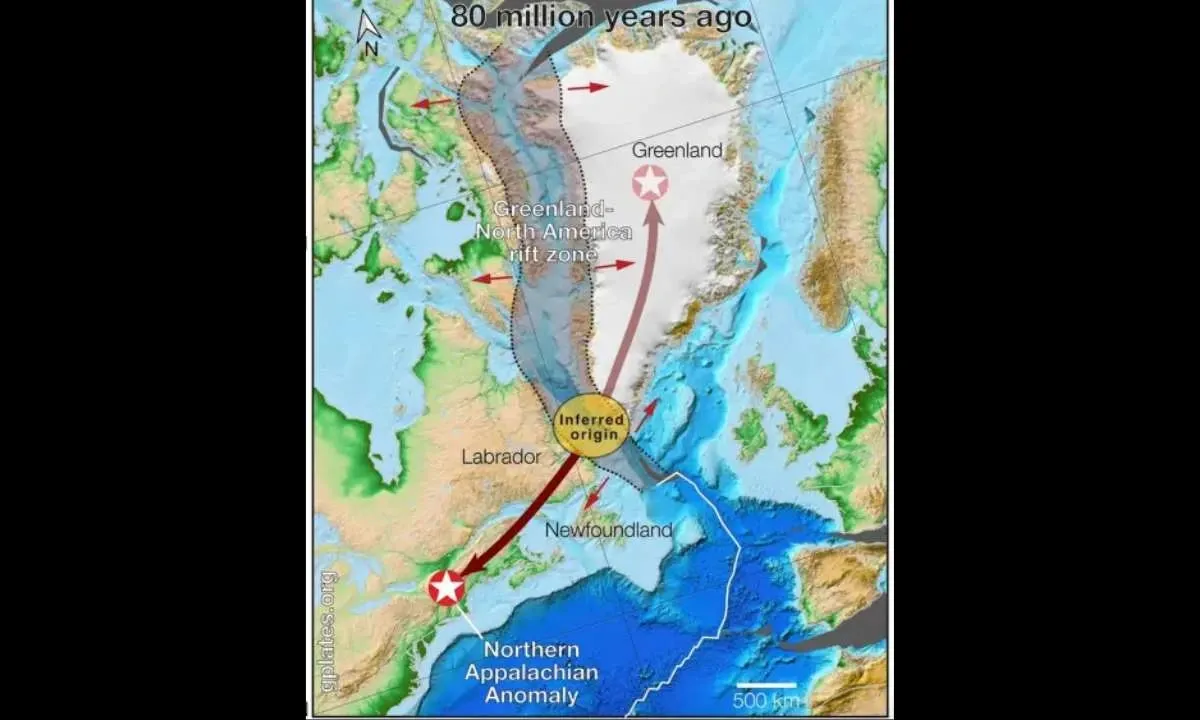
Using seismic tomography (imaging Earth’s interior through seismic waves), geodynamic simulations, and plate reconstructions, researchers traced the blob’s path back to a time about 80 million years ago — when Greenland and North America began separating near the Labrador Sea.
By their calculations, the NAA has traveled roughly 1,118 miles (1,800 kilometers) from its birthplace, moving at a rate of about 12.4 miles (20 kilometers) every million years. The driving mechanism, scientists believe, comes from a process they call “mantle waves.”
Picture a lava lamp: hot, dense rock detaches from the base of tectonic plates after rifting and starts moving in slow “blobs” beneath the continents. These blobs disturb the base of the continental root, triggering a chain reaction known as Rayleigh–Taylor instability, where pieces of dense material drip downward one after the other. Over millions of years, these drips migrate inland, carrying heat deep under stable regions like the Appalachians.
This heat doesn’t just sit there. It can weaken the base of the continental crust, making it more buoyant — like a hot air balloon after it drops some weight. This may help explain why the Appalachian Mountains, some of the oldest ranges in the world, remain taller than expected despite millions of years of erosion. In fact, the NAA may have contributed to a renewed uplift of the Appalachians over the last several million years.
The research also points to a “sibling” anomaly beneath north-central Greenland. This twin likely formed during the same continental breakup, but on the opposite side of the rift. Today, it helps generate heat beneath the thick Greenland ice sheet, influencing how the ice moves and melts.
Despite the playful comparisons to Ghostbusters II’s River of Slime, this underground blob poses no danger to human life or infrastructure. At its current pace, it won’t pass beneath New York for at least 10 million years. When it eventually moves on, scientists expect the crust beneath the Appalachians to settle, and erosion will slowly wear down the mountains further.
The discovery matters because it forces geologists to rethink how ancient tectonic events continue shaping Earth long after the surface appears calm.
“Even though the surface shows little sign of ongoing tectonics, deep below, the consequences of ancient rifting are still playing out,”
says lead author Tom Gernon, professor of Earth science at the University of Southampton.
These deep processes can influence everything from mountain building to rare volcanic eruptions — even the delivery of diamonds to the surface.
Researchers like Maureen D. Long at Yale are continuing to collect seismic data to better understand the NAA’s structure, behavior, and influence. Others, like seismologist Junlin Hua, see the proposed mechanism as promising, but believe more observation and modeling will be needed to confirm it.
What’s certain is that anomalies like this are rare windows into the long-term workings of our planet — processes that began tens of millions of years ago and will continue long after our cities, coastlines, and even current continents have changed beyond recognition.
In the end, the Northern Appalachian Anomaly isn’t a fast-moving threat. It’s a slow geological traveler, carrying with it the story of ancient rifts, shifting continents, and the hidden heat that helps keep mountains standing tall. It’s a reminder that beneath our feet, Earth is always in motion — just not at a pace we can see.
Disclosure: We may earn a commission when you make a purchase through the ads.