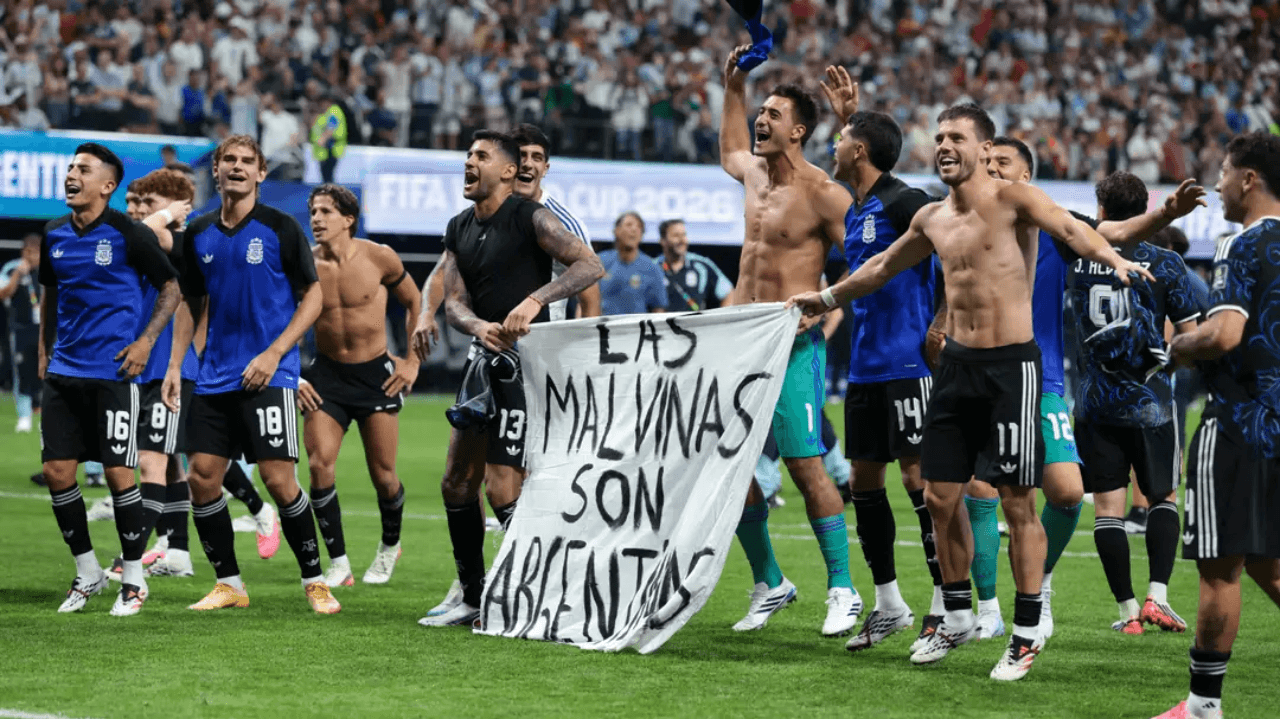
Argentina Falklands banner controversy has put politics, football and the World Cup final under sudden pressure.
FIFA is reviewing whether Argentina broke tournament rules after players displayed a Falkland Islands related banner following their World Cup semifinal win over England.
The controversy erupted after Argentina beat England 2 to 1 in Atlanta on Wednesday, July 15. During post match celebrations, players posed with a banner reading “Las Malvinas son Argentinas,” which means “The Malvinas are Argentine.”
The message refers to the Falkland Islands, a British overseas territory that Argentina claims and calls the Malvinas.
FIFA Is Reviewing the Match Reports
FIFA has not announced immediate bans for Argentina players before Sunday’s World Cup final against Spain.
A FIFA spokesperson told ITV that the independent Disciplinary Committee is assessing match reports and reviewing the circumstances before deciding on any further steps.
The same report said FIFA’s code of conduct bans banners, flags, flyers, clothing and other items of a political, offensive or discriminatory nature inside stadiums.
More details are available in ITV News’ report on FIFA’s review.
Why the Timing Matters
The timing of FIFA’s review matters because Argentina is due to face Spain in the World Cup final in East Rutherford, New Jersey.
Because FIFA is still assessing reports, Argentina’s players are expected to remain available for the final unless a new decision is announced before kickoff.
That makes the likely short term impact clear. The banner row has created political pressure, but it has not yet changed Argentina’s team selection for the final.
The longer term impact could come after the tournament if FIFA decides to fine the Argentine Football Association or punish individual players.
Britain Calls the Banner Inappropriate
The British government urged FIFA to investigate the incident.
A spokesperson for Prime Minister Keir Starmer said the World Cup might not belong to England, but the Falkland Islands do. The spokesperson added that self determination rests with the islanders.
U.K. Business Secretary Peter Kyle also criticized the banner. He said politics needs to be separate from football.
The Associated Press reported that FIFA can investigate Argentina’s players and federation because its disciplinary code bans political and ideological messages at stadiums. Read the AP report here: Associated Press report on the Falklands banner row.
Falkland Islands Officials Demand Action
The Falkland Islands Government Office in London said it was disappointed by the banner.
Officials said the gesture was insensitive to people in the Falklands, especially given the history of the 1982 war between Britain and Argentina.
The statement also said the islands and their people should not be used as a political football whenever England and Argentina meet in sport.
The government called on FIFA to enforce its own rules against political messages in football.
A Dispute With a Painful History
The Falkland Islands dispute has shaped relations between Britain and Argentina for decades.
Argentina invaded the islands in 1982 during the rule of its military dictatorship. Britain fought to retake them in a conflict that lasted about ten weeks.
The war killed 649 Argentine troops, 255 British service members and three islanders, according to the Associated Press.
That history gives the banner more weight than a normal post match celebration. For many people in Britain and the Falklands, the message reopened a painful political wound.
Argentina Has Faced FIFA Punishment Before
This is not the first time Argentina has faced FIFA scrutiny over a similar message.
AP reported that Argentina players displayed the same slogan before the 2014 World Cup during a warm up match against Slovenia. FIFA later fined the Argentine Football Association 30,000 Swiss francs.
That past case may shape expectations now. A fine may be more likely than an immediate player ban, though FIFA has not announced a decision.
A Final Overshadowed by Politics
Argentina’s semifinal win should have sent the team into the final with the focus on football.
Instead, the match has been followed by political backlash, calls for sanctions and questions over whether FIFA will act before the biggest game of the tournament.
For now, Argentina appears set to face Spain with its players available.
But the banner row has already changed the mood around the final. What began as a celebration has become a test of how firmly FIFA will enforce its promise to keep politics out of football.