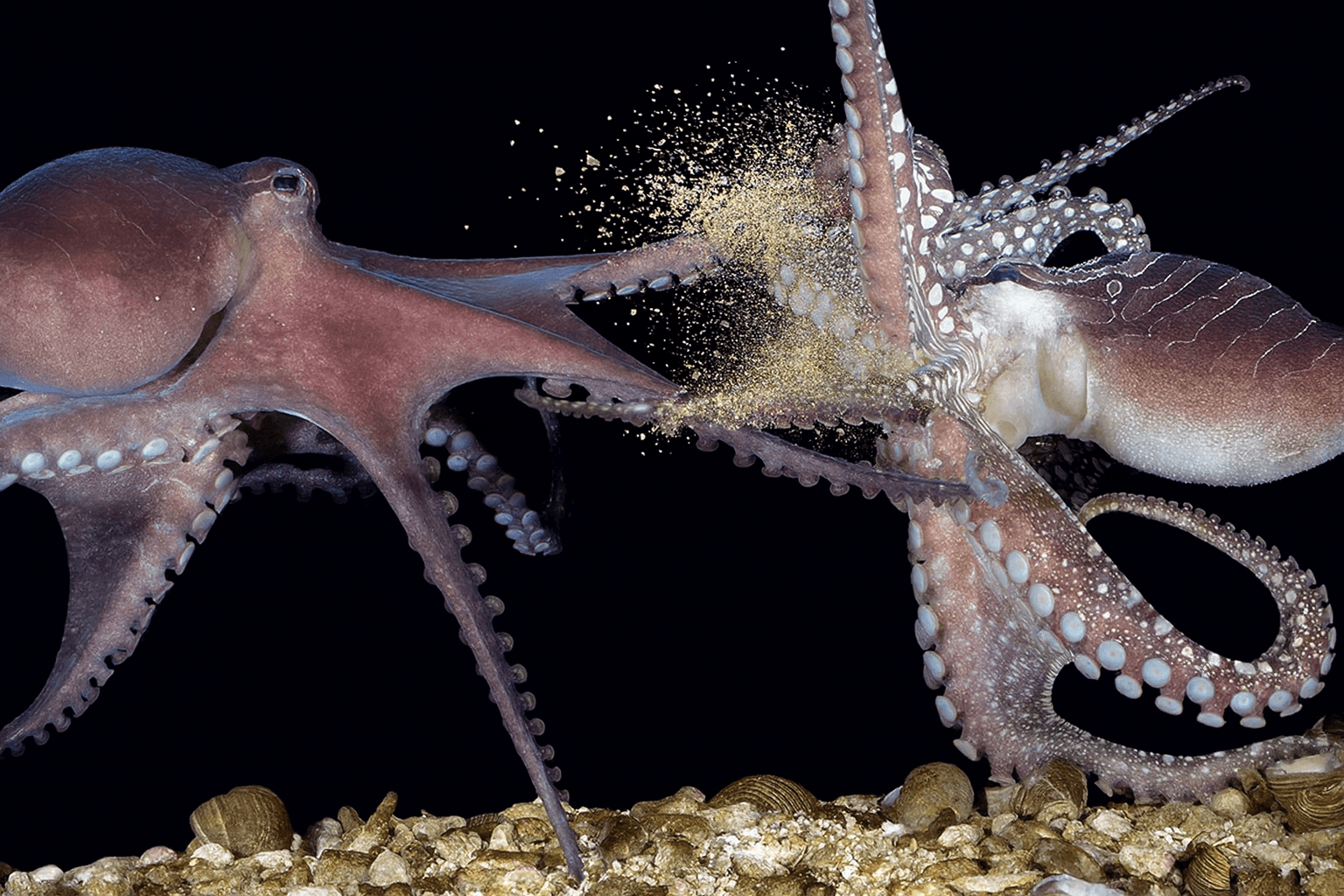
Off the coast of southeastern Australia, at a site nicknamed Octopolis, scientists observed something unusual. Instead of gliding silently across the sea floor or hiding in rocky dens, octopuses were flinging objects at one another.
Shells, silt, and even algae were scooped up, held in their arms, and then blasted through the water with a jet from their siphon. Sometimes the projectiles struck fish or even the cameras set up to record them. But most fascinating of all, many of these throws seemed aimed at fellow octopuses—especially when males refused to stop pestering females.

Researchers spent more than 20 hours filming octopuses in January 2015, capturing over 1,300 social interactions. In that time, they recorded 102 distinct throwing events. Two females were responsible for most of the action, launching debris at both nearby females and persistent males. Nearly nine out of ten throws were by females. Some of the most dramatic moments came when a female repeatedly hurled plumes of silt at a male trying to mate with her. By the end, the male began ducking before she even released the debris, as if expecting to be hit.
Octopuses are not the only animals known to throw things. Chimpanzees and capuchin monkeys have been seen tossing sticks or stones. Elephants sometimes hurl objects, and certain birds fling food or pebbles. But among animals, throwing at members of the same species is rare. That’s why the behavior at Octopolis drew so much attention. It places octopuses on a short list of creatures that use projectiles in social situations not just for hunting or defense, but also to communicate frustration or rejection.
The mechanics of the throw are uniquely octopus. Unlike humans, they don’t hurl with an arm. Instead, they gather debris under their web of arms, shift their siphon beneath the body, and blast water to propel the material outward. Throws can be weak, dropping shells a short distance, or powerful enough to launch debris several body lengths away. In social situations, females often threw with more force and chose silt more frequently than shells. Silt created a cloud that obscured vision, making it both messy and effective.
Not all throws hit their mark, but many did. In about one-third of social throws, another octopus was struck. Researchers even noticed that some females shifted the angle of their siphon or changed which arms they released material from, increasing the chance of a direct hit. In one sequence, a single female threw 17 times in an hour, hitting her neighbor nine times. In another, a female struck a male five times over a few hours after repeated mating attempts. The male eventually ducked earlier and earlier, anticipating her next shot.
Interestingly, the behavior wasn’t limited to battles of the sexes. Octopuses also threw at neighboring females, at fish that came too close, and even at cameras. At least a dozen projectiles were aimed toward recording equipment, and some hit the tripod itself. This suggests the throwing wasn’t random, it may have been a way of managing space, defending territory, or signaling annoyance.
Still, scientists debate whether octopuses truly intend to hit their targets. Some experts argue they might simply be cleaning their dens or discarding food remains, with other animals caught in the crossfire. Others point to altered aim, timing, and the persistence of hits on specific individuals as signs of deliberate targeting. The truth may lie somewhere in between: throwing as both a cleaning method and a social tool.
The broader significance is clear. Octopuses have long fascinated researchers with their intelligence. They can solve puzzles, escape enclosures, and even short-circuit aquarium lights by squirting water at bulbs. Their arms are packed with sensory neurons, allowing them to taste and feel with extraordinary sensitivity. Adding projectile throwing to their list of behaviors shows how flexible and inventive they are.
Whether meant as aggression, frustration, or a dramatic “leave me alone,” these throws reshape how we think about octopuses. Once seen as solitary and mysterious, they are now recognized as animals with complex social lives and surprising ways of asserting boundaries. Watching a female octopus blast a cloud of silt at an overzealous male might feel strangely familiar—it’s a reminder that even in the alien world of the ocean, the struggle to say no is universal.