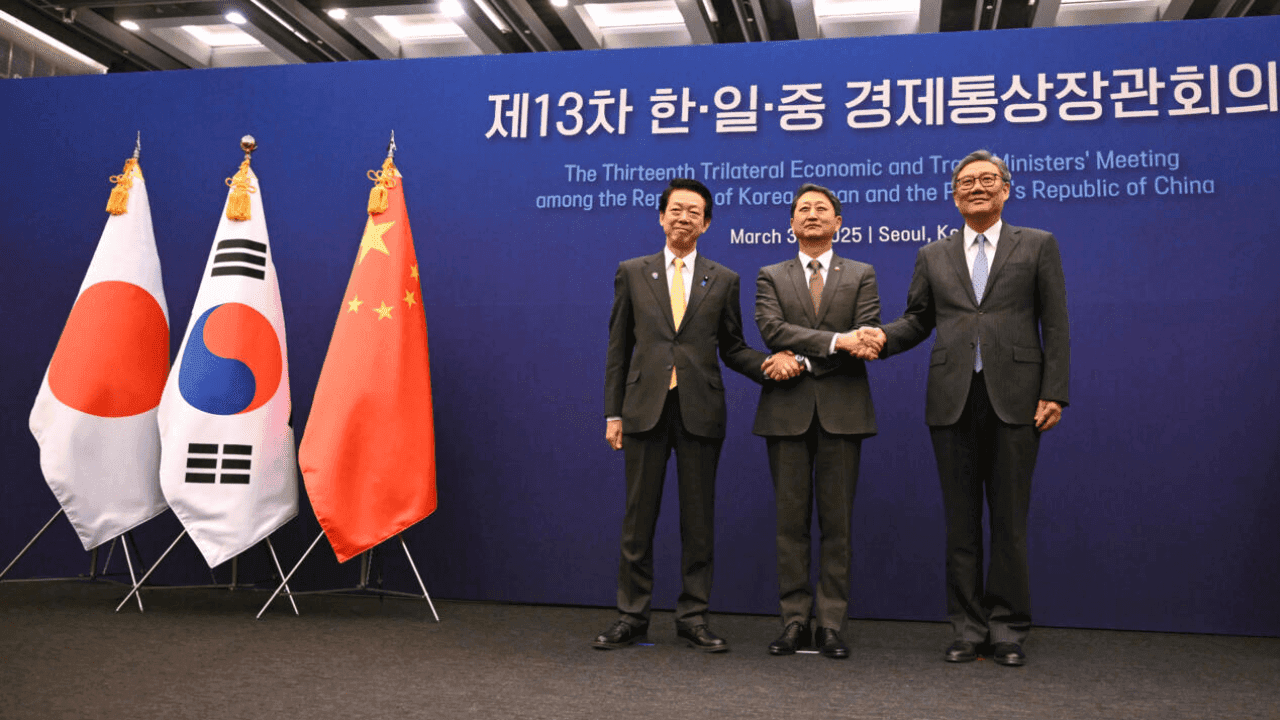
In a historical move, China, Japan, and South Korea have joined forces against a common economic adversary: the U.S. tariffs. During their first economic talks in five years, these Asian powerhouses agreed to collaborate in response to mounting U.S. tariffs, which are part of broader trade tensions with the United States. The meeting was critical, marking a significant pivot towards regional unity amid escalating trade pressures from the West.
The catalyst for this unprecedented alliance is the U.S. government’s plan to escalate its tariff strategy under the leadership of President Donald Trump. Set to announce new tariffs on April 2, dubbed as ‘Liberation Day, ‘ Trump aims to reduce U.S. dependency on foreign imports by imposing reciprocal tariffs. These developments have intensified regional trade dynamics, bringing traditionally competitive neighbors together.
Trade ministers from the three countries, namely South Korea’s Trade Minister Ahn Duk-geun, Japan’s Yoji Muto, and China’s Wang Wentao, engaged in robust discussions in Seoul. They unanimously agreed on strengthening supply chains and increasing trade collaboration to mitigate the impact of U.S. tariffs. Japan and South Korea agreed to import semiconductor raw materials from China, while China plans to procure finished chip products from its neighbors, further solidifying their integrated economic strategy.
This alliance transcends mere economic cooperation; it represents a pivotal shift towards regional stability and economic resilience in Asia. The three nations are exploring a comprehensive free trade agreement, which has the potential to reshape global trade patterns. Their objective remains focused: to preserve smooth trade flows despite increasing economic pressures and to counteract the potential disruptions caused by U.S. trade policies.
The significance of this emerging alliance cannot be understated. While the U.S. continues to adopt protectionist policies, Asia’s response demonstrates a commitment to open trade and cooperation. Expert analysts see this move as both a defensive strategy and an opportunity to redefine trade relationships on a global scale. The historical tensions among China, Japan, and South Korea add an extra layer of complexity, making this economic rapprochement a remarkable development.
Historically rivals, the spirit of cooperation in managing economic challenges could herald a new era of Asian economic integration. The pursuit of a joint strategy reflects a broader acknowledgment of shared challenges and mutual benefits, underscoring the importance of regional solidarity in the face of global economic shifts. As the world watches, the actions of these three nations may set a precedent for how countries can navigate the turbulent waters of international trade warfare.