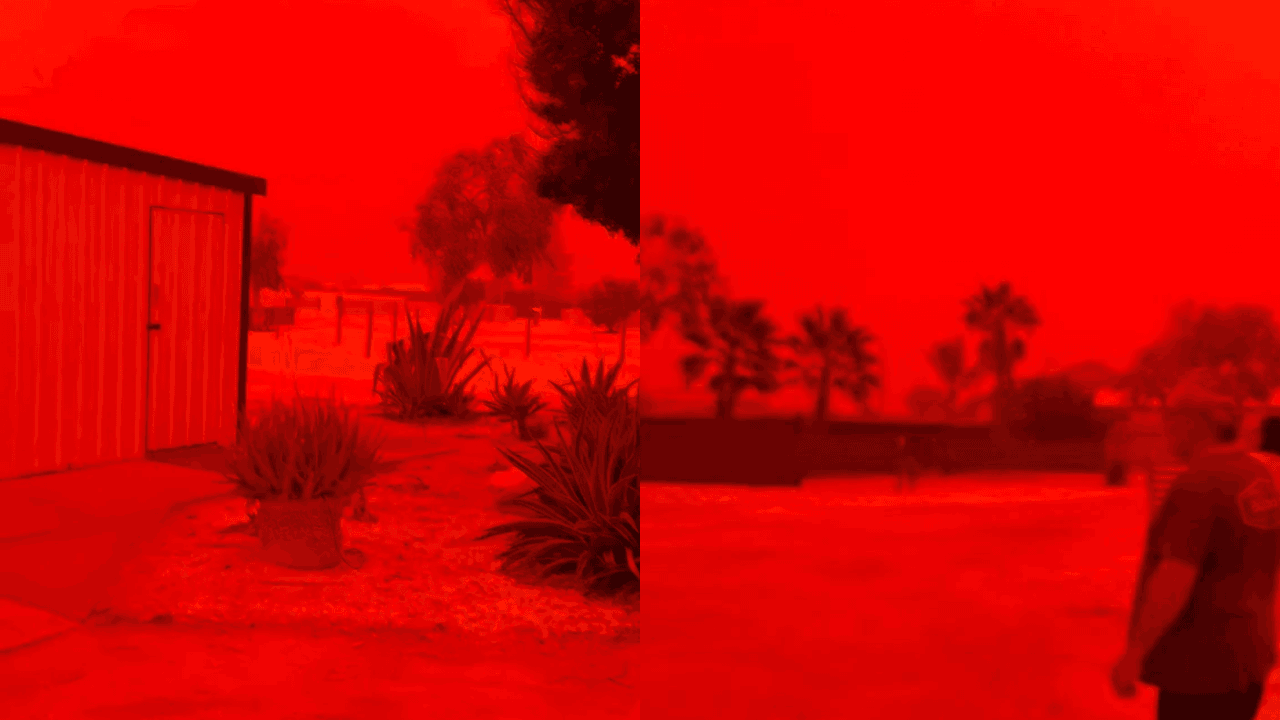
Residents in Western Australia looked up and saw a sky that didn’t look real.
On March 27, 2026, areas like Shark Bay and the Pilbara were covered in a deep red glow. The scene looked like something from another planet. But scientists say the cause was very real and rooted in powerful weather and physics.
What Caused the Red Sky
The strange color came from Tropical Cyclone Narelle. As the storm approached, strong winds lifted huge amounts of dust from the Australian outback.
This dust is rich in iron oxide, a mineral that reflects red light. When the dust filled the air, it filtered sunlight and changed the color of the sky.
More details on atmospheric events can be found at the NASA Earth Observatory.
The Science Behind the Color
Normally, the sky appears blue because of a process called Rayleigh scattering. This happens when small air molecules scatter shorter wavelengths of light.
In this case, larger dust particles changed the effect. Scientists call this Mie scattering. These particles blocked blue and green light while allowing red light to pass through.
The result was a deep red sky, similar to what scientists observe on Mars.
A Rare and Powerful Storm
Tropical Cyclone Narelle is not an ordinary storm. Meteorologists say it is only the third storm on record to cross three different Australian coastlines.
It reached Category 3 to 4 strength, bringing winds over 125 kilometers per hour. While the storm caused damage, it was the red sky that captured global attention.
Official cyclone tracking data can be accessed through the Australian Bureau of Meteorology.
More Than Just a Visual Spectacle
Experts warn that these events are not just dramatic to look at. Dust storms can harm air quality and reduce visibility.
There are also long-term concerns. Scientists believe climate change may increase the frequency of such events by drying inland areas and strengthening storms.
The dust can also affect ocean ecosystems when it settles into the water, changing nutrient cycles.
Why This Event Matters
The red sky over Australia is a powerful reminder of how nature can transform the world in unexpected ways.
It shows how weather, geography, and physics can combine to create something both beautiful and alarming.
For many who witnessed it, the moment felt unreal. But for scientists, it offers valuable insight into how our planet is changing.