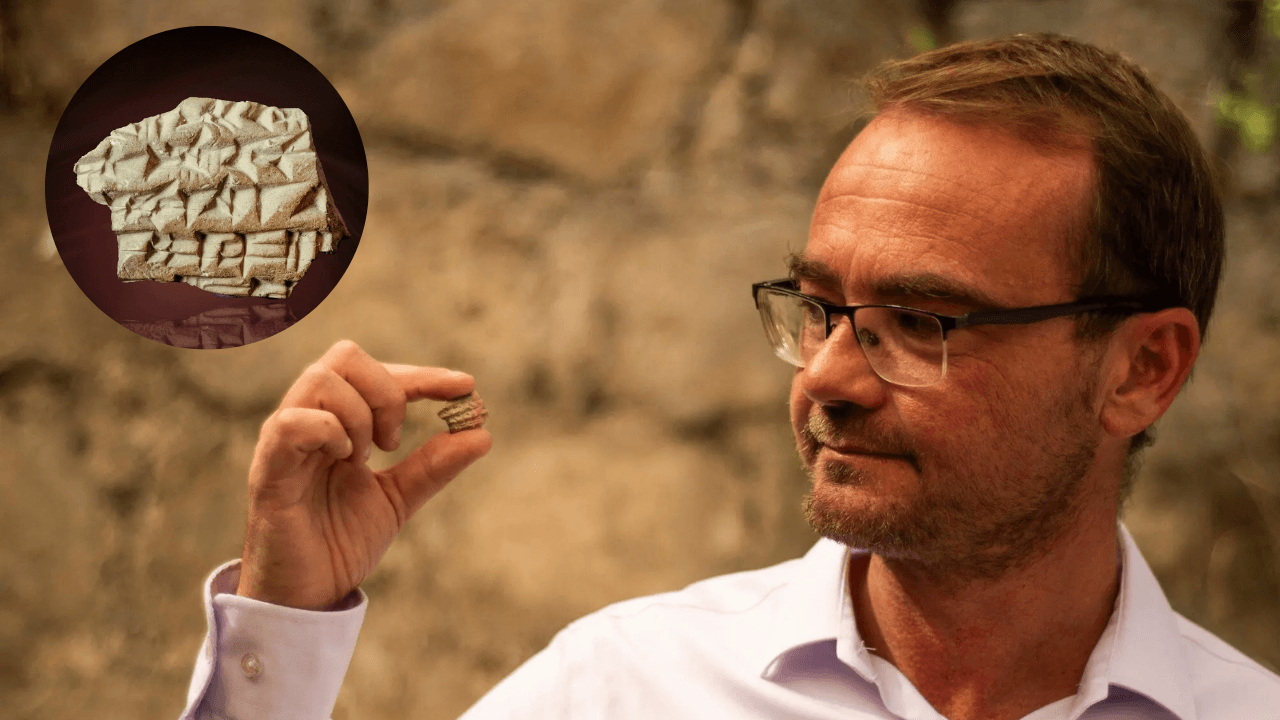
A tiny Assyrian inscription found in Jerusalem may reveal a real political crisis behind a famous Bible story.
Archaeologists say the small clay fragment, dating back about 2,700 years, appears to point to tense relations between the Assyrian Empire and the Kingdom of Judah. The find was uncovered near the Temple Mount area in Jerusalem and may be the first known Assyrian inscription of its kind found in the city.
The fragment is only about 1 inch wide. But researchers say it may have once been part of an official clay sealing used to close or authenticate a royal message. The text was written in Akkadian cuneiform, the writing system used by the Assyrian Empire.
The discovery was announced by the Israel Antiquities Authority, which described it as rare evidence of royal Assyrian communication with the king of Judah.

A Small Fragment With a Large Historical Message
Researchers believe the inscription refers to a delayed payment from Judah to Assyria. The message appears to mention a payment deadline connected to the first day of the Hebrew month of Av.
That detail matters because Judah was under heavy pressure from Assyria during the late eighth and seventh centuries BCE. At that time, Assyria was one of the most powerful empires in the ancient Near East. Smaller kingdoms, including Judah, often had to pay tribute to keep their position and avoid military punishment.
Peter Zilberg, a Near Eastern studies expert at Bar-Ilan University, helped study the artifact. He told The Times of Israel that the inscription works like “a flashlight in the fog of history.”
Scientists also studied the clay itself. Their analysis traced its origin to the Tigris basin, the region where major Assyrian cities once stood. That suggests the item likely came from the heart of the Assyrian Empire before reaching Jerusalem.

Why It Connects to the Bible Story
The discovery does not prove every detail of the biblical account. But it may support the broader historical setting behind the story of Judah, Assyria, tribute, and rebellion.
In the Second Book of Kings, King Hezekiah of Judah rebels against Assyria. The account says King Sennacherib of Assyria later marched against the fortified cities of Judah and demanded payment.
The passage says Hezekiah sent a message to the Assyrian king at Lachish. He then agreed to pay what Assyria imposed on him, including silver and gold.
Experts say the newly found inscription appears to echo that same world of tribute demands, delayed payments, and political pressure. The artifact does not name Hezekiah or Sennacherib in the surviving text. The broken fragment also does not preserve the exact year.
Still, its style and language place it in the same broad period of conflict between Judah and Assyria. That makes it a rare piece of evidence from Jerusalem itself, rather than from Assyrian archives found elsewhere.
Researchers Urge Caution About the Find
The most important word around this discovery is “may.” The inscription may relate to the same kind of tribute dispute described in the Bible, but researchers cannot yet say which Judean king received the message.
The possible recipients include kings who ruled during periods of Assyrian power over Judah. The fragment may date to the time of Hezekiah, Manasseh, or Josiah, according to reporting on the discovery.
The Biblical Archaeology Society reported that Zilberg and Filip Vukosavović said the demand could reflect a technical delay or a more political act. Either way, they said the official appeal points to friction between Judah and the Assyrian government.
That careful wording is important. Archaeology rarely gives a full story from one object. In this case, the fragment gives researchers a direct clue about how imperial power reached Jerusalem through taxes, messages, deadlines, and pressure.
A Rare Look at Ancient Power Politics
The find helps show how small kingdoms had to deal with ancient superpowers. Judah was not isolated. It sat inside a dangerous political world shaped by empire, money, military force, and diplomacy.
Assyria controlled large areas of the Near East. Its rulers used tribute payments to keep smaller states in line. When those payments stopped or slowed, the result could be military action.
That is why this tiny fragment has drawn so much attention. It may capture a real moment when Judah faced pressure from one of the strongest empires of the ancient world.
For historians, the find also helps connect different kinds of evidence. The Bible preserves a religious and national memory of the crisis. Assyrian sources preserve the empire’s view. This fragment adds a new piece from Jerusalem itself.
Why the Discovery Matters Now
The discovery stands out because it comes from a place tied to some of the most studied events in biblical history. It also shows why small artifacts can change how scholars understand the past.
A broken piece of clay cannot settle every debate. But it can narrow the gap between ancient text and ancient reality.
In this case, the Assyrian inscription gives researchers a rare look at the official pressure Judah faced under imperial rule. It also reminds readers that famous Bible stories often took shape inside real political conflicts, with kings, taxes, deadlines, and consequences.
That is why this 1 inch fragment matters. It does not just sit in the past. It opens a small but powerful window into the world behind one of the Bible’s most dramatic political stories.::contentReference{index=0}