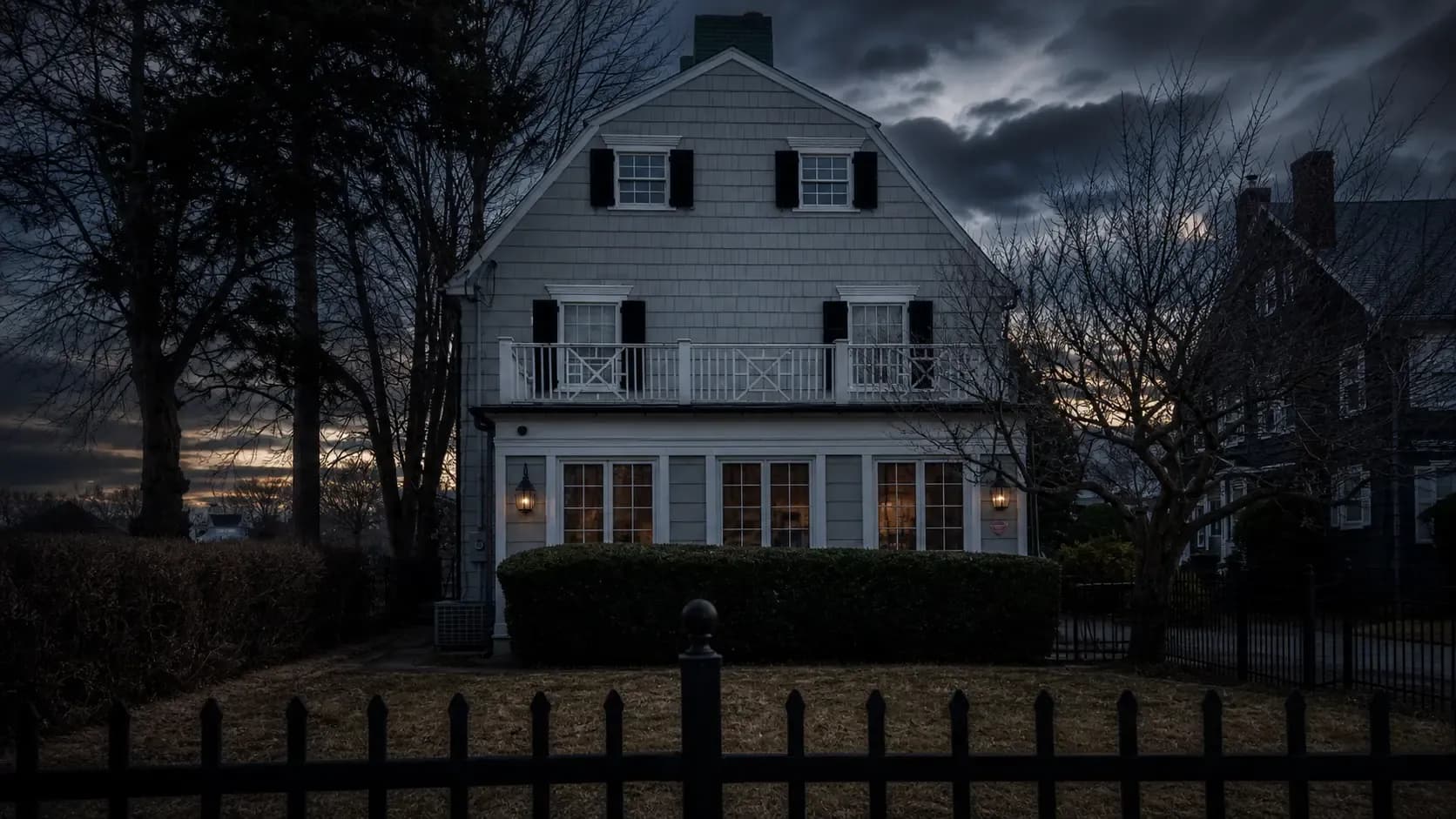
The Amityville Horror House is one of the rare American homes whose address became a warning sign. The Dutch Colonial on Ocean Avenue in Amityville, New York, was first known for a brutal 1974 mass murder. Then came the Lutz family, who moved in one year later and said the house drove them out in 28 days.
The story grew into Jay Anson’s 1977 book, a blockbuster 1979 horror movie and a franchise that still feeds new films, documentaries and online debates. Yet the house itself is not a museum, attraction or ghost tour stop. It is a private home, changed over time by owners who wanted distance from the legend.
Creep Factor Score: 8.8/10
Rating: Nightmare Fuel
| Historical Darkness | 10/10 |
| Paranormal Reputation | 8/10 |
| Atmosphere | 8/10 |
| Horror Fame | 10/10 |
| Visitor Experience | 6/10 |
How We Calculated This Score
This editorial Creep Factor Score is based on the home’s verified murder history, disputed but world-famous paranormal reputation, unsettling suburban atmosphere, major horror-film legacy and limited visitor access. The score is high because the cultural impact is enormous, even though the haunting claims remain contested.
Why Is The Amityville Horror House Famous?
The Amityville Horror House is famous because two stories fused into one national nightmare. The first is verified crime history. On Nov. 13, 1974, Ronald DeFeo Jr. killed six members of his family inside the home, including his parents and four siblings. He was later convicted of six counts of second-degree murder.
The second story is disputed paranormal folklore. George and Kathy Lutz bought the house in 1975, moved in with three children and left less than a month later. They claimed the home was plagued by voices, cold spots, foul odors, strange noises, moving objects and demonic presences.
Those claims became the basis for Jay Anson’s 1977 novel The Amityville Horror, which was marketed as a true story. The 1979 movie adaptation turned the house into one of the most recognizable haunted homes in American pop culture.
The Story Behind The Legend
The house was built in 1928 on the Amityville River. Its waterfront setting, boathouse and Dutch Colonial profile once made it look like an upper-middle-class Long Island dream. The DeFeo family moved there in the 1960s and called the home “High Hopes.”
That name became grim after the 1974 murders. Ronald DeFeo Jr., then 23, initially claimed someone else had killed his family. Police soon found problems in his account, and DeFeo confessed. He later changed his story several times, including claims that voices told him to kill and later claims involving his sister Dawn.
Records support the central fact: six members of the DeFeo family died in the house. DeFeo was convicted in 1975 and sentenced to 25 years to life for each count. He died in state custody in 2021.
In December 1975, the Lutz family bought the house at a reduced price. They knew about the murders. What happened next depends on whom you ask. The Lutzes said the atmosphere changed almost immediately. George Lutz later described waking around 3:15 a.m., the approximate time associated with the killings. Other claims included slime on walls, a hidden red room, flies in winter and a red-eyed piglike figure named Jodie.
After 28 days, the family left. Their story reached newspapers, paranormal investigators and eventually publishers. Anson’s book arrived in 1977, and The Amityville Horror followed in 1979 with James Brolin and Margot Kidder. The film was not shot inside the real house. Production used a home in Toms River, New Jersey, and soundstages in Los Angeles.
View this post on Instagram
Why People Think It’s Haunted
The haunting reputation rests mostly on the Lutz family’s claims and the paranormal investigators who supported them. Ed and Lorraine Warren visited the house in 1976, and their involvement helped move the story from local mystery to supernatural case file.
The most famous claims are vivid: a priest warned away by a hostile voice, invisible forces, unexplained illness, levitation, blackened toilets, cold rooms and the Jodie figure watching from the old quarter-round windows. These details are powerful storytelling, which is exactly why they endured.
But the evidence remains disputed. Later owners have publicly said they experienced no haunting. Ronald DeFeo Jr.’s former attorney, William Weber, said the story was invented with the Lutzes. George Lutz denied that and maintained that much of the story was true.
That tension is why Amityville still works as horror folklore. It has enough verified tragedy to feel grounded and enough disputed detail to keep people arguing.
Fact Vs Fiction
Some stories about The Amityville Horror House come from documented history, while others grew through folklore, horror movies or disputed retellings.
Fact: Ronald DeFeo Jr. killed six family members in the house in 1974.
Fact: George and Kathy Lutz left the home after 28 days.
Fiction: The 1979 movie was not filmed inside the real Amityville house.
Fiction: Claims of demons, slime and levitation are not supported by verified public records.
Can You Visit Today?
No, visitors should not try to enter the Amityville Horror House. It is a private home, not a public attraction. There are no official tours, overnight stays or public paranormal investigations at the property.
Horror fans still drive through Amityville, but the respectful choice is simple: do not trespass, block traffic, photograph residents or treat the house like a set. The story may be public, but the property is not.
For travelers, the better experience is cultural rather than physical. Watch the original film, read about the case, compare the real house with the Toms River filming location and explore Long Island history without disturbing the current occupants.
Is It Worth Visiting?
The Amityville Horror House is worth understanding, but not worth treating as a destination you can tour. Its power comes from the strange overlap of suburban comfort, true crime, paranormal claims and Hollywood mythmaking.
Horror fans will find it essential background. For dark tourism readers, it is a cautionary case about where curiosity meets privacy. Paranormal believers still see it as one of America’s most famous haunting claims. Skeptics may read it as a classic example of how media can turn contested testimony into national folklore.
The creepiest thing about Amityville may not be whether the walls whispered. It may be that an ordinary family home became impossible to see as ordinary again.
FAQ
There is no verified proof that the house is haunted. The haunting claims come mainly from the Lutz family and paranormal investigators, while later owners reported no unusual activity.
On Nov. 13, 1974, Ronald DeFeo Jr. killed six members of his family inside the home. He was convicted of six counts of second-degree murder.
No. The house is a private residence. It is not open for tours, overnight stays or public investigations.
No. The 1979 film used a house in Toms River, New Jersey, and studio interiors, not the actual Amityville home.
The home was originally known as 112 Ocean Ave. The address was later changed to 108 Ocean Ave. to discourage unwanted visitors.