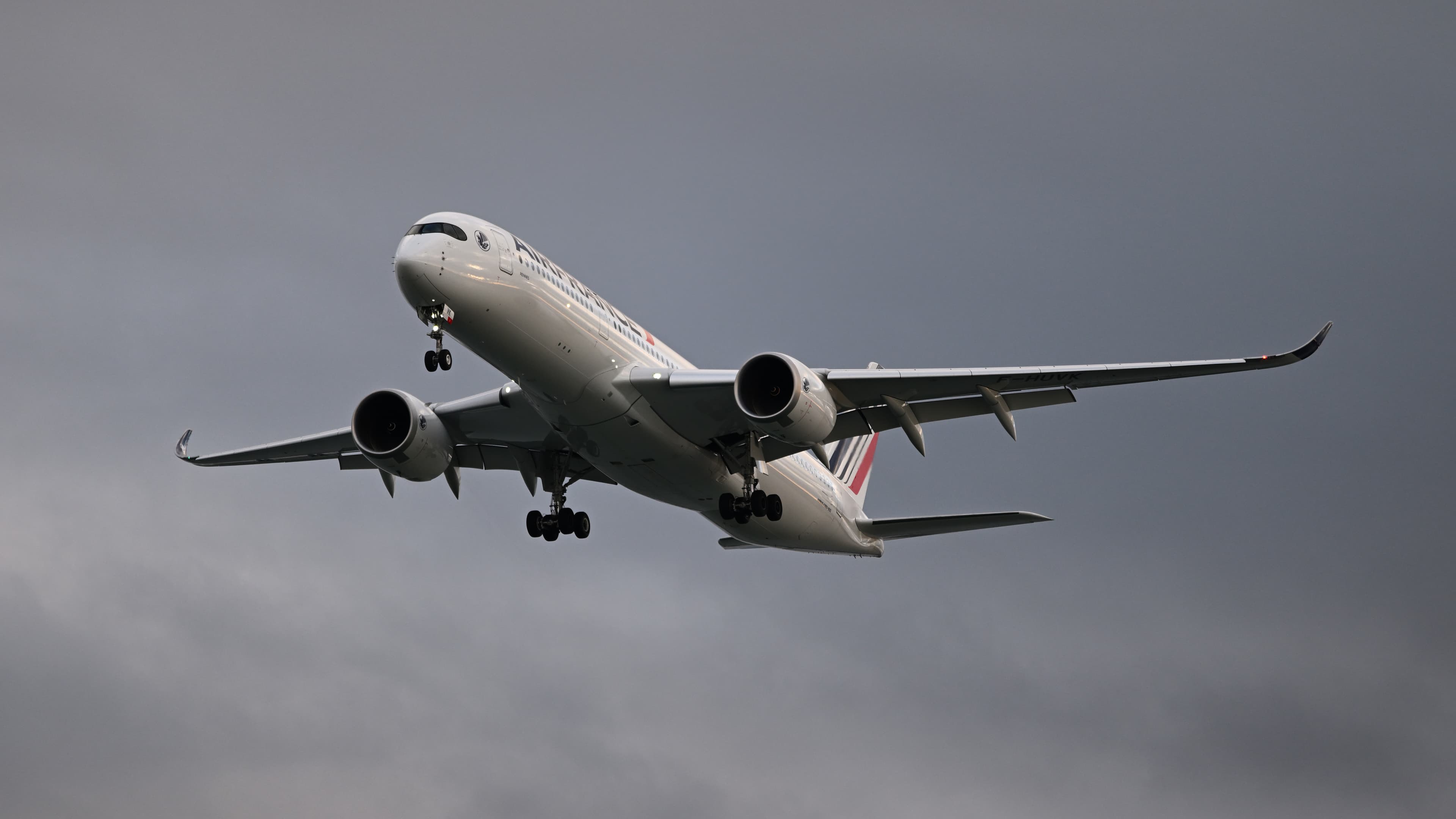
An Air France passenger jet made an unexpected turn shortly after taking off from Los Angeles International Airport, bringing it toward the flight path of an American Airlines plane that had just departed from another runway.
The two aircraft were climbing into the night sky on November 7, 2026, when an air traffic controller spotted the developing conflict.
The controller ordered the Air France pilots to turn immediately and told the American Airlines crew to stop climbing.
Both flights continued safely, but the radio exchange revealed how quickly the situation had developed.
Air France Jet Turned Toward Another Plane After Takeoff
The incident happened at approximately 12:15 a.m. local time on Saturday, November 7.
Air France Flight AF28, an Airbus A350-900, had departed runway 24L at LAX. The flight was bound for Papeete, Tahiti, in French Polynesia.
About a minute later, American Airlines Flight AA1660, an Airbus A321-200, departed runway 25R for Dallas–Fort Worth, Texas.
The runways are part of LAX's parallel departure system.
According to aviation reports and available air traffic control recordings, the Air France aircraft made an unexpected left turn instead of following its assigned departure route.
That turn carried it toward the path of the American Airlines jet.
The cause of the unexpected maneuver has not been confirmed.
Air Traffic Controller Issued an Immediate Warning
The American Airlines crew had reported climbing through approximately 2,000 feet toward 5,000 feet.
As the two flight paths converged, the controller gave Air France an urgent instruction to fly a heading of 270 degrees, directing it west.
The American Airlines crew received a traffic warning.
“Traffic twelve o'clock. Less than a mile,” the controller said, according to the recorded exchange reported by aviation outlet View from the Wing.
The controller also instructed the American Airlines pilots to maintain 2,000 feet rather than continue climbing.
The crews acknowledged the instructions and the aircraft moved apart.
The intervention prevented the developing conflict from continuing.
How Close Did the Two Planes Get?
Early reports gave slightly different figures for the aircraft's separation.
Flight-tracking analysis cited by AIRLIVE estimated that the jets came as close as 0.76 nautical miles apart horizontally.
The same analysis reported roughly 300 feet of vertical separation at a point when the planes were about 1.6 nautical miles apart.
Other aviation reports described a vertical gap of approximately 400 feet.
Those numbers describe different measurements and moments during the encounter. They do not mean the aircraft came within only 300 or 400 feet of one another in total distance.
The available figures are preliminary, and no final official reconstruction had been released as of November 8.
There were no reported injuries or aircraft damage.
Controller Questioned the Air France Crew
Once the immediate danger had passed, the controller asked the Air France pilots about the departure clearance they had received.
The aircraft had been assigned the SUMMR2 standard instrument departure, a published route used to guide planes away from LAX after takeoff.
According to the recorded exchange, the crew eventually confirmed the assigned procedure.
The controller then advised the pilots of a possible pilot deviation and gave them a telephone number to call.
That notification is not a final finding that the pilots broke a rule. It indicates that the event may require further review.
The reason for the unexpected turn remains unclear. No official finding has established whether it involved a misunderstanding, a flight-management issue or another cause.
Both Flights Continued to Their Destinations
After the aircraft were safely separated, the American Airlines jet was cleared to continue climbing.
The Air France plane also resumed its journey toward Tahiti.
Both aircraft completed their flights without a reported collision, injury or damage.
The incident drew attention after air traffic control audio and flight-tracking replays circulated online.
Aviation observers praised the controller's quick instructions, while also raising questions about why the Air France aircraft departed from its expected route.
Why This Close Call Matters
Airports such as LAX handle departures from several runways within a small area.
Pilots rely on assigned routes and instructions to keep aircraft separated as they climb.
When a plane turns unexpectedly, its path can cross into the space being used by another aircraft.
In this case, the controller responded by changing one aircraft's heading and limiting the other's climb.
The event shows how several layers of aviation safety work together: published departure routes, radar monitoring, radio communication and prompt action by flight crews.
The passengers on both aircraft reached their destinations safely. But the encounter left an important unanswered question: why did the Air France jet turn toward another departing plane?
Editor's note: This incident occurred on November 7, 2026. Early flight-tracking reports differ on the precise vertical separation, and a possible pilot deviation notice is not an official determination of fault. No final explanation for the turn had been publicly confirmed as of November 8.
Sources: AeroTime — Air France A350 departure deviation near American A321, November 8, 2026; AIRLIVE — Flight-tracking separation analysis, November 8, 2026; View from the Wing — ATC audio and departure-route analysis, November 8, 2026; AeroCorner — Aircraft, route and FAA procedure analysis, November 8, 2026; New York Post — Original news report, November 8, 2026.