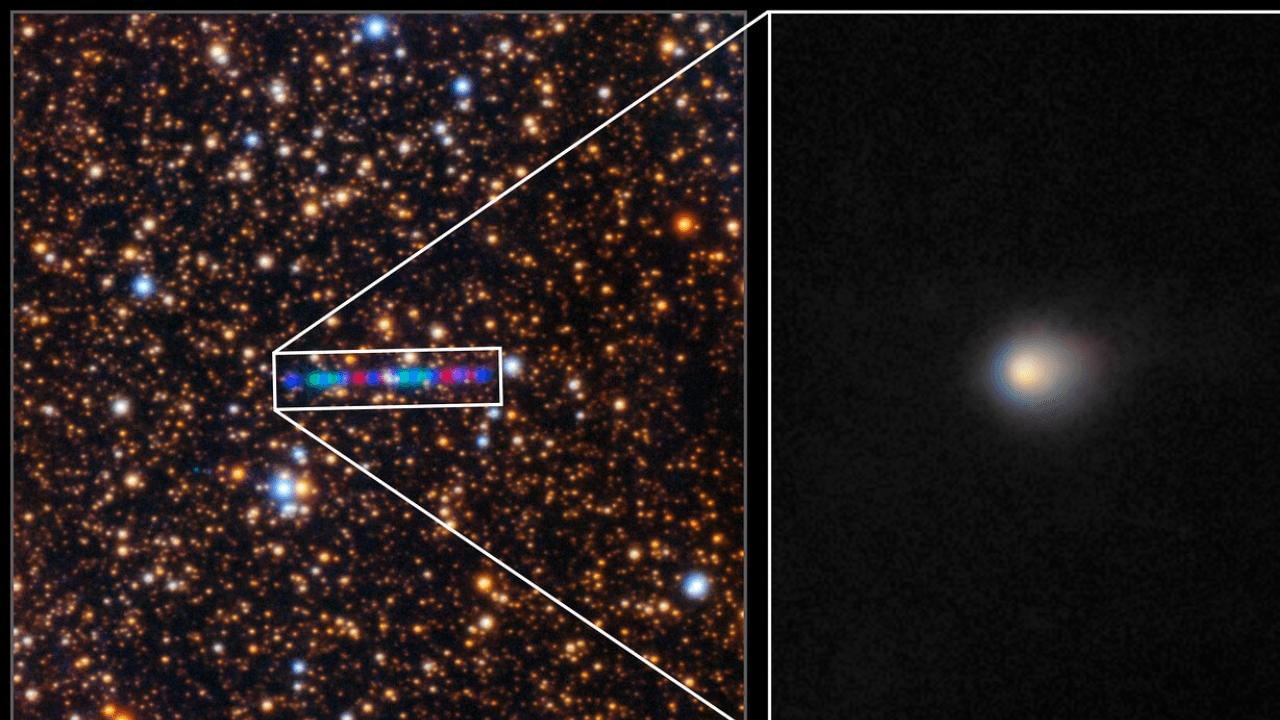
The comet known as 3I/ATLAS arrives at a major milestone today — its closest approach to the Sun, called perihelion. Though invisible to the naked eye, this event matters deeply for astronomers and science as a whole.
What’s happening today
The comet hits perihelion today at about 11:47 UTC when it will pass roughly 1.36 astronomical units (AU) from the Sun .that’s between Earth’s orbit and Mars’.But from Earth, the view is blocked because the comet sits behind the Sun, so ground-based telescopes can’t capture the moment.
Why scientists are watching closely
Because this comet came from outside our solar system making it only the third confirmed interstellar object ever observed. As it warms up near the Sun, it’s already showing unusual behavior: jets of gas and dust, strange chemical signatures like a strong nickel line without much iron, and a rich CO₂-laden coma. These odd features make it a hot target for study.
Good news: no threat to Earth
Despite all the intrigue, scientists stress that 3I/ATLAS poses no hazard to our planet. Its closest approach to Earth will be about 1.8 AU in December – safely far away. :contentReference
What’s next in its journey
After clearing its closest point to the Sun, the comet will head outward again. It will pass about 0.65 AU from Venus in early November and continue to drift past Jupiter in 2026 as it leaves the inner solar system. Meanwhile, observatories are preparing for its return from behind the Sun so they can catch it in the pre-dawn sky later in November.
The bigger story
This tiny visitor holds clues about other star systems and the materials found far beyond our Solar System. Since it did not form around our Sun, the dust and gases it releases could reflect the chemistry of distant space.Through it, scientists hope to deepen our understanding of how common or rare different objects and conditions are across the galaxy.