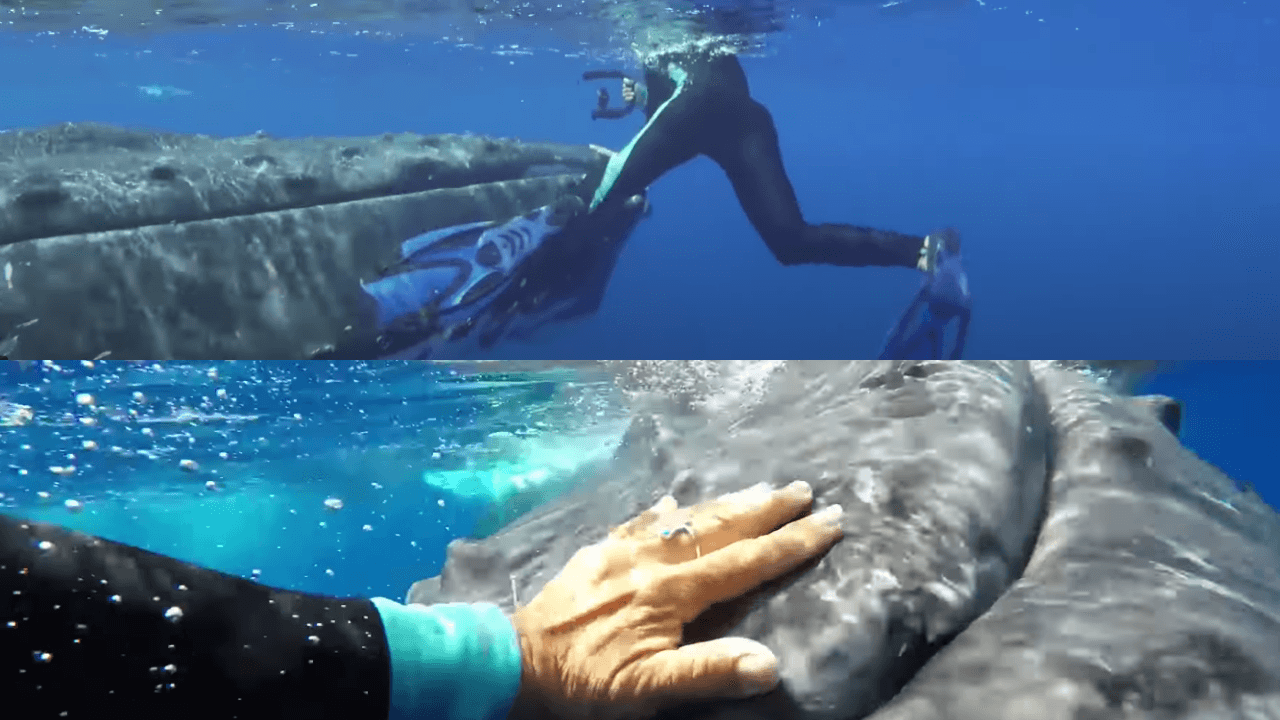
Marine biologist Nan Hauser was filming whales when a massive humpback whale swam directly toward her. This was no ordinary encounter. The whale nudged her, lifted her partially out of the water, and even attempted to tuck her under its pectoral fin.
Though confused at first, Nan soon noticed something alarming nearby a large shark, likely a 14-foot tiger shark, was trailing in the distance. For over seven minutes, the whale kept its enormous body between Nan and the shark, continuously maneuvering to block her from the predator. It seemed as if the whale sensed she was in danger and chose to protect her.

Was this instinct? Empathy? Something beyond human understanding? Whatever it was, the moment carried the weight of something deeper an encounter that felt like connection between two vastly different beings.
Nan later recounted, “I’ve never experienced anything like it in my life.” The whale swam beneath her, gently lifting her, almost as if to say, “You’re safe with me.” The experience was breathtaking and calming a reminder that nature, in its wildest corners, still holds mysteries we are only beginning to grasp.
This encounter wasn’t just a fluke.
Over the years, humpback whales have been observed exhibiting what some scientists interpret as protective behavior such as intervening when orcas attack seals or other whales. While it’s still debated whether these actions are deliberate acts of altruism, Hauser’s experience gave rise to questions about how such behavior might extend to humans.
This humbling moment showed Nan something profound: that sometimes, the wild isn’t entirely wild. It’s full of intelligence, surprises, and maybe even empathy.

The world took notice.
After Nan shared her story and underwater footage, the scientific and public response was intense. People tried to make sense of how a creature known for its size and strength had shown such apparent tenderness. Some marine researchers considered the possibility of “protective altruism” where one species intentionally shields another from harm while others urged caution, citing curiosity or instinct as more likely explanations.
Regardless, it sparked renewed interest in understanding cetacean behavior. Could whales really sense fear? Could they recognize humans as vulnerable? While science hasn’t reached consensus, Nan’s story has deepened the conversation.
A surprising reunion followed.
During a recent filming expedition, Nan believes she encountered the very same whale again. Using fluke pattern analysis (a common whale identification method), she reported a match and described the moment as emotionally powerful.
“I felt an unbelievable bond with her,” she shared. “It was like being found by a family member.” In those few minutes, she says, they weren’t just a marine biologist and a whale, they were participants in something far more intimate: a shared dance of life.

The bigger question remains: Can animals feel empathy?
Encounters like Nan’s stir debates across science and society. Do whales recognize distress in other species? Are they willing to act on it? Or are we projecting our emotions onto the wild?
Whatever the truth, moments like this shake loose our assumptions. They hint at a kind of guardianship in nature that we rarely witness and even more rarely understand.
A gentle reminder from the deep.
Reflecting on this experience, one can’t help but wonder: Why are such moments so rare? How can we foster more connection and respect for the creatures who share this planet?
Nan Hauser’s encounter reminds us that the natural world may be far more emotionally complex than we assume. Sometimes, we need guardianship from nature itself and that guardianship may come in the most unexpected, awe-inspiring ways.
Disclosure: We may earn a commission when you make a purchase through the ads.