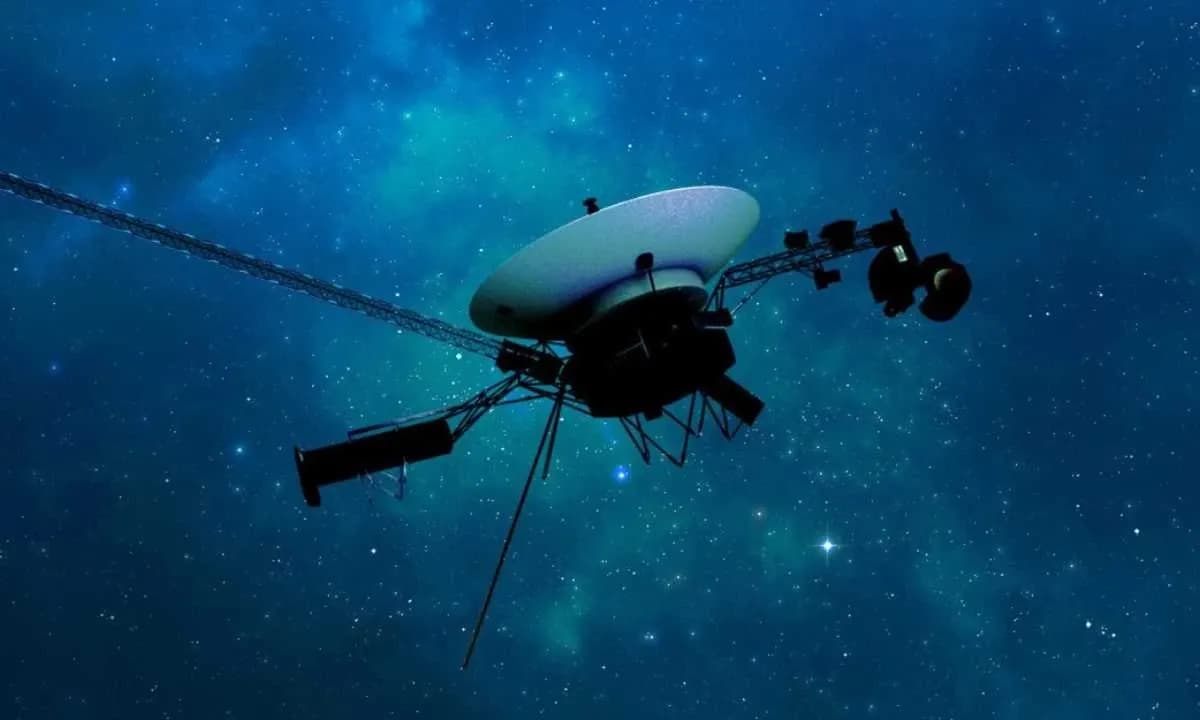
In 1977, NASA launched two spacecraft, Voyager 1 and Voyager 2, to explore the outer planets of our solar system. Fast-forward nearly five decades, and these metallic voyagers continue their journey in interstellar space, but they have yet to cover the staggering distance that light travels in just one day.
So, what’s a light-day? It’s the distance light travels in 24 hours, which amounts to nearly 26 billion kilometers (16 billion miles). To put it into perspective, it’s about 172 times the distance from the Earth to the Sun. Yet here we are, almost 50 years later, and Voyager 1 is currently around 24.9 billion kilometers (15.5 billion miles) from Earth.
The missions lasted far longer than anyone ever expected. Both Voyagers zipped past the giant planets like Jupiter and Saturn, sending stunning images and groundbreaking scientific data back to Earth. Somehow, though, even at a speed of about 61,000 kilometers per hour (38,000 miles per hour), they still haven’t crossed that light-day mark.
The nearest star to our solar system, Proxima Centauri, is over 4.2 light-years distant, or about 40 trillion kilometers (25 trillion miles) away! If Voyager 1 were heading in that direction, it would take over 70,000 years just to get there. Imagine humanity waiting that long for news from its furthest emissary!
Despite these unbelievable distances, Voyager’s journey emphasizes our relentless pursuit of knowledge. Each time researchers analyze the data that Voyager beams back, we learn something new about our universe and our place within it.
Now, why does that matter? In an era where space travel is becoming more prominent, Voyager’s slow crawl through the cosmos puts the vastness of space into perspective. It reminds us of the challenges we face in exploring further realms of our universe.
After 48 years of travel, Voyager 1 and 2 remain a testament to human ingenuity and curiosity, but they also highlight the tiny speck we occupy in this extraordinary universe. It challenges us to dream even bigger about what lies beyond.
The remarkable thing is, Voyager continues to send back data. Its mission inspires countless engineers, scientists, and aspiring astronauts to ponder not just where we’ve been, but where we can go next.
So, as we marvel at the technologies that allow us to launch probes into the infinite abyss, let’s reflect: Are we ready to face the scale of our universe? What new frontiers can we explore?