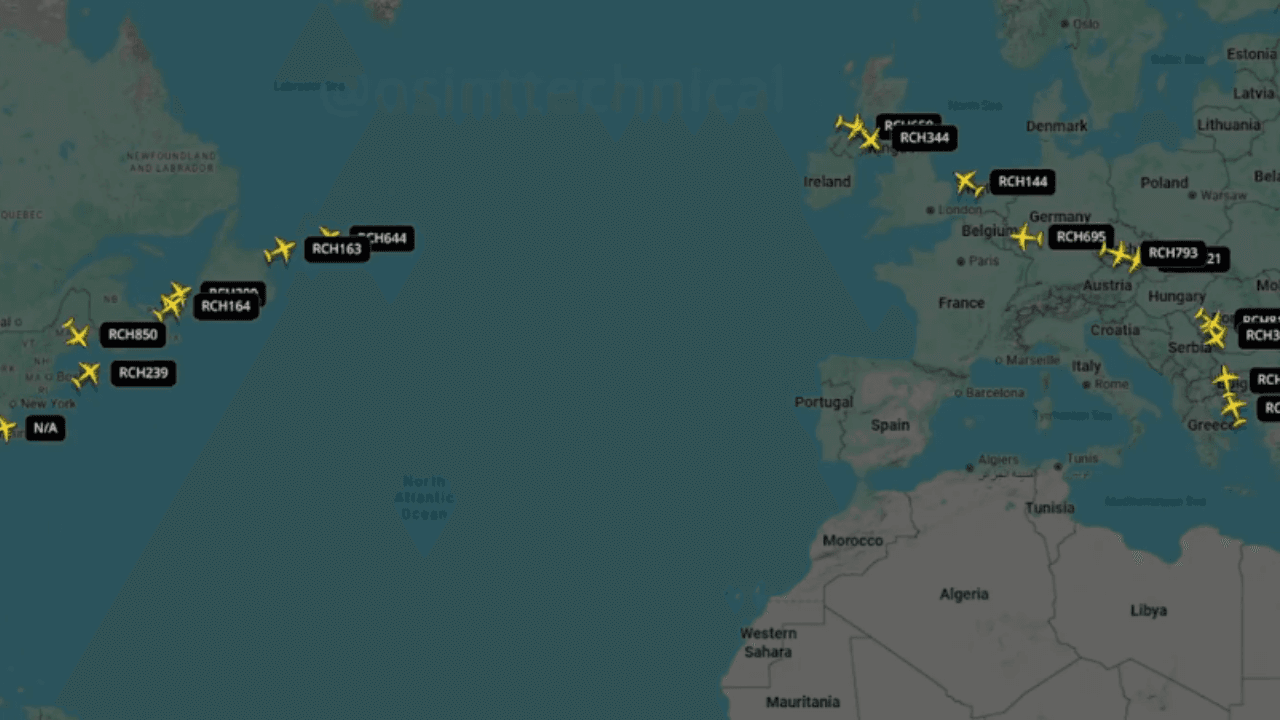
The United States has dramatically increased military flights to the Middle East, forming what analysts describe as a large scale air bridge across the Atlantic.
The surge comes as negotiations with Iran over its nuclear program remain unstable and tensions continue to rise.
Flight tracking data from public platforms shows a steady flow of fighter jets, refueling tankers, and cargo aircraft heading toward Europe and beyond.
Fighter Jets and Support Aircraft Deployed
According to reporting by Air and Space Forces, F-16 Fighting Falcons from Spangdahlem Air Base in Germany, Aviano Air Base in Italy, and McEntire Joint National Guard Base in South Carolina have moved toward the region.
F-15E Strike Eagles from RAF Lakenheath in the United Kingdom and F-22 Raptors from Joint Base Langley Eustis in Virginia have also deployed.
These aircraft previously took part in operations targeting Iranian facilities. The US Air Force provides information on aircraft capabilities at af.mil.
Support planes including RC-135 Rivet Joint intelligence aircraft and P-8 Poseidon maritime patrol planes have also repositioned. Some intelligence aircraft have reportedly relocated to Crete for added security.
Carrier Strike Groups Move Closer
The US Navy has increased its presence in the region. The USS Abraham Lincoln carrier strike group is operating in the Arabian Sea.
The USS Gerald R Ford is moving toward the Eastern Mediterranean after recent operations in the Caribbean.
Carrier strike group details and deployments are routinely published by the US Navy at navy.mil.
Pressure Mounts Over Nuclear Deal
President Donald Trump has demanded a new agreement that would prohibit Iran from enriching uranium. Iran has said talks continue but no final agreement has been reached.
US officials have acknowledged that military planning is underway should diplomacy fail. Iran has warned that it would retaliate if attacked.
The International Atomic Energy Agency continues to monitor Iran’s nuclear activity and provides updates at iaea.org.
A Strategic Signal
Military analysts say the size and scale of the air bridge allow for sustained operations if needed. Refueling tankers and command aircraft suggest preparations for extended missions rather than short term strikes.
For now, US officials maintain that diplomacy remains the preferred path. But the growing air and naval presence sends a clear signal that Washington is preparing for all outcomes.
With negotiations ongoing and both sides issuing warnings, the region stands at a critical moment.