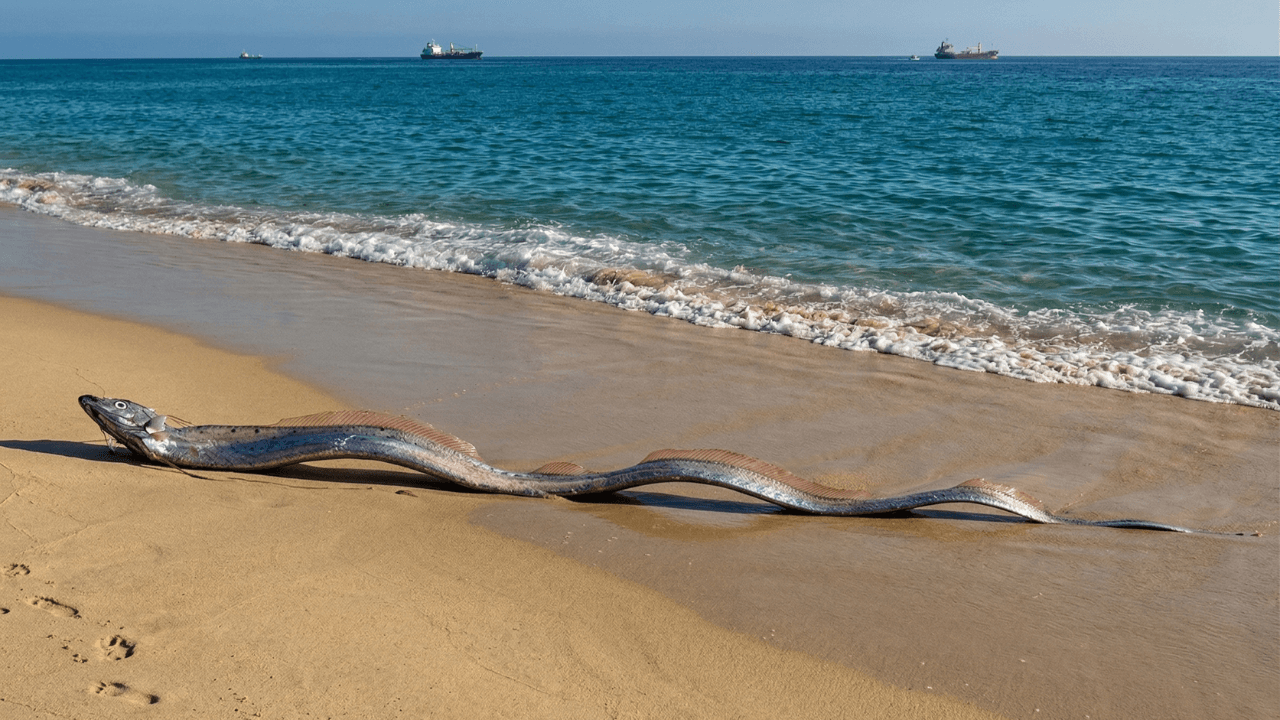
A standard beach day in Cabo San Lucas recently turned into a surreal, once-in-a-lifetime marine rescue mission. Tourists and locals were left stunned when not one, but two massive, metallic-looking deep-sea creatures washed into the shallow waters of the popular Mexican shoreline.
These creatures, identified as rare deep-sea oarfish, are heavily steeped in maritime legend and are notoriously referred to as the “Doomsday Fish.” Sighting a single oarfish on a shoreline is an incredibly rare biological anomaly. Seeing two side-by-side is almost entirely unheard of.
Here is everything you need to know about the viral Cabo San Lucas oarfish encounter, the history of these bizarre deep-sea giants, and what really happens when they surface.
The Incident: What Happened in Cabo San Lucas?
The extraordinary event unfolded in late February/early March 2026 when two sisters on vacation, Monica and Katie Pittenger, noticed a strange, bright silver flashing in the distant shoreline.
As they approached the surf, they realized the long, ribbon-like creatures struggling in the shallow waves were oarfish. Rather than panicking at the sight of the giant, serpent-like fish, the beachgoers sprang into action.
- The First Rescue: Katie Pittenger quickly handed off her belongings and rushed into the surf. Working alongside other locals and tourists, they managed to successfully push the massive, disoriented fish back into deeper waters.
- The Second Shock: Just as the crowd celebrated saving the first fish, a second oarfish appeared nearby, also struggling against the shore break.
- The Outcome: The group successfully guided the second creature back into the ocean as well, and both fish were seen swimming away. The footage, uploaded to social media, instantly went viral, garnering millions of views and sparking global fascination.
View this post on Instagram
What is an Oarfish? The “Doomsday Fish” Explained
Before understanding why this event is so significant, it is important to understand what exactly an oarfish is.
Scientifically known as Regalecus glesne, the giant oarfish is the longest bony fish on the planet. They can grow to staggering lengths of up to 30 feet (or more) and weigh hundreds of pounds.
Key Oarfish Characteristics:
- Appearance: They lack traditional scales, boasting a smooth, highly reflective silver skin. They have long, bright crimson dorsal fins that run the length of their bodies, giving them a prehistoric, dragon-like appearance.
- Habitat: They are strictly deep-sea dwellers. Oarfish live in the mesopelagic zone, hovering silently in the dark depths between 600 and 3,300 feet below the surface.
- Diet: Despite their massive size, they are filter feeders, primarily surviving on tiny krill, plankton, and small crustaceans.
Because of their sheer size and bizarre appearance, marine historians believe oarfish are responsible for centuries of “sea serpent” sightings reported by ancient sailors.
Everything Seen Before: The Lore and Past Sightings
The internet quickly dubbed the Cabo sighting a “warning,” and for good reason—the oarfish carries a heavy, mythical reputation.
The Japanese Folklore
In Japanese mythology, the oarfish is known as the Ryugu no Tsukai, which translates directly to the “Messenger from the Sea God’s Palace.” According to ancient superstition, because these fish live so close to the ocean floor, they only flee to the surface when they sense impending tectonic movement.
Therefore, their arrival on a beach is believed to be a harbinger of massive earthquakes and tsunamis. This legend gained massive modern traction in 2011 when approximately 20 oarfish washed ashore in Japan in the months leading up to the devastating Fukushima earthquake.
Recent Sightings in Mexico
While the Cabo incident involving two oarfish is exceptionally rare, the Baja California peninsula does see occasional sightings. In 2024, sports fishermen off the coast of Cabo San Lucas pulled a 3-meter oarfish from the water after it was attacked by sharks. Another was spotted in La Paz in 2020. However, almost all historical sightings involve a single, isolated fish.
Why Did Two Oarfish Wash Ashore Together?
If they aren’t warning us of an impending apocalypse, why did two of these deep-sea giants end up on a sunny beach in Mexico?
Marine biologists and scientists have thoroughly debunked the earthquake myth. Studies have shown zero statistical correlation between oarfish sightings and seismic activity. Instead, the scientific reality is much more biological:
- Sickness or Injury: When deep-sea creatures surface, it is almost always because they are incredibly sick, dying, or injured.
- Disorientation: Strong ocean currents, severe storms, or sudden shifts in water temperature (upwelling) can physically force these fish out of their deep-water habitats. Once they hit the warm, sunlit shallows, they become hopelessly disoriented.
- Following Prey: Occasionally, oarfish may chase a dense bloom of krill too close to the surface and find themselves trapped in the coastal surf.
While the tourist rescue in Cabo was a beautiful display of human compassion, experts note that returning a beached oarfish to the shallows rarely guarantees its long-term survival, given the extreme pressure and temperature differences it has already endured.
Conclusion
The viral sighting of two oarfish in Cabo San Lucas is a perfect blend of weird news, marine biology, and ancient folklore. While social media might panic over the “Doomsday Fish,” the reality is much less terrifying. It stands as an incredible, rare glimpse into the unexplored depths of our oceans—and a reminder that reality is often stranger than fiction.